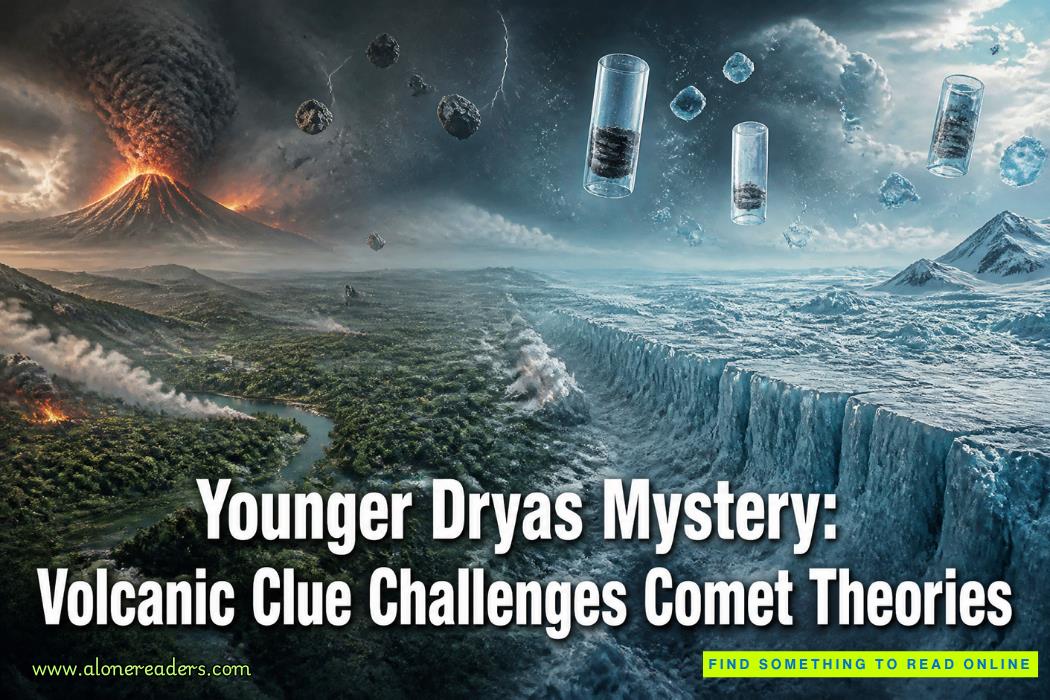
The Younger Dryas mystery begins with a shock to Earth’s climate system—an abrupt plunge back into near-glacial conditions just as the planet was warming up after the last Ice Age. Around 12,900 years ago, temperatures in parts of the Northern Hemisphere dropped dramatically within decades. Glaciers stabilized or advanced, ecosystems shifted, and early human societies faced a suddenly harsher world.
For decades, scientists have debated what could trigger such a rapid reversal. Among the most popular explanations was a cosmic catastrophe. But emerging evidence is shifting that narrative in a grounded—and arguably more intriguing—direction.
Key Takeaways
A climate system that flipped fast
Earth’s climate doesn’t usually change overnight. Yet the Younger Dryas appears to have unfolded over mere decades. Ice core data from Greenland show sharp temperature drops, not gradual cooling.
A global footprint
Evidence of the event appears across multiple continents—from pollen records in Europe to sediment layers in North America. This wasn’t a regional anomaly; it was a hemispheric, possibly global, phenomenon.
A missing trigger
The real puzzle wasn’t just the cooling—it was what caused it. Ocean circulation changes, particularly a slowdown of the Atlantic Meridional Overturning Circulation, were suspected. But something had to initiate that disruption.
A dramatic explanation gains traction
The Younger Dryas comet theory proposed that a fragmented comet or asteroid struck Earth or exploded in the atmosphere. The impact would have injected dust, soot, and aerosols into the atmosphere, blocking sunlight and triggering rapid cooling.
The Greenland platinum spike
One of the most compelling pieces of evidence was the discovery of elevated platinum levels in Greenland ice cores. Platinum is rare in Earth’s crust but more common in extraterrestrial material. This “Greenland platinum spike” seemed to align perfectly with the onset of the Younger Dryas.
Fire, extinction, and cultural shifts
Supporters linked the theory to widespread wildfires, megafaunal extinctions, and disruptions to early human cultures. It offered a single, dramatic explanation tying together climate, ecology, and archaeology.
But there was a problem: consistency.
Irregular evidence distribution
If a comet impact triggered a global event, the evidence should be globally consistent. Instead, platinum anomalies and impact markers appeared unevenly distributed.
Lack of a confirmed crater
Despite extensive searches, no definitive impact crater from this time has been identified that matches the scale required for global cooling.
Alternative explanations for “impact markers”
Some materials initially interpreted as impact debris could also form through terrestrial processes, including volcanic eruptions and biomass burning.
This opened the door to a different explanation—one rooted not in space, but deep within Earth.
Reframing the Greenland platinum spike
Recent analyses suggest that volcanic eruptions can release platinum and similar elements into the atmosphere. These particles can travel vast distances and settle into ice sheets, mimicking the geochemical signature once attributed to extraterrestrial impacts.
How volcanoes alter climate
Large eruptions inject sulfur dioxide and ash into the stratosphere. These form reflective aerosols that reduce incoming solar radiation. The result is short-term cooling, which can cascade into longer-term climate shifts if feedback systems—like ocean circulation—are affected.
A plausible chain reaction
A major volcanic eruption or series of eruptions could have:
This aligns more closely with observed climate patterns and avoids the need for a catastrophic extraterrestrial event.
Historical parallels
The 1815 eruption of Mount Tambora caused the “Year Without a Summer,” leading to crop failures and global temperature drops. While smaller in scale, it demonstrates how volcanic activity can rapidly influence climate.
Shifting away from catastrophic singular events
The appeal of the Younger Dryas comet theory lies in its simplicity—a single dramatic event explaining multiple phenomena. The volcanic explanation is more complex but also more consistent with known Earth systems.
Atlantis and lost civilization claims
The Younger Dryas has been linked in popular media to stories of lost advanced civilizations wiped out by sudden catastrophe. These narratives often rely on the idea of an impact event causing near-instant destruction.
If the cooling was driven by volcanic processes and gradual feedback loops rather than a sudden cosmic blast, it weakens the foundation of these claims. Human societies likely faced environmental stress and adaptation challenges—not sudden annihilation.
Human resilience over collapse
Archaeological evidence suggests that human groups adapted to changing climates rather than being erased by them. Migration, technological shifts, and dietary changes tell a story of resilience, not disappearance.
“The Younger Dryas was caused by a single event”
It was likely the result of interacting systems—atmospheric, oceanic, and possibly volcanic—not a single trigger.
“Platinum always means extraterrestrial impact”
Volcanoes can also release platinum group elements, complicating interpretations.
“Rapid climate change requires an external cause”
Earth’s internal systems are capable of abrupt shifts, especially when thresholds are crossed.
The Younger Dryas mystery illustrates how science evolves—not by clinging to dramatic explanations, but by refining them as new evidence emerges.
The comet hypothesis wasn’t irrational; it was a reasonable interpretation of available data. But as datasets expanded and analytical techniques improved, inconsistencies became clearer. The volcanic interpretation doesn’t just replace the comet theory—it integrates better with what we know about Earth’s climate system.
This is how complex historical puzzles are solved: not with a single breakthrough, but through gradual convergence of evidence.
The real insight isn’t just what caused the Younger Dryas. It’s how easily compelling narratives can take hold—and how patiently they must be tested, challenged, and sometimes rewritten.
In the end, the Younger Dryas mystery may not be about a cosmic catastrophe at all. It may be a reminder that Earth itself is capable of sudden, powerful change—and that understanding those processes is far more valuable than chasing dramatic but unsupported explanations.
What is the Younger Dryas mystery?
The Younger Dryas mystery refers to the sudden return to near-glacial conditions about 12,900 years ago after a warming period at the end of the last Ice Age.
What is the Younger Dryas comet theory?
It proposes that a comet or asteroid impact triggered global cooling by injecting dust and debris into the atmosphere.
What is the Greenland platinum spike?
It is a layer in Greenland ice cores showing elevated platinum levels, initially interpreted as evidence of an extraterrestrial impact.
How do volcanoes explain the Younger Dryas?
Large eruptions can release aerosols and metals like platinum, blocking sunlight and cooling the planet for extended periods.
Does this disprove lost civilization theories?
It weakens claims linking the event to catastrophic impacts that destroyed advanced ancient civilizations, though debates continue.



 Château de Vincennes: France’s Forgotten Royal Fortress and Medieval Stronghold
 Château de Carcassonne: Europe’s Greatest Medieval Citadel and Fortress
 Château de Chenonceau: The Castle Built by Remarkable Women
 Château de Chambord: France’s Magnificent Renaissance Castle and Architectural Wonder
 Tehri Dam: India's Tallest Dam and the Debate Behind It
 Bhakra Nangal Dam: India's Temple of Modern Development










