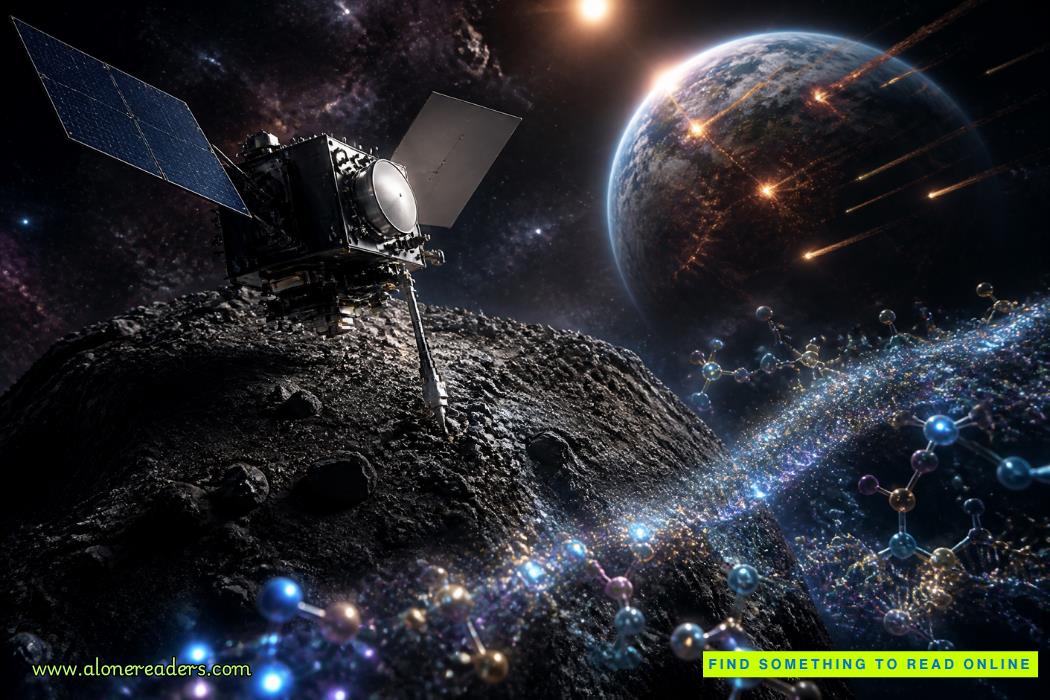
The sample arrived like a time capsule—untouched material from the dawn of the Solar System, older than Earth itself. Inside it, scientists didn’t find fossils or microbes. Instead, they uncovered something more profound: the raw chemical script that may have made life possible. This is where the story of asteroid Bennu life ingredients begins—not with life itself, but with the quiet, ancient chemistry that set the stage.
Key Takeaways
Bennu is not just another space rock. It’s a carbon-rich asteroid classified as a “primitive body,” meaning it has undergone minimal change since the Solar System formed over 4.5 billion years ago.
The OSIRIS-REx Bennu Sample
NASA’s OSIRIS-REx mission executed a precise sample return, collecting material from Bennu’s surface and delivering it to Earth. Unlike meteorites that burn and alter during atmospheric entry, this sample remained pristine.
Inside, researchers found:
This matters because Bennu acts as a preserved archive. It holds chemical conditions from a time before planets stabilized—essentially a snapshot of prebiotic chemistry.
Why Bennu Is Different
Most asteroids are either metallic or rocky. Bennu, however, is loaded with volatile elements and fragile compounds that rarely survive intact over billions of years.
Its structure is loosely bound, almost like a rubble pile, allowing it to retain delicate chemical signatures. That makes it one of the best candidates for studying how life’s ingredients formed and traveled across space.
One of the most significant findings from the NASA Bennu discovery is the abundance of organic molecules—carbon-based compounds that form the backbone of life.
What Was Found
Scientists identified:
These are not living organisms, but they are chemically active and capable of forming more complex structures under the right conditions.
Why This Matters
Organic molecules are essential because they:
Think of them as ingredients in a kitchen. Bennu doesn’t contain a finished dish—it contains flour, sugar, and spices. The question is how those ingredients ever combined into something alive.
The presence of organic molecules alone isn’t enough. Life requires a medium for chemical reactions—and Bennu appears to have had one.
Evidence of Water Interaction
The asteroid contains hydrated minerals, meaning water once flowed through its parent body. This likely occurred when radioactive decay heated the interior of a larger asteroid, melting ice into liquid water.
This process created:
Salt Minerals and Evaporation
Even more intriguing, scientists found salt deposits—similar to what forms when water evaporates.
These salts suggest:
On early Earth, similar environments—like tidal pools or hydrothermal vents—are considered prime locations for life’s emergence.
Bennu shows that such environments may not have been unique to Earth.
The idea that life’s building blocks came from space isn’t new, but Bennu provides stronger evidence than ever before.
The Origin of Life Asteroid Hypothesis
During the early Solar System, Earth experienced intense bombardment. Asteroids and comets frequently collided with the planet, delivering vast amounts of material.
If those objects contained:
Then Earth may have been seeded with the ingredients necessary for life.
A Realistic Scenario
Imagine early Earth—hot, unstable, and constantly reshaped by impacts. Each collision brings new chemical diversity.
Over millions of years:
Eventually, some environments—perhaps shallow pools or volcanic regions—become laboratories for prebiotic chemistry.
Bennu supports this scenario by showing that asteroids can carry not just simple molecules, but complex, reactive systems.
“Bennu contains life”
It does not. It contains organic molecules, not living organisms.
“This proves life came from space”
It suggests ingredients came from space, but life itself likely formed on Earth.
“Organic molecules mean biology”
Not necessarily. Organic chemistry can occur without any biological processes
Here’s where the mystery deepens.
We now know that the ingredients for life were likely widespread. Bennu confirms that organic molecules, water, and reactive minerals existed beyond Earth and could be delivered here.
But something crucial is still missing.
The Problem of Organization
Life isn’t just chemistry—it’s organized chemistry.
For life to begin, molecules must:
No asteroid sample has yet shown evidence of these transitions.
The Role of Environment
Earth may have provided something unique:
These conditions could drive molecules to assemble into increasingly complex systems.
Why Bennu Still Matters
Even without solving the final step, Bennu narrows the mystery.
It tells us:
The Bennu sample reshapes how we think about life’s origins. It suggests that the universe is chemically fertile—filled with the raw materials needed for life.
But ingredients alone don’t create a living system.
Somewhere between organic molecules and the first cell lies a transition we still don’t fully understand. It may have happened in a fleeting environment, under rare conditions, or through a sequence of events we’ve yet to replicate.
Bennu doesn’t answer that question—but it sharpens it.
And in science, a sharper question is often more valuable than an incomplete answer.
1. What did NASA discover in asteroid Bennu samples?
NASA found organic molecules, carbon compounds, and water-bearing salts—key ingredients linked to life’s chemistry.
2. Does Bennu prove life came from asteroids?
No, it shows that essential ingredients may have been delivered, but not life itself.
3. What is the OSIRIS-REx mission?
A NASA mission that collected samples from asteroid Bennu and returned them to Earth for analysis.
4. Why are organic molecules important?
They form the building blocks of life, including amino acids and other carbon-based compounds.
5. What is still missing in the origin of life theory?
The transition from simple molecules to self-replicating, living systems remains unresolved.



 Château de Vincennes: France’s Forgotten Royal Fortress and Medieval Stronghold
 Château de Carcassonne: Europe’s Greatest Medieval Citadel and Fortress
 Château de Chenonceau: The Castle Built by Remarkable Women
 Château de Chambord: France’s Magnificent Renaissance Castle and Architectural Wonder
 Tehri Dam: India's Tallest Dam and the Debate Behind It
 Bhakra Nangal Dam: India's Temple of Modern Development