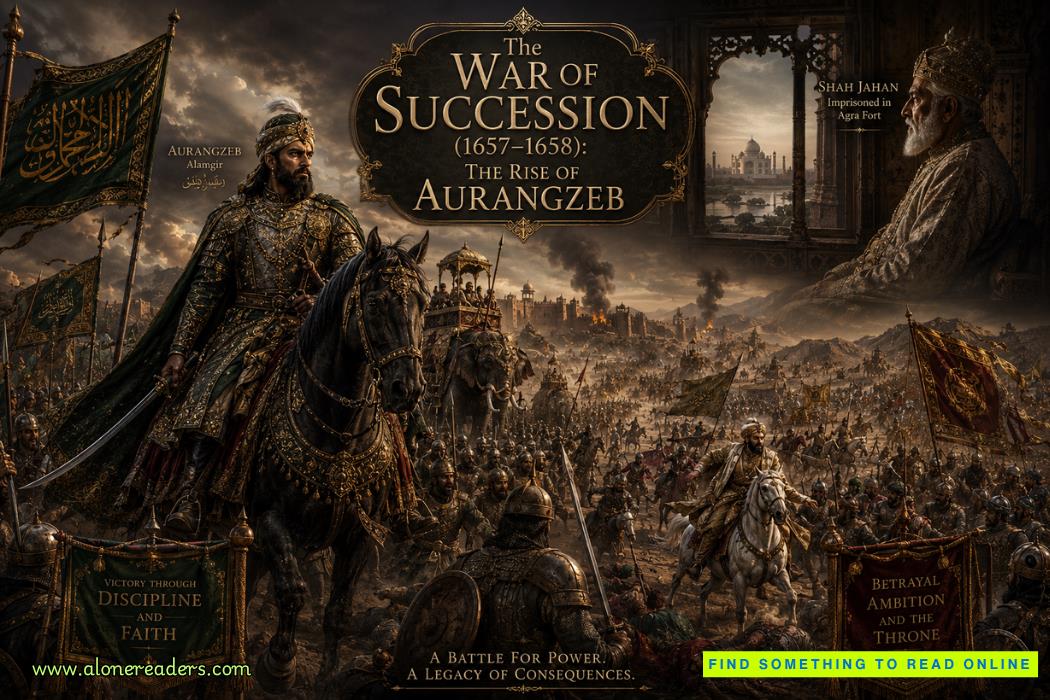
The Mughal Empire, at the height of its power under Emperor Shah Jahan, appeared stable, wealthy, and culturally vibrant. Yet beneath this glittering surface lay a volatile truth: there was no fixed law of succession in the Mughal dynasty. Unlike European monarchies that often followed primogeniture, the Mughal tradition encouraged competition among royal heirs. Every prince had to prove his worth not only through lineage but through strength, political acumen, and military success. This unwritten rule transformed succession into a brutal contest, and in 1657, it ignited one of the most decisive and dramatic conflicts in South Asian history—the War of Succession.
The crisis began when Shah Jahan fell gravely ill in September 1657. His illness sent shockwaves across the empire, triggering immediate political maneuvering among his four sons: Dara Shikoh, Shah Shuja, Aurangzeb, and Murad Baksh. Each prince governed powerful provinces and commanded loyal armies, making the empire a fragmented yet combustible arena. Among them, Dara Shikoh, the eldest, was the favored heir. He resided in the imperial court and enjoyed his father’s trust, effectively acting as regent during Shah Jahan’s illness. However, Dara’s intellectual inclinations, religious openness, and limited battlefield experience would soon prove to be weaknesses in a conflict defined by military precision and ruthless pragmatism.
Aurangzeb, the third son, emerged as the most formidable contender. Unlike Dara, Aurangzeb was a seasoned general with years of administrative and military experience. He had governed the Deccan and led successful campaigns, earning a reputation for discipline, patience, and unwavering ambition. His personality contrasted sharply with Dara’s philosophical and spiritual nature. Where Dara sought harmony between religions, Aurangzeb adhered to a stricter interpretation of Islam, which would later shape his reign. More importantly, Aurangzeb possessed a strategic mind capable of long-term planning and calculated risk.
As news of Shah Jahan’s illness spread, the empire quickly descended into chaos. Shah Shuja declared himself emperor in Bengal, while Murad Baksh did the same in Gujarat. Aurangzeb, rather than making an immediate claim, chose a more subtle approach. He formed a strategic alliance with Murad, presenting a united front against Dara. This alliance was not born of trust but of necessity, and Aurangzeb always intended to outmaneuver his brother at the right moment. This move highlights one of the defining traits of Aurangzeb’s rise: his ability to use alliances as temporary tools rather than permanent commitments.
The first major confrontation occurred at the Battle of Dharmat in April 1658. Dara, acting on behalf of Shah Jahan, sent an imperial army led by Rajput ruler Jaswant Singh to stop Aurangzeb and Murad. Despite having a larger force, the imperial army suffered from poor coordination and leadership. Aurangzeb, on the other hand, demonstrated superior tactical skill. His disciplined troops and effective use of artillery led to a decisive victory. This battle marked a turning point, revealing that Dara’s camp lacked the military competence needed to secure the throne.
Following this victory, Aurangzeb advanced toward Agra, the heart of the empire. Dara prepared to defend his position, leading to the crucial Battle of Samugarh in May 1658. This battle would determine the fate of the Mughal Empire. Dara personally led his forces, but his lack of battlefield experience became painfully evident. His army, though large, was poorly organized and suffered from low morale. Aurangzeb, in contrast, maintained strict discipline and executed a well-planned strategy. The result was a crushing defeat for Dara, who fled the battlefield in disarray.
The victory at Samugarh allowed Aurangzeb to take control of Agra. However, his next move demonstrated both his political cunning and his ruthlessness. Instead of immediately declaring himself emperor, he focused on neutralizing his father. Shah Jahan, who had recovered from his illness, still held symbolic authority. Aurangzeb placed him under house arrest in the Agra Fort, effectively removing him from power while maintaining a facade of respect. This act underscored a harsh reality: Aurangzeb was willing to sacrifice familial bonds for political dominance.
With Shah Jahan imprisoned, Aurangzeb turned his attention to his remaining rivals. Murad, his former ally, was no longer useful. Aurangzeb had him arrested and later executed, eliminating a potential threat. Shah Shuja, who had declared himself emperor in Bengal, was defeated in a series of campaigns and eventually fled the empire. Dara Shikoh, the most significant rival, remained at large and attempted to regroup. However, he struggled to gain support, as many nobles shifted their allegiance to Aurangzeb, recognizing his growing power.
Dara’s final defeat came after a prolonged pursuit. Betrayed by allies and weakened by constant flight, he was captured and brought before Aurangzeb. In 1659, Dara was executed on charges of heresy and rebellion. His death marked the end of the War of Succession and solidified Aurangzeb’s position as emperor. This moment was not just a political victory but a symbolic one, representing the triumph of military strength and political calculation over intellectual idealism.
Aurangzeb formally ascended the throne with the title Alamgir, meaning “Conqueror of the World.” His rise was not merely the result of battlefield victories but a combination of strategic alliances, calculated betrayals, and administrative skill. He understood that power in the Mughal Empire was not inherited but seized. His actions during the war reflected a deep understanding of this reality, as well as a willingness to act decisively, even when it involved morally complex choices.
The War of Succession had profound consequences for the Mughal Empire. It exposed the vulnerabilities of a system without a clear succession policy, where internal conflict could threaten the stability of even the most powerful empire. The war also reshaped the political landscape, as many nobles and regional powers recalibrated their loyalties based on Aurangzeb’s dominance. This shift would influence the empire’s governance for decades to come.
Aurangzeb’s victory also marked a turning point in the ideological direction of the Mughal state. While his predecessors, particularly Akbar, had promoted religious tolerance and cultural synthesis, Aurangzeb adopted a more orthodox approach. This shift would later contribute to tensions within the empire, as diverse communities reacted to changing policies. However, during the War of Succession, ideology played a secondary role to power. Aurangzeb’s primary objective was control, and he pursued it with relentless focus.
One of the most striking aspects of this conflict is the contrast between the personalities of the contenders. Dara Shikoh represented a vision of the Mughal Empire rooted in intellectual curiosity and spiritual inclusivity. Aurangzeb embodied discipline, ambition, and a pragmatic approach to governance. The outcome of the war suggests that, in times of crisis, practical strategy often outweighs philosophical ideals. This does not diminish Dara’s legacy but highlights the harsh realities of political power in the early modern world.
The war also demonstrated the importance of military organization and leadership. Aurangzeb’s success was not solely due to his ambition but also his ability to command and inspire his troops. His use of artillery, defensive positioning, and coordinated attacks gave him a significant advantage over his rivals. In contrast, Dara’s forces suffered from poor leadership and lack of cohesion, illustrating how even a numerically superior army can fail without effective command.
In examining the rise of Aurangzeb, it becomes clear that his success was the result of multiple factors working in his favor. His experience in governance and warfare provided a strong foundation, while his strategic mindset allowed him to navigate the complex political landscape. His willingness to make difficult decisions, including the elimination of his own brothers, ensured that no rival could challenge his authority. These qualities, while controversial, were instrumental in his ascent to power.
The War of Succession remains a defining episode in Mughal history, not only for its dramatic events but for its lasting impact. It highlights the fragility of dynastic systems and the role of individual agency in shaping historical outcomes. Aurangzeb’s rise serves as a powerful example of how ambition, strategy, and determination can alter the course of an empire.
In the end, the conflict was more than a struggle for the throne; it was a test of leadership, resilience, and vision. Aurangzeb emerged victorious because he understood the nature of power in a way his brothers did not. His journey from prince to emperor was marked by calculated moves and decisive actions, reflecting a deep awareness of the stakes involved. The War of Succession was not just a battle for control but a moment that redefined the Mughal Empire, setting the stage for its future trajectory under one of its most complex and controversial rulers.



 The Hundred Days Offensive: How the Allies Defeated Germany in World War I
 The Second Battle of the Marne: The Turning Point of World War I in 1918
 The Spring Offensive of 1918: Germany's Final Gamble to Win World War I
 The Treaty of Brest-Litovsk: How Russia Left World War I
 The Russian Revolution and World War I: How War Brought Down the Tsar
 The Zimmermann Telegram Explained: Germany's Secret Offer to Mexico in World War I