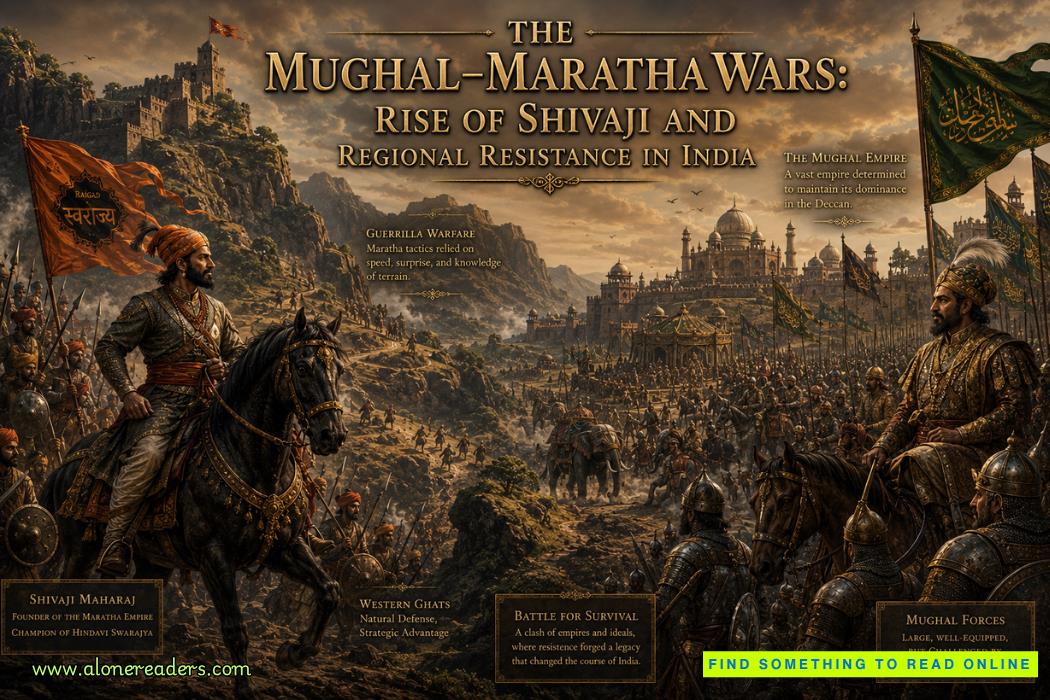
The Mughal–Maratha Wars stand as one of the most defining and transformative conflicts in early modern Indian history, marking not just a military struggle but a deeper contest between centralized imperial authority and rising regional power. At the heart of this prolonged confrontation was the remarkable rise of Shivaji Bhonsle, a leader whose vision, adaptability, and strategic brilliance reshaped the political landscape of the Indian subcontinent. His emergence signaled the beginning of a new kind of resistance—localized, mobile, and deeply rooted in regional identity—that challenged the vast but increasingly strained Mughal Empire.
During the mid-seventeenth century, the Mughal Empire under Aurangzeb had reached its territorial zenith. It was an empire defined by administrative sophistication, economic wealth, and military might. Yet beneath this grandeur lay structural vulnerabilities: overextension, regional dissatisfaction, and an increasing reliance on coercion rather than consensus. It was within this context that the Maratha movement emerged—not merely as a rebellion, but as a systematic alternative to imperial dominance.
Shivaji’s early life in the Deccan region exposed him to a complex political environment dominated by the declining Deccan Sultanates and the expanding Mughal frontier. His father, Shahaji, served various Deccan rulers, giving Shivaji a unique understanding of shifting allegiances and military politics. However, Shivaji departed from this pattern of service and instead envisioned sovereignty rooted in local governance and cultural assertion. His campaigns began modestly with the capture of hill forts, but these early successes revealed a strategic mind that prioritized terrain, speed, and intelligence over brute force.
The Western Ghats, with their rugged mountains and dense forests, became the natural theater for Shivaji’s innovations in warfare. Unlike the Mughal armies, which relied on heavy cavalry and large-scale formations, Shivaji perfected guerrilla tactics known as “ganimi kava”. These tactics emphasized surprise attacks, rapid movement, and intimate knowledge of the landscape. Mughal forces, accustomed to conventional warfare, found themselves repeatedly outmaneuvered and unable to effectively respond to these unpredictable assaults.
One of Shivaji’s most significant achievements was his network of forts, which served as both defensive strongholds and administrative centers. Forts like Raigad, Pratapgad, and Sinhagad became symbols of Maratha resilience and strategic planning. Rather than defending territory in a static manner, Shivaji used these forts as nodes in a flexible defense system, allowing his forces to retreat, regroup, and strike again. This approach frustrated Mughal attempts to establish lasting control over the region.
The confrontation between Shivaji and the Mughal Empire intensified in the 1660s when Aurangzeb turned his attention toward the Deccan. The Mughal campaign, led by generals such as Jai Singh I, initially achieved some success, culminating in the Treaty of Purandar in 1665. Under this agreement, Shivaji ceded several forts and agreed to serve the Mughal court. However, this apparent submission was short-lived. Shivaji’s visit to the Mughal court in Agra ended in a dramatic episode of detention and escape, which further elevated his legend and reinforced his image as a leader who could outwit even the most powerful empire of his time.
Following his return to the Deccan, Shivaji resumed his campaigns with renewed vigor. His coronation in 1674 as Chhatrapati marked a critical moment in Indian history. It was not merely a ceremonial act but a declaration of independence and legitimacy. Shivaji consciously revived ancient Hindu political traditions, blending them with pragmatic governance. His administration was marked by efficient revenue systems, disciplined military organization, and a relatively inclusive approach toward different communities.
The Mughal–Maratha conflict entered a new phase after Shivaji’s death in 1680. Aurangzeb personally led campaigns in the Deccan, determined to crush the Maratha resistance. However, this decision would prove to be one of the most consequential strategic errors of his reign. The Mughal emperor spent nearly three decades in the Deccan, draining imperial resources and weakening central authority. Despite capturing key forts and executing Shivaji’s son Sambhaji, the Mughals failed to achieve decisive victory.
Instead, the Maratha resistance evolved into a decentralized and resilient network. Leaders such as Rajaram and Tarabai continued the struggle, adopting even more flexible tactics and expanding Maratha influence beyond the Deccan. What began as a regional resistance transformed into a broader movement that challenged Mughal authority across multiple fronts. The Marathas mastered the art of warfare without fixed centers, making it nearly impossible for the Mughals to deliver a final blow.
A crucial aspect of the Mughal–Maratha Wars was their economic dimension. Continuous warfare disrupted trade, agriculture, and revenue collection. The Mughal system, heavily dependent on land revenue, began to falter under the strain of prolonged conflict. Meanwhile, the Marathas developed alternative revenue mechanisms, including the collection of chauth and sardeshmukhi, which allowed them to sustain their military campaigns and gradually expand their sphere of influence.
Culturally and politically, the wars symbolized a shift from imperial centralization to regional assertion. Shivaji’s emphasis on local identity, language, and governance resonated with various communities across India. His legacy inspired other regional powers to assert autonomy, contributing to the gradual fragmentation of the Mughal Empire. The Marathas, once considered insurgents, emerged as one of the dominant political forces in eighteenth-century India.
The Mughal–Maratha Wars also reveal the limits of imperial power. The Mughal Empire, despite its resources, struggled to adapt to the changing nature of warfare and regional politics. Its reliance on traditional military structures and centralized control proved inadequate against a dynamic and decentralized opponent. In contrast, the Marathas demonstrated the effectiveness of adaptability, mobility, and local support in sustaining long-term resistance.
The human dimension of these wars cannot be overlooked. The prolonged conflict brought hardship to ordinary people, with villages caught between opposing forces and economies disrupted by constant warfare. Yet, it also fostered a sense of resilience and identity among local populations, who increasingly viewed the Maratha cause as a defense of their autonomy and way of life.
In many ways, the Mughal–Maratha Wars foreshadowed later patterns in Indian history, where regional powers would continue to challenge centralized authority, and where asymmetrical warfare would play a decisive role. Shivaji’s legacy, in particular, transcends his own time. He is remembered not only as a warrior but as a visionary leader who redefined the possibilities of resistance against a seemingly invincible empire.
The decline of the Mughal Empire in the early eighteenth century cannot be understood without considering the cumulative impact of these wars. What began as a regional uprising evolved into a sustained challenge that exposed the structural weaknesses of imperial rule. By the time of Aurangzeb’s death in 1707, the empire was significantly weakened, and the Marathas were poised to expand their influence across large parts of India.
Ultimately, the Mughal–Maratha Wars were not just about territory or power; they were about competing visions of governance and legitimacy. On one side stood a vast empire seeking to maintain control through centralized authority and military force. On the other stood a rising regional power advocating for localized rule, strategic flexibility, and cultural assertion. The outcome of this संघर्ष reshaped the political trajectory of India, setting the stage for the emergence of new powers and the eventual transformation of the subcontinent’s political order.
The story of Shivaji and the Maratha resistance continues to resonate because it highlights the enduring importance of leadership, strategy, and the ability to adapt to changing circumstances. It serves as a reminder that even the most powerful empires can be challenged by determined and innovative opponents, and that the course of history is often shaped by those who dare to redefine the rules of power.



 The Hundred Days Offensive: How the Allies Defeated Germany in World War I
 The Second Battle of the Marne: The Turning Point of World War I in 1918
 The Spring Offensive of 1918: Germany's Final Gamble to Win World War I
 The Treaty of Brest-Litovsk: How Russia Left World War I
 The Russian Revolution and World War I: How War Brought Down the Tsar
 The Zimmermann Telegram Explained: Germany's Secret Offer to Mexico in World War I










