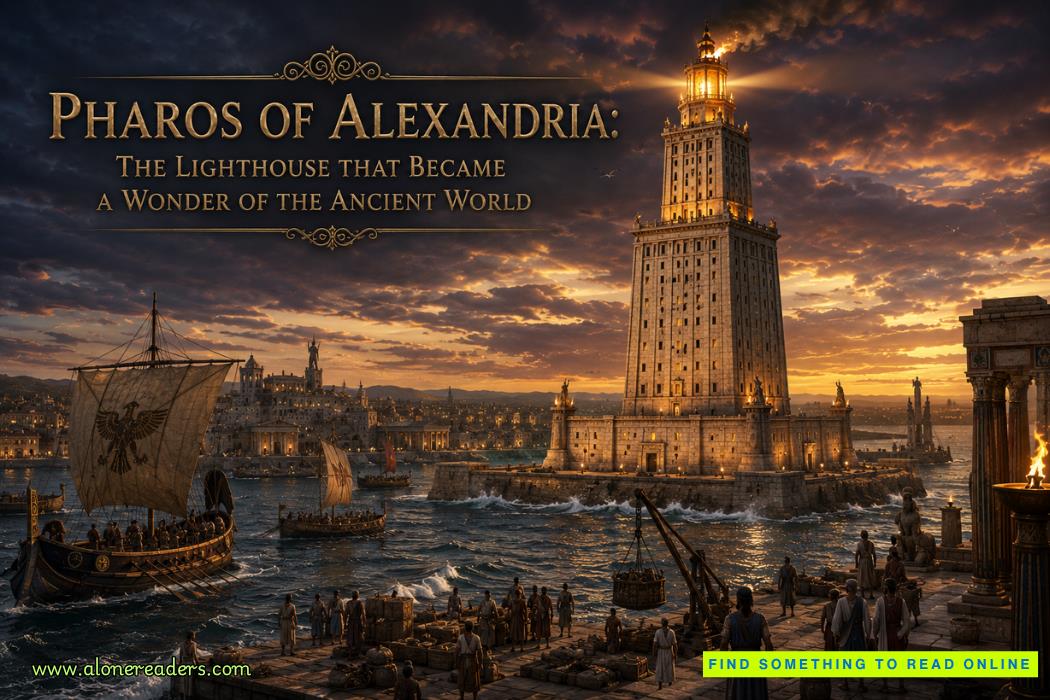
The story of the Pharos of Alexandria is not merely the story of a lighthouse. It is the story of how human ambition, maritime necessity, imperial prestige, and architectural genius combined to create one of the most celebrated structures in ancient history. Rising above the shores of the Mediterranean for centuries, the Pharos became a symbol of technological achievement and cultural power so extraordinary that its very name eventually became synonymous with lighthouses across multiple languages. Even long after its destruction, the memory of the tower continued to inspire engineers, travelers, historians, and sailors who regarded it as one of the greatest accomplishments of the ancient world.
The lighthouse stood near the ancient city of Alexandria in Egypt, a city founded by Alexander the Great in 331 BCE. Alexandria rapidly became one of the most important urban centers of the Hellenistic world. Positioned strategically between the Mediterranean Sea and the Nile Delta, the city emerged as a major commercial, political, and intellectual capital. Merchants from Greece, Egypt, Phoenicia, North Africa, Persia, and beyond converged there, transforming Alexandria into a crossroads of civilizations. The famous Library of Alexandria attracted scholars from across the ancient world, while the harbor became one of the busiest maritime centers in existence.
However, Alexandria’s coastline posed a serious danger to sailors. The Egyptian coast around the Nile Delta contained shallow waters, hidden reefs, sandbars, and unpredictable currents that could easily destroy incoming ships. Unlike naturally protected harbors found elsewhere in the Mediterranean, Alexandria required an advanced navigational solution to support the enormous volume of maritime traffic entering the city. As trade expanded, the need for a monumental beacon became increasingly urgent.
The construction of the Pharos began during the reign of Ptolemy I Soter, one of Alexander the Great’s former generals who became ruler of Egypt after Alexander’s death. The project was completed during the reign of his son, Ptolemy II Philadelphus, around the early third century BCE. The lighthouse was constructed on the small island of Pharos, located just off the coast of Alexandria and connected to the mainland by a massive causeway called the Heptastadion. This strategic location allowed the beacon to guide ships approaching both eastern and western harbor entrances.
Ancient accounts suggest that the architect responsible for the structure was Sostratus of Cnidus, a Greek engineer whose reputation became closely associated with the project. According to later stories, Sostratus secretly inscribed his own name beneath the official dedication to the Ptolemaic ruler, ensuring that future generations would remember the true designer of the monument. Whether entirely factual or partly legendary, the story reflects how highly the achievement was regarded even in antiquity.
What made the Pharos extraordinary was not only its purpose but also its unprecedented scale. Ancient estimates vary, but historians generally believe the lighthouse stood between 100 and 130 meters tall, making it one of the tallest human-made structures of the ancient world. For centuries, only the Great Pyramids of Giza may have surpassed it in height. To sailors approaching Alexandria from far across the Mediterranean, the lighthouse would have appeared like an immense stone tower rising directly from the sea itself.
The structure was composed of three distinct architectural sections stacked vertically. The lowest section was a massive square base that provided stability and contained storage rooms, work areas, administrative chambers, and possibly quarters for workers and guards. This section was built using enormous blocks of light-colored limestone that reflected sunlight brilliantly during the day. Above the square base stood an octagonal middle section, reducing the structure’s visual heaviness while increasing its elegance and aerodynamic stability against strong coastal winds. The uppermost section was cylindrical and supported the great beacon fire that illuminated the night sky.
At the summit stood either a large statue of Zeus, Poseidon, or another divine figure associated with maritime protection, though historical accounts differ regarding its exact identity. Regardless of the figure represented, the symbolism was clear: the lighthouse was not merely an engineering installation but also a statement of divine protection, imperial authority, and cultural sophistication.
The engineering behind the Pharos was astonishing for its time. Constructing such a massive structure beside the sea required advanced understanding of foundations, weight distribution, and resistance to erosion. The builders used specially cut stone blocks fitted tightly together to withstand centuries of waves, salt exposure, and earthquakes. Internal ramps or spiral passageways reportedly allowed animals and workers to transport fuel upward to the beacon chamber. Maintaining the fire atop such a tall structure would have required continuous logistical coordination, including fuel transport, maintenance crews, and constant monitoring.
The beacon itself was one of the most remarkable features of the lighthouse. During the night, enormous fires burned continuously at the summit. Ancient writers also described the use of polished metal mirrors—possibly bronze—to reflect sunlight during the day and amplify firelight at night. Some later legends exaggerated the mirror’s capabilities, claiming it could burn enemy ships using concentrated sunlight. While such stories are almost certainly mythical, they demonstrate how deeply the lighthouse impressed ancient observers. The Pharos became so legendary that people attributed near-magical powers to its technology.
Its role in navigation fundamentally transformed Mediterranean maritime trade. Before the development of large-scale navigational aids, sailors relied heavily on stars, coastlines, and local knowledge. Dangerous weather or nighttime conditions made harbor approaches extremely risky. The Pharos dramatically improved the safety and efficiency of navigation into Alexandria, enabling ships to approach the harbor with greater confidence even under difficult conditions. This increased maritime reliability strengthened Alexandria’s position as one of the greatest commercial centers of the ancient world.
The lighthouse also served military and political functions. By controlling one of the Mediterranean’s busiest harbors, the Ptolemaic Kingdom could monitor naval movements, regulate trade, and demonstrate its wealth and technological superiority. The tower effectively acted as both an infrastructure project and a propaganda monument. It announced to every arriving sailor that Alexandria was a city of immense power, knowledge, and ambition.
Travelers from across the ancient world wrote about the structure with admiration. Greek and Roman historians repeatedly described its immense height, brilliance, and beauty. The lighthouse eventually earned recognition as one of the Seven Wonders of the Ancient World, joining monumental achievements such as the Great Pyramid of Giza and the Hanging Gardens of Babylon. Unlike many ancient monuments built primarily for religion or burial, the Pharos stood out because it served a highly practical purpose while still achieving artistic and symbolic magnificence.
Its influence extended far beyond Egypt. The design principles and symbolic prestige of the Pharos inspired lighthouse construction throughout the Mediterranean and later across Europe and the Islamic world. In fact, the word “pharos” itself eventually became a generic term for lighthouse in several languages, demonstrating how completely the structure defined the concept of monumental maritime beacons.
The Pharos also existed at the center of Alexandria’s broader intellectual and economic ecosystem. Ships arriving safely at the harbor brought not only goods but also ideas, languages, scientific knowledge, religious beliefs, and cultural traditions. Alexandria became a center for mathematics, astronomy, medicine, philosophy, and engineering partly because maritime trade connected the city to virtually every major civilization of the Mediterranean world. The lighthouse therefore symbolized more than navigation alone. It represented the interconnectedness of ancient civilizations.
Over the centuries, the Pharos survived political transformations, including Roman conquest, Byzantine rule, and the rise of Islamic governance in Egypt. Remarkably, the lighthouse continued functioning for many hundreds of years despite changing empires and evolving maritime technologies. Medieval Arab writers still described the tower with amazement, although by that period portions of the structure had likely been repaired or modified multiple times.
However, the greatest threat to the lighthouse came not from warfare or neglect but from nature itself. Alexandria lies within a seismically active region, and the lighthouse suffered repeated earthquake damage across centuries. Major earthquakes in 956 CE, 1303 CE, and 1323 CE severely weakened the structure. Each disaster caused partial collapses and increasing structural instability. Eventually, the once-magnificent tower was reduced to ruins.
By the fifteenth century, the remaining stones of the Pharos were repurposed during the construction of the Citadel of Qaitbay, a defensive fortress built by the Mamluk Sultan Al-Ashraf Sayf al-Din Qa'it Bay on the very site where the lighthouse once stood. In a symbolic sense, the lighthouse disappeared physically but remained embedded within the foundations of later Egyptian history.
Modern underwater archaeology has revealed fascinating remnants of the structure beneath Alexandria’s harbor waters. Divers and researchers have discovered enormous stone blocks, statues, columns, and architectural fragments believed to originate from the lighthouse complex. These discoveries have provided valuable insights into the tower’s scale, design, and artistic features. Although the original lighthouse no longer survives, its submerged remains continue to attract historians, archaeologists, and tourists fascinated by ancient engineering.
Today, the site of the Pharos remains one of the most historically significant locations in Egypt. Visitors to Alexandria often explore the Citadel of Qaitbay, fully aware that beneath and around the fortress once stood one of humanity’s greatest architectural achievements. The memory of the lighthouse still shapes Alexandria’s cultural identity, connecting the modern city to its ancient maritime legacy.
The tourism value of the Pharos extends beyond physical ruins. The lighthouse occupies a unique position in global historical imagination. It appears in documentaries, historical reconstructions, academic studies, novels, games, and artistic depictions across the world. Its story appeals not only because of its immense scale but because it represents a timeless human aspiration: the desire to master nature, guide travelers through danger, and project civilization into the unknown.
The enduring fascination with the Pharos also reflects humanity’s emotional relationship with lighthouses themselves. Across cultures and centuries, lighthouses have symbolized hope, safety, knowledge, and endurance against darkness and chaos. The Pharos amplified these meanings on an unprecedented scale. It was not simply a tower with a fire—it was a beacon of civilization visible across the sea.
In many ways, the lighthouse embodied the spirit of the Hellenistic age. It combined Greek engineering, Egyptian geography, Mediterranean commerce, imperial politics, and scientific ambition into a single monumental structure. Few buildings in human history have united practical functionality and symbolic grandeur so successfully. The Pharos guided ships physically, but it also guided the imagination of generations who viewed it as proof of what human ingenuity could accomplish.
Even now, more than two thousand years after its construction, the Lighthouse of Alexandria remains one of the most recognizable achievements of the ancient world. Though earthquakes destroyed its stones, they could not erase its legacy. Historians still study it, engineers still admire it, and travelers still dream about it. Its influence survives in every modern lighthouse standing along dangerous coasts around the globe.
The Pharos of Alexandria therefore deserves its place among history’s greatest wonders not merely because it was tall or technologically advanced, but because it fundamentally changed how civilizations interacted with the sea. It transformed maritime navigation, strengthened international commerce, inspired generations of architects, and became one of the most powerful symbols of ancient human achievement. For centuries, its light guided sailors safely home. Long after the flame vanished, the legend itself continued to illuminate history.



 Château de Vincennes: France’s Forgotten Royal Fortress and Medieval Stronghold
 Château de Carcassonne: Europe’s Greatest Medieval Citadel and Fortress
 Château de Chenonceau: The Castle Built by Remarkable Women
 Château de Chambord: France’s Magnificent Renaissance Castle and Architectural Wonder
 Tehri Dam: India's Tallest Dam and the Debate Behind It
 Bhakra Nangal Dam: India's Temple of Modern Development










