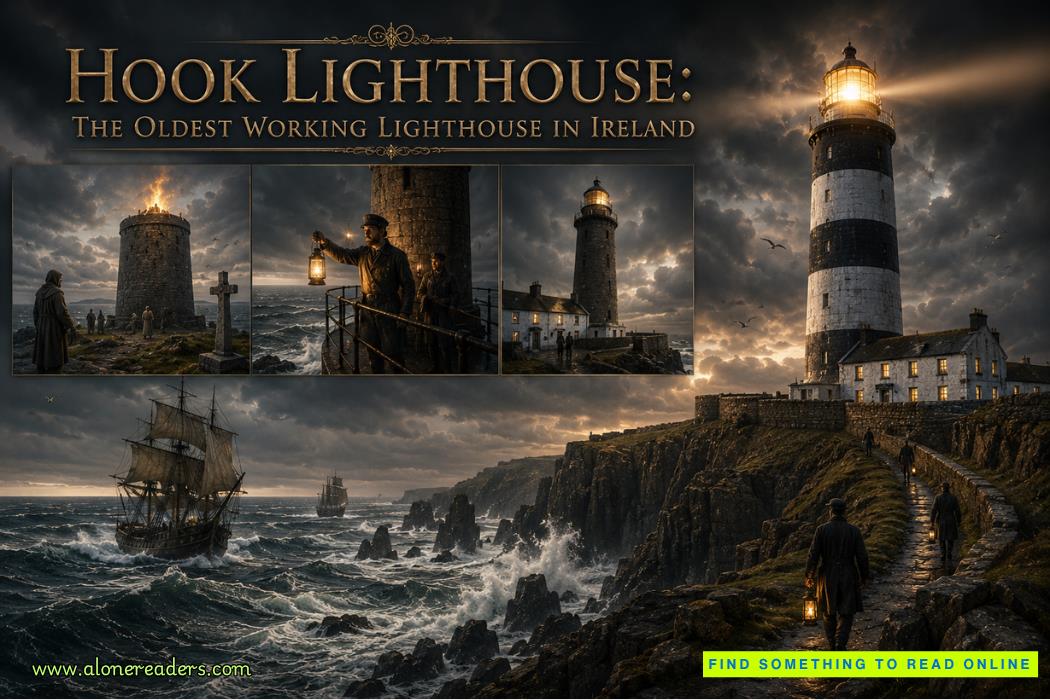
The coastline of southeastern Ireland is shaped by fierce Atlantic winds, unpredictable tides, jagged reefs, and narrow maritime passages that have challenged sailors for centuries. Along this dangerous edge of Europe stands one of the most remarkable structures in maritime history: Hook Lighthouse. Rising above the rocky shoreline of County Wexford, this ancient beacon has watched over the sea for approximately 800 years, making it one of the oldest operational lighthouses in the world and the oldest working lighthouse in Ireland. Few navigational structures anywhere on Earth possess such an extraordinary combination of medieval heritage, engineering resilience, and continuous service.
What makes Hook Lighthouse especially fascinating is not simply its age, but the fact that it has remained active through radically different eras of human history. The lighthouse existed before the Renaissance, before the age of transatlantic empires, before industrialization, and long before modern electricity. It guided medieval trading vessels, fishing boats, military fleets, steamships, and eventually modern cargo ships using advanced navigational systems. Very few buildings in Europe have maintained such a continuous practical purpose for so many centuries.
The lighthouse stands at Hook Head, a narrow peninsula extending into the meeting point of the Atlantic Ocean and the Irish Sea. This region has long been notorious for dangerous currents and hidden rocks. Ships approaching important ports such as Waterford faced significant risks, particularly during storms or heavy fog. Maritime trade was essential to medieval Ireland’s economy, and safe passage through these waters became increasingly critical as commerce expanded between Ireland, Britain, and continental Europe.
The origins of navigational aid at Hook Head may stretch back even further than the current stone tower. Historical traditions suggest that as early as the fifth century, monks associated with Saint Dubhán maintained some form of warning beacon on the headland. These early Christian communities often established monasteries along isolated coastal regions, where they served not only religious purposes but also practical functions for travelers and sailors. Fires were reportedly lit to warn ships of the hazardous coastline. Whether every detail of these traditions can be historically verified or not, they reflect a deep and enduring connection between the site and maritime safety.
The present tower was constructed in the early thirteenth century during the period of Norman influence in Ireland. William Marshal, one of the most powerful Anglo-Norman lords of the era, is generally credited with commissioning the lighthouse around 1200 AD. Marshal recognized the immense commercial importance of Waterford Harbor, which had become a major center for trade and political power. Protecting shipping routes was therefore not only a humanitarian concern but also an economic and strategic necessity.
The structure built under Marshal’s authority was extraordinary for its time. Unlike temporary wooden beacons or exposed fire platforms common elsewhere in medieval Europe, Hook Lighthouse was designed as a durable fortified tower capable of withstanding Atlantic weather. Constructed from local limestone, the tower rose prominently above the cliffs, creating a visible landmark both day and night. The walls were immensely thick, enabling the building to survive storms that would have destroyed weaker coastal structures.
In its earliest operational phase, the lighthouse relied on open coal fires to produce illumination. Lighthouse keepers, often referred to historically as “watchmen,” had the exhausting responsibility of maintaining these fires through harsh weather conditions. The heat, smoke, and labor involved were immense. Coal had to be transported upward repeatedly, and the flame required constant attention to remain visible during storms. Despite these challenges, the system dramatically improved maritime safety in the region.
One of the most remarkable aspects of Hook Lighthouse is the sophistication of its medieval engineering. The tower was not simply a beacon; it was a carefully designed maritime machine. Its tapered cylindrical shape provided both stability and wind resistance. Narrow windows minimized structural weakness while protecting occupants from severe weather. Internal spiral staircases allowed keepers to move efficiently between floors while preserving the integrity of the thick masonry walls.
The building also demonstrates the overlap between military and navigational architecture during the medieval period. In many ways, Hook Lighthouse resembles a defensive tower or small fortress. This was intentional. Coastal areas during the Middle Ages faced threats from piracy, raids, and political conflict. Structures built near important maritime routes therefore needed defensive qualities. The lighthouse’s heavy stone construction and elevated position gave it both durability and strategic visibility.
Over the centuries, the lighting technology evolved significantly. Open coal fires eventually gave way to improved oil lamps and reflector systems. By the eighteenth and nineteenth centuries, lighthouse engineering underwent major transformations across Europe, and Hook Lighthouse benefited from these technological advances. The introduction of optical systems dramatically increased visibility range and efficiency.
The nineteenth century represented a particularly important phase in the lighthouse’s modernization. During this era, many traditional lighthouses were upgraded to accommodate the rapidly expanding scale of global shipping. Ireland’s maritime trade increased substantially, and vessels became larger and more dependent on reliable coastal navigation systems. Hook Lighthouse underwent renovations that improved both safety and operational capability.
The installation of Fresnel lens technology revolutionized lighthouse illumination worldwide, and Hook Lighthouse eventually incorporated advanced optical equipment that allowed its light to project much farther across the sea. Fresnel lenses, developed by French physicist Augustin-Jean Fresnel, used concentric rings of glass to focus and magnify light efficiently. This innovation enabled lighthouses to produce powerful beams visible over vast distances while consuming less fuel.
The external appearance of Hook Lighthouse also evolved over time. Today, the tower’s distinctive black-and-white horizontal bands are among its most recognizable features. These markings serve a practical navigational function by making the structure highly visible during daylight hours. Mariners could identify the lighthouse even before nightfall, helping them confirm their position along the coast.
The lighthouse’s role in maritime navigation cannot be overstated. The waters surrounding Hook Head are among the most treacherous in Ireland due to strong currents, submerged rocks, and rapidly changing weather conditions. Before modern GPS systems and electronic navigation, coastal lighthouses served as essential reference points for sailors attempting to navigate safely through dangerous waters.
For ships approaching Waterford Harbor, Hook Lighthouse acted as a critical guide. Waterford was historically one of Ireland’s most important ports, deeply connected to trade networks involving Britain, France, Spain, and beyond. Merchant vessels carrying wine, grain, textiles, timber, and other goods depended heavily on accurate coastal navigation. A single navigational mistake could result in shipwreck, cargo loss, or death.
The lighthouse was especially valuable during storms and winter conditions. The Irish coastline is infamous for violent Atlantic weather, including dense fog, powerful winds, and towering waves. In such conditions, even experienced sailors could lose orientation. The steady light from Hook Head often represented the difference between safe passage and catastrophe.
Stories of shipwrecks and maritime disasters form an important part of the lighthouse’s history. Although the beacon undoubtedly prevented countless tragedies, the coastline still witnessed numerous wrecks over the centuries. Some ships were destroyed by storms before reaching safety, while others struck hidden rocks despite navigational efforts. These events reinforced the necessity of maintaining and improving the lighthouse continuously.
The human dimension of lighthouse operation is equally compelling. For centuries, lighthouse keepers lived isolated and demanding lives. Their responsibilities extended far beyond simply lighting a lamp. They maintained equipment, monitored weather conditions, cleaned optical systems, managed fuel supplies, and remained vigilant during dangerous storms.
Life as a lighthouse keeper at Hook Head could be physically exhausting and psychologically isolating. Severe weather sometimes cut the lighthouse off from nearby communities. Keepers had to endure relentless Atlantic winds, freezing rain, and long periods of solitude. Yet their work carried immense importance. Sailors relied upon the lighthouse’s consistency and reliability.
The culture surrounding lighthouse keepers became deeply romanticized in later centuries, but the reality was often harsh. Maintaining an operational lighthouse before automation required discipline, technical skill, and endurance. The keepers of Hook Lighthouse formed part of a long maritime tradition dedicated to protecting human life at sea.
Automation eventually transformed lighthouse operations during the twentieth century. Advances in electrical systems and remote monitoring reduced the need for permanent resident keepers. Hook Lighthouse was automated in 1996, ending centuries of continuous manual operation. This transition marked the end of an era in Irish maritime history.
Despite automation, the lighthouse remains fully operational today. Modern navigation technologies such as radar, satellite positioning, and electronic mapping have reduced dependence on traditional lighthouses, yet physical coastal beacons still play an important supporting role in maritime safety. Hook Lighthouse continues to function as an active navigational aid while simultaneously serving as a major historical and tourism destination.
Its preservation is especially significant because many ancient maritime structures around the world have either disappeared, fallen into ruin, or become inactive museums. Hook Lighthouse, by contrast, still fulfills the essential purpose for which it was originally built centuries ago. This continuity gives the structure a rare sense of living history.
Tourism has become one of the lighthouse’s defining modern roles. Visitors from around the world travel to County Wexford to experience the site’s unique atmosphere and historical significance. The surrounding landscape contributes enormously to its appeal. Rugged cliffs, crashing Atlantic waves, dramatic skies, and expansive sea views create an environment that feels simultaneously ancient and timeless.
Guided tours allow visitors to explore the interior of the medieval tower, including the spiral staircases, thick stone chambers, and lantern room. These tours provide insight into both the engineering and human history of lighthouse operation. Walking through the structure offers a vivid sense of how demanding life would have been for medieval watchmen and later lighthouse keepers.
The lighthouse has also become an important educational resource. Exhibitions and interpretive programs explain the evolution of maritime navigation, coastal engineering, and Irish seafaring history. Visitors learn not only about Hook Lighthouse itself but also about the broader development of lighthouse technology across centuries.
Architecturally, the structure remains extraordinarily well preserved considering its age and exposure to Atlantic weather. The limestone masonry has survived relentless storms, salt corrosion, and centuries of environmental pressure. Preservation efforts have carefully balanced historical authenticity with modern safety requirements, allowing the tower to remain accessible without compromising its heritage value.
The surrounding region has embraced the lighthouse as a central cultural symbol. It appears prominently in Irish tourism campaigns and maritime heritage initiatives. Local communities view the lighthouse not merely as an old building but as part of the region’s identity. It represents endurance, resilience, and continuity across generations.
The lighthouse’s visual impact also contributes to its enduring popularity. Few maritime structures possess such a striking combination of simplicity and authority. The black-and-white tower standing against dark Atlantic skies creates an image that feels almost mythic. Photographers, artists, historians, and filmmakers have long been drawn to its dramatic setting.
Beyond tourism and architecture, Hook Lighthouse carries symbolic meaning connected to humanity’s relationship with the sea. Coastal civilizations have always depended upon navigation, trade, and maritime survival. Lighthouses embody the human desire to impose order and guidance upon dangerous natural environments. They represent warning, protection, and hope.
In many ways, Hook Lighthouse symbolizes the continuity of human ingenuity across centuries. Medieval builders lacking modern machinery created a structure so effective that it remains operational eight hundred years later. Successive generations adapted and modernized the lighthouse without abandoning its original purpose. The tower therefore stands as both a historical monument and a testament to long-term engineering vision.
Its endurance also reflects Ireland’s deep maritime heritage. As an island nation, Ireland’s history has always been profoundly shaped by the sea. Fishing, trade, migration, warfare, and exploration all depended upon maritime routes. Coastal structures such as Hook Lighthouse played critical roles in sustaining these activities safely.
Today, visitors standing atop Hook Head often experience a powerful sense of historical continuity. The same Atlantic winds that battered medieval ships still crash against the cliffs below. The same coastline that terrified sailors centuries ago remains dramatic and unpredictable. Yet above those dangerous waters, the ancient lighthouse still shines.
In an age dominated by digital navigation and satellite technology, Hook Lighthouse continues to remind people of a more tactile and human era of seafaring. It connects the modern world with centuries of maritime experience, engineering adaptation, and coastal survival. Few structures anywhere in Europe preserve such an uninterrupted relationship between past and present.
Hook Lighthouse is far more than an old tower on the Irish coast. It is a surviving witness to medieval commerce, maritime danger, technological evolution, and human perseverance. Across eight centuries, it has remained a guardian of one of Ireland’s most hazardous coastlines, protecting countless sailors navigating the dark Atlantic waters. Its continued operation, remarkable preservation, and extraordinary historical depth make it not only Ireland’s oldest working lighthouse but also one of the greatest maritime monuments in the world.



 Château de Vincennes: France’s Forgotten Royal Fortress and Medieval Stronghold
 Château de Carcassonne: Europe’s Greatest Medieval Citadel and Fortress
 Château de Chenonceau: The Castle Built by Remarkable Women
 Château de Chambord: France’s Magnificent Renaissance Castle and Architectural Wonder
 Tehri Dam: India's Tallest Dam and the Debate Behind It
 Bhakra Nangal Dam: India's Temple of Modern Development










