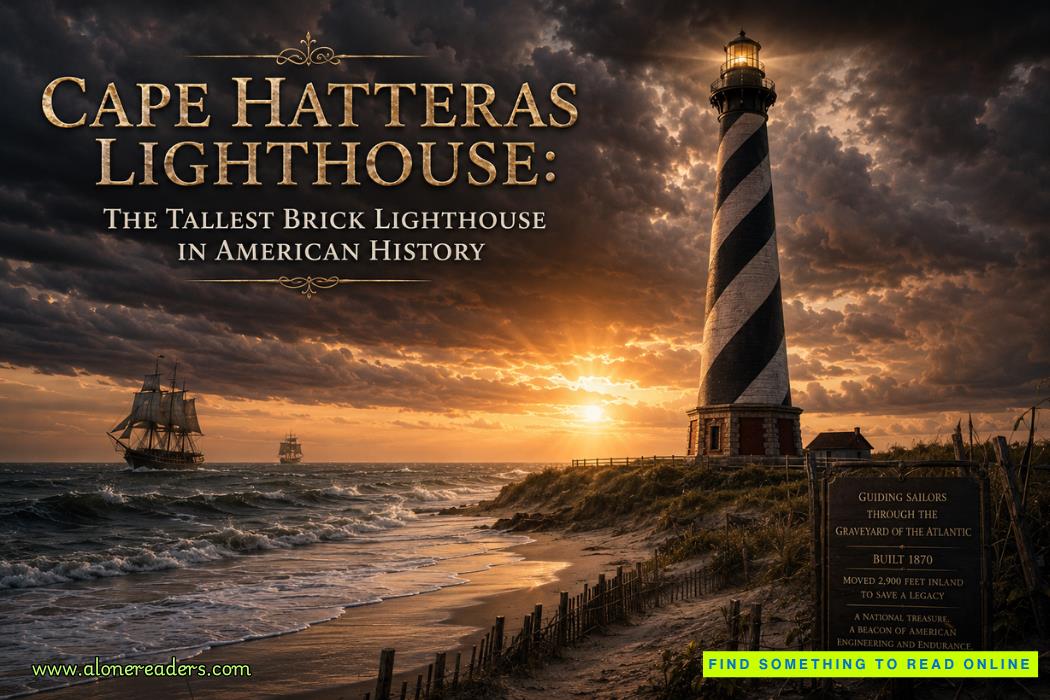
The story of the Cape Hatteras Lighthouse is inseparable from the violent waters of the Atlantic Ocean and the maritime history of the eastern United States. Rising dramatically above the shifting sands of North Carolina’s Outer Banks, the lighthouse stands not merely as a navigational structure, but as one of the most recognizable engineering landmarks in American coastal history. Towering at 198.49 feet (60.5 meters), it remains the tallest brick lighthouse ever constructed in the United States, and one of the tallest masonry lighthouses in the world. For generations of sailors navigating the treacherous waters surrounding Cape Hatteras, its rotating beacon represented survival, direction, and the final warning before entering one of the deadliest stretches of ocean along the Atlantic seaboard.
The origins of Cape Hatteras Lighthouse date back to the late eighteenth century, during the formative years of the United States. The waters off Cape Hatteras had already developed a notorious reputation among mariners. Powerful ocean currents collided near the cape, particularly where the cold Labrador Current met the warm Gulf Stream. Combined with hidden shoals extending miles into the ocean, unpredictable storms, and hurricane activity, the region became a graveyard for countless vessels. Ships carrying cargo, naval supplies, immigrants, and commercial goods frequently ran aground or disappeared entirely in these waters. Over time, the area earned the ominous nickname “The Graveyard of the Atlantic.”
By the 1790s, American political leaders recognized that maritime trade could not safely expand without improved coastal navigation systems. Congress authorized the construction of several major lighthouses, including one at Cape Hatteras. The first lighthouse was completed in 1803. Compared to the towering structure that exists today, the original lighthouse was relatively modest, standing roughly 90 feet tall and built from sandstone. Its lantern utilized whale oil lamps with reflectors, which represented advanced lighting technology for its era. However, despite its strategic importance, the original tower quickly proved inadequate. Mariners complained that the light was too dim and too short to be seen at sufficient distance, especially during severe weather conditions common along the Carolina coast.
As transatlantic trade increased throughout the nineteenth century, the need for a larger and more powerful lighthouse became unavoidable. Steamships and commercial vessels were becoming larger and faster, while maritime traffic along the eastern seaboard intensified dramatically. Government inspectors repeatedly criticized the old lighthouse for failing to provide reliable long-distance visibility. By the mid-1800s, officials concluded that a completely new structure was necessary rather than attempting incremental improvements.
Construction of the current lighthouse began in 1868, shortly after the end of the American Civil War. The engineering ambitions behind the project were extraordinary for the time. Builders designed a massive brick tower capable of withstanding intense coastal winds, salt exposure, and shifting sands. The final structure was completed in 1870, instantly becoming one of the most impressive maritime engineering achievements in the country. More than 1.25 million bricks were used in its construction, forming an immense tapered tower engineered to maintain stability despite its extreme height.
One of the lighthouse’s most iconic characteristics is its distinctive black-and-white spiral exterior pattern. Interestingly, the original structure was not painted in this famous design immediately after construction. The lighthouse initially retained a plain brick appearance before receiving the spiral daymark pattern in 1873. These bold markings served an essential navigational purpose. During daylight hours, sailors could identify specific lighthouses visually based on their unique paint schemes. The spiral pattern of Cape Hatteras quickly became one of the most recognizable maritime symbols in the United States.
The engineering behind the tower remains remarkable even by modern standards. The structure’s walls are extraordinarily thick at the base, gradually narrowing toward the top to reduce weight while preserving stability. The foundation extends deep below ground level to anchor the tower against coastal erosion and hurricane-force winds. Inside, a cast-iron spiral staircase containing 257 steps winds upward through the tower’s hollow core. The staircase itself was considered an engineering masterpiece during the nineteenth century because it combined structural durability with reduced interior weight.
Perhaps the most important technological feature of the lighthouse was its Fresnel lens. Imported from France, the first-order Fresnel lens installed in Cape Hatteras Lighthouse represented the pinnacle of nineteenth-century optical science. Invented by French physicist Augustin-Jean Fresnel, these lenses revolutionized lighthouse illumination worldwide. Rather than relying on massive solid glass lenses, the Fresnel system used concentric prisms to focus and intensify light into a powerful beam visible over vast distances. The Cape Hatteras lens could project light approximately 20 miles out to sea, dramatically improving navigational safety.
At night, the rotating beam became a critical guide for mariners attempting to avoid Diamond Shoals, one of the most dangerous underwater formations along the Atlantic coast. These constantly shifting sandbars extended far into the ocean and frequently trapped ships before crews had any opportunity to react. Storms could suddenly push vessels toward the shoals, while fog and darkness made navigation nearly impossible without reliable coastal beacons. The lighthouse therefore functioned not merely as a warning structure, but as a lifeline for countless sailors.
Throughout the late nineteenth and early twentieth centuries, lighthouse keepers played an essential role in maintaining the beacon’s operation. Life as a keeper at Cape Hatteras was demanding and often isolated. Keepers regularly climbed hundreds of steps carrying heavy supplies, cleaned soot from lamps, polished the delicate Fresnel lens, monitored fuel systems, and maintained clockwork mechanisms responsible for rotating the light. During storms, they remained on duty despite hurricane-force winds and dangerous flooding. Their dedication directly affected the survival of ships navigating nearby waters.
The lighthouse also became deeply connected to the broader economic development of the United States. During the era of expanding industrialization, enormous quantities of goods moved along Atlantic shipping routes. Cotton, timber, tobacco, manufactured products, and imported materials all traveled through waters near Cape Hatteras. A functioning lighthouse reduced insurance costs, protected valuable cargo, and improved maritime efficiency. In this sense, the structure indirectly contributed to national economic growth during a transformative period in American history.
The strategic significance of Cape Hatteras extended beyond commerce. During wartime periods, particularly the Civil War and later World Wars, the Outer Banks region became militarily important. German submarines operated off the Atlantic coast during World War II, and many ships were attacked near North Carolina waters. The lighthouse continued functioning as a vital navigational reference point during these dangerous years, though coastal lighting systems occasionally faced restrictions to reduce visibility to enemy forces.
Despite its massive construction, Cape Hatteras Lighthouse faced an enemy that engineering alone could not permanently defeat: coastal erosion. The Outer Banks are among the most geographically unstable coastal environments in North America. Wind, storms, hurricanes, and tidal movements continuously reshape the shoreline. When the lighthouse was completed in 1870, it stood approximately 1,500 feet from the ocean. Over the following century, relentless erosion gradually pushed the shoreline closer and closer toward the tower.
By the late twentieth century, the situation had become critical. The Atlantic Ocean had advanced alarmingly near the lighthouse foundation, threatening eventual collapse. Engineers, historians, and preservationists debated possible solutions for years. Some advocated constructing seawalls or protective barriers, while others argued that the only realistic option was relocating the entire lighthouse inland.
The decision to move the lighthouse became one of the most ambitious historic preservation engineering projects ever attempted in the United States. In 1999, engineers successfully relocated the entire 4,830-ton structure approximately 2,900 feet inland. The operation required extraordinary precision and months of preparation. Specialized steel beams and hydraulic systems were installed beneath the foundation, allowing the enormous brick tower to travel slowly across prepared tracks.
Many experts initially feared that moving the lighthouse could cause catastrophic structural damage. However, the relocation proved remarkably successful. The tower maintained its structural integrity throughout the journey, and the project became internationally recognized as a triumph of preservation engineering. The successful move demonstrated that historic structures could be protected through innovative engineering rather than sacrificed to environmental change.
Today, the lighthouse stands within the boundaries of Cape Hatteras National Seashore, administered by the National Park Service. It remains one of the most visited historic sites in North Carolina and one of the most famous lighthouses in the world. Tourists travel from across the United States and internationally to experience its immense scale and historical significance firsthand.
Visitors who climb the 257-step staircase gain sweeping panoramic views of the Atlantic Ocean, the Outer Banks, and surrounding coastal landscapes. The experience offers more than scenic beauty; it provides direct connection to centuries of maritime history. Standing atop the tower, visitors can understand why sailors depended so heavily on the lighthouse beacon during storms and darkness.
The surrounding museum exhibits and visitor centers preserve the broader story of maritime life along the Outer Banks. Displays explore shipwrecks, lighthouse keeper traditions, coastal rescue operations, and the evolving technologies of navigation. These educational components transform the lighthouse from a simple tourist attraction into a major historical and cultural resource.
The lighthouse also plays an important symbolic role in American cultural identity. Its spiral design appears in countless photographs, paintings, documentaries, books, and tourism campaigns. For many Americans, Cape Hatteras represents resilience against nature’s forces, engineering innovation, and the enduring importance of maritime heritage. The structure has become especially associated with perseverance because of its dramatic relocation project and continued survival despite hurricanes, erosion, and environmental threats.
Environmental concerns continue to shape the lighthouse’s future. Rising sea levels, increasingly powerful storms, and ongoing coastal erosion remain major challenges throughout the Outer Banks region. Scientists frequently study the area as part of broader climate and shoreline management research. The lighthouse therefore exists not only as a historical monument, but also as a visible reminder of the dynamic relationship between human engineering and natural coastal processes.
Architecturally, Cape Hatteras Lighthouse remains an extraordinary example of nineteenth-century American engineering confidence. Its immense height, elegant tapering form, durable masonry construction, and distinctive visual design combine functionality with aesthetic power. Unlike many modern navigational systems that operate invisibly through satellites and digital technology, the lighthouse possesses a physical and emotional presence that continues to captivate visitors.
Even in the age of GPS and advanced electronic navigation, the lighthouse retains operational significance. Although modern vessels no longer rely exclusively on lighthouse beams for survival, the beacon continues functioning as an active aid to navigation. Its light still flashes across Atlantic waters, connecting present-day maritime activity with traditions stretching back centuries.
The enduring fascination surrounding Cape Hatteras Lighthouse emerges from the combination of history, danger, engineering, and human determination embodied within the structure. It represents an era when navigation depended on visible beacons rather than electronic signals, when isolated keepers battled storms to maintain lifesaving lights, and when coastal engineering projects required immense manual labor and ingenuity. At the same time, its successful preservation demonstrates how modern engineering can protect historical landmarks threatened by environmental change.
Among the great lighthouses of history, Cape Hatteras occupies a uniquely powerful position. It is not merely America’s tallest brick lighthouse; it is a monument to maritime survival, technological progress, and preservation against overwhelming natural forces. Rising above the dunes of the Outer Banks, its striped tower continues to symbolize guidance, endurance, and the enduring relationship between humanity and the sea.




 Château de Vincennes: France’s Forgotten Royal Fortress and Medieval Stronghold
 Château de Carcassonne: Europe’s Greatest Medieval Citadel and Fortress
 Château de Chenonceau: The Castle Built by Remarkable Women
 Château de Chambord: France’s Magnificent Renaissance Castle and Architectural Wonder
 Tehri Dam: India's Tallest Dam and the Debate Behind It
 Bhakra Nangal Dam: India's Temple of Modern Development