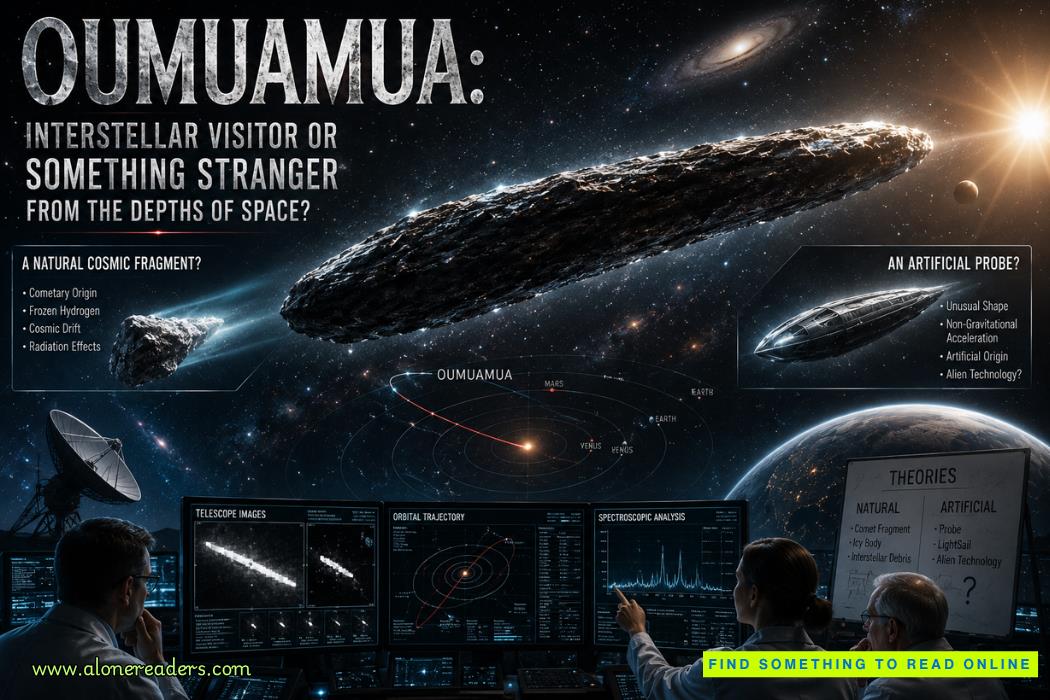
In October 2017, astronomers observing the night sky detected an object unlike anything previously seen. At first glance, it appeared to be another small body passing through the Solar System, similar to countless asteroids and comets discovered every year. However, as scientists analyzed its trajectory, brightness, shape, and motion, they realized they were witnessing something unprecedented.
The object was named Oumuamua, a Hawaiian word meaning “scout” or “messenger from afar arriving first.” The name was remarkably fitting. Oumuamua was the first confirmed interstellar object ever detected passing through our Solar System. Unlike planets, asteroids, and comets that orbit the Sun and originated within the Solar System, Oumuamua had arrived from deep interstellar space.
What began as a routine astronomical observation quickly evolved into one of the most fascinating scientific mysteries of the modern era. Even years after its discovery, Oumuamua continues to generate intense debate among astronomers, physicists, and planetary scientists. Some regard it as a highly unusual but natural object. Others argue that its characteristics are so extraordinary that more exotic explanations deserve consideration.
The story of Oumuamua is not simply about a rock traveling through space. It is a story about the limits of human knowledge, the challenge of interpreting incomplete data, and the possibility that the universe may still contain surprises beyond our current understanding.
Oumuamua was first detected by the Pan-STARRS1 telescope in Hawaii on October 19, 2017. At the time of discovery, the object was already moving away from the Sun. Scientists quickly calculated its orbit and reached a startling conclusion. The trajectory was hyperbolic, meaning it was not gravitationally bound to the Solar System.
Every ordinary asteroid or comet follows an orbit around the Sun. Oumuamua did not. It was traveling so fast that it would eventually escape the Solar System entirely. More importantly, calculations showed that it had entered the Solar System from interstellar space and would continue its journey back into the vast darkness between stars.
This was a historic moment in astronomy. Scientists had long predicted that objects from other star systems must occasionally pass through our cosmic neighborhood. However, Oumuamua was the first confirmed example ever observed.
Its estimated speed before entering the Solar System was approximately 26 kilometers per second relative to the Sun. After receiving a gravitational boost from its close approach to the Sun, it accelerated further and began leaving the Solar System at tremendous speed.
The object's path indicated that it originated from no known nearby star system. After traveling through interstellar space for potentially hundreds of millions or even billions of years, it happened to pass through humanity's observational reach for only a brief period.
One of the first mysteries emerged when astronomers attempted to determine Oumuamua's shape.
Most asteroids and comets are irregular but roughly compact bodies. Oumuamua appeared dramatically different. As it rotated, its brightness changed by a factor of about ten. Such extreme brightness variation suggested an exceptionally elongated shape.
Early calculations indicated that Oumuamua might be ten times longer than it was wide, resembling a giant cosmic cigar. Some estimates suggested dimensions of approximately 400 meters in length and only a few dozen meters in width.
Later studies proposed an alternative possibility. Instead of being cigar-shaped, Oumuamua might have been extremely thin and flattened, resembling a pancake or disk.
Regardless of which interpretation was correct, both possibilities described a shape unlike the overwhelming majority of known Solar System objects.
The unusual geometry immediately attracted scientific attention because it implied a unique formation history that had rarely, if ever, been observed before.
Another intriguing characteristic involved Oumuamua's surface.
Observations revealed a reddish coloration similar to some outer Solar System objects. Such coloring can result from prolonged exposure to cosmic radiation over immense timescales. During its long journey through interstellar space, high-energy particles may have altered the chemistry of its outer layers.
The surface also appeared surprisingly reflective in certain analyses. Some researchers suggested the possibility of an icy crust hidden beneath a radiation-processed exterior.
Because the object was already moving away when discovered, astronomers had only a limited window to collect data. As a result, many questions about its composition remain unanswered.
The greatest scientific puzzle emerged when researchers carefully tracked Oumuamua's motion.
Normally, an object traveling through space follows a predictable path governed by gravity. However, Oumuamua displayed a small but measurable acceleration as it moved away from the Sun.
This extra acceleration could not be fully explained by gravitational forces alone.
For comets, such behavior is common. As sunlight heats the comet's surface, volatile materials vaporize and produce jets of gas. These jets act like tiny rocket engines, subtly changing the object's trajectory.
Initially, scientists suspected that Oumuamua was simply a comet.
However, there was a problem.
Sensitive observations failed to detect the characteristic gas, dust, or tail normally associated with cometary activity. Even powerful telescopes could not identify evidence of substantial outgassing.
This created a significant scientific dilemma.
If Oumuamua was an asteroid, the acceleration was difficult to explain.
If it was a comet, the expected signs of cometary behavior appeared absent.
Researchers proposed numerous solutions. Some suggested that Oumuamua contained exotic forms of ice that evaporated without producing easily detectable signatures. Others proposed hidden jets, unusual chemical compositions, or previously unknown physical processes.
Each explanation addressed certain observations while creating new questions.
One of the most widely discussed hypotheses involved hydrogen ice.
According to this theory, Oumuamua could have consisted largely of molecular hydrogen frozen at extremely low temperatures. As the object approached the Sun, the hydrogen would sublimate and generate acceleration without producing visible comet-like features.
The concept was innovative but faced challenges. Many scientists questioned whether large hydrogen-ice objects could survive the harsh conditions of interstellar space for long periods.
Another proposal suggested that Oumuamua might be composed of nitrogen ice similar to material found on Pluto. Nitrogen sublimation could potentially explain the observed acceleration while remaining difficult to detect.
Yet this explanation also sparked debate regarding formation mechanisms and survival timescales.
A more recent hypothesis proposed that Oumuamua may have originated from a water-rich planetary body that experienced unusual physical processing during its history.
While these natural explanations remain plausible, none has achieved universal acceptance within the scientific community.
The uncertainty surrounding Oumuamua opened the door to more speculative discussions.
The most controversial interpretation was advanced by astrophysicist Avi Loeb.
Loeb argued that Oumuamua's unusual shape, apparent acceleration, and lack of detectable outgassing justified consideration of an artificial origin.
He suggested that Oumuamua might resemble a light sail, a thin structure designed to use radiation pressure from stars for propulsion.
Light sails have been seriously proposed by engineers and physicists as a potential technology for future interstellar travel. A sufficiently thin object could experience measurable acceleration from sunlight alone.
According to Loeb, this mechanism could potentially explain Oumuamua's non-gravitational acceleration without requiring comet-like gas emissions.
Importantly, Loeb did not claim that Oumuamua was definitively alien technology. Instead, he argued that the possibility should be investigated scientifically rather than dismissed automatically.
The idea attracted enormous public attention.
Many scientists strongly disagreed with the hypothesis, emphasizing that extraordinary claims require extraordinary evidence. Critics argued that natural explanations, although imperfect, remained more likely than an artificial origin.
The debate highlighted a broader issue in science. When observations are incomplete, researchers must balance open-mindedness with skepticism. New discoveries often challenge existing assumptions, but scientific conclusions require robust evidence.
As a result, the alien technology hypothesis remains highly controversial and far from accepted by the scientific consensus.
One of the most frustrating aspects of the Oumuamua mystery is that humanity had only a brief opportunity to study it.
By the time astronomers recognized its unusual nature, the object was already leaving the Solar System at high speed. Existing spacecraft were incapable of intercepting it.
Scientists were therefore forced to rely entirely on remote observations collected over a limited period.
This data shortage is a major reason why debates continue today. Many critical properties, including its precise composition, internal structure, and detailed surface characteristics, remain unknown.
Future interstellar visitors may not escape so easily.
Modern sky surveys are becoming increasingly powerful. New observatories can detect incoming objects much earlier than was possible in 2017. Earlier detection would provide scientists with more time to conduct observations and potentially launch dedicated missions.
The discovery of a second confirmed interstellar object in 2019 demonstrated that Oumuamua was not unique. The object known as 2I/Borisov behaved much more like a conventional comet and exhibited clear signs of outgassing.
Comparisons between Oumuamua and Borisov highlighted just how unusual Oumuamua truly was. While Borisov fit existing cometary models reasonably well, Oumuamua continued to resist straightforward classification.
Today, Oumuamua remains one of the most intriguing objects ever observed.
It may ultimately prove to be an exotic natural body formed through processes not yet fully understood. It may represent an entirely new category of interstellar object. Or it may reveal that our assumptions about the diversity of objects wandering between stars are incomplete.
What makes Oumuamua so compelling is not necessarily the possibility of alien technology. Rather, it is the reminder that the universe still contains profound mysteries. A single object passing briefly through our Solar System challenged decades of assumptions about planetary formation, cometary behavior, and interstellar travel.
Whether Oumuamua was a cosmic fragment, an icy relic from another star system, or something even stranger, its appearance marked the beginning of a new era in astronomy. For the first time, humanity observed a visitor from another stellar neighborhood. The questions it raised continue to drive research, inspire debate, and expand our understanding of the cosmos.
In the vastness of interstellar space, countless objects may be traveling between stars at this very moment. Oumuamua was simply the first one we noticed. It may not be the last mystery to arrive from the darkness between worlds.



 Château de Vincennes: France’s Forgotten Royal Fortress and Medieval Stronghold
 Château de Carcassonne: Europe’s Greatest Medieval Citadel and Fortress
 Château de Chenonceau: The Castle Built by Remarkable Women
 Château de Chambord: France’s Magnificent Renaissance Castle and Architectural Wonder
 Tehri Dam: India's Tallest Dam and the Debate Behind It
 Bhakra Nangal Dam: India's Temple of Modern Development