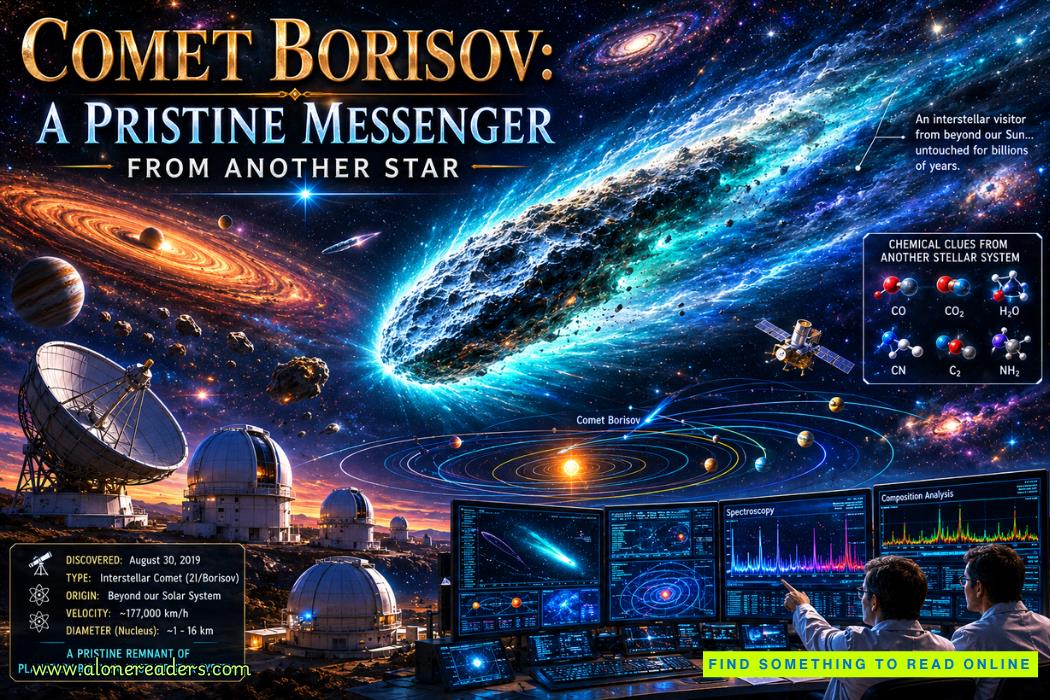
In the history of astronomy, very few discoveries have transformed scientific understanding as rapidly as the appearance of Comet Borisov. For centuries, astronomers observed comets originating from the distant reaches of our own Solar System. These icy wanderers carried valuable information about the formation of the Sun and planets, but they were ultimately local objects. Everything changed in 2019 when astronomers confirmed that a newly discovered comet was not from our Solar System at all. It had traveled across interstellar space from another star.
Known officially as 2I/Borisov, Comet Borisov became only the second confirmed interstellar object ever detected and the first interstellar comet observed in detail. Unlike its predecessor, which displayed unusual characteristics and sparked intense debate, Borisov appeared remarkably familiar. Yet that familiarity was precisely what made it so important. It provided scientists with their first opportunity to directly study material formed around another star and compare it with the building blocks of our own planetary system
The Discovery That Changed Interstellar Astronomy
On August 30, 2019, amateur astronomer Gennadiy Borisov detected an unusual object using a telescope he had built himself. The discovery occurred at the MARGO observatory in Crimea. Initial observations suggested that the object might be a comet, but further analysis revealed something far more extraordinary.
Astronomers quickly calculated its orbit and found that it was moving too fast to be gravitationally bound to the Sun. Its trajectory was hyperbolic, meaning it was merely passing through the Solar System rather than orbiting within it. The object had originated beyond the influence of our Sun and would eventually leave the Solar System forever.
This realization immediately elevated Borisov into one of the most important astronomical discoveries of the decade. Scientists suddenly had access to a physical sample—visible through telescopes—of material formed around another star.
Why Borisov Was Different From 'Oumuamua
Two years before Borisov's discovery, astronomers had detected an interstellar object called ʻOumuamua. That object generated enormous controversy because of its unusual shape, unexpected acceleration, and lack of visible cometary activity.
Borisov was different.
Instead of behaving strangely, Borisov behaved exactly like a comet. It developed a bright coma of gas and dust surrounding its nucleus. It produced a visible tail extending millions of kilometers into space. It released volatile materials as sunlight heated its surface.
Because Borisov acted like a typical comet, scientists could apply decades of cometary research techniques to study it. Ironically, its normal behavior made it a more useful scientific target than the more mysterious 'Oumuamua.
Researchers could measure its composition, estimate its size, analyze its dust particles, and compare its chemistry with comets from our own Solar System.
A Visitor From the Deep Interstellar Void
Before entering the Solar System, Borisov spent millions—possibly billions—of years traveling through interstellar space.
Its velocity relative to the Sun suggested that it originated from another stellar system within the Milky Way galaxy. However, identifying its exact birthplace proved impossible. Over immense timescales, gravitational interactions with stars, molecular clouds, and galactic forces altered its trajectory.
By the time it reached our Solar System, Borisov had become a cosmic messenger carrying information from an unknown stellar environment.
Scientists believe it was likely ejected from its original planetary system during the chaotic early stages of planet formation. Similar processes are thought to have occurred in our own Solar System when giant planets scattered countless icy bodies into deep space.
Borisov may therefore represent one of trillions of interstellar comets wandering through the galaxy.
The Physical Characteristics of Borisov
Observations revealed that Borisov possessed many features expected from a classical comet.
Its nucleus was estimated to be relatively small compared with some famous Solar System comets. Measurements suggested a diameter of less than one kilometer, although precise estimates varied as dust obscured direct observations.
Surrounding the nucleus was a large cloud of gas and dust known as the coma. This glowing envelope expanded dramatically as the comet approached the Sun.
The comet also generated:
• A dust tail composed of microscopic solid particles
• An ion tail created by interactions with solar radiation
• Jets of gas erupting from active surface regions
• Continuous outgassing driven by solar heating
These characteristics allowed scientists to study Borisov using the same techniques employed for ordinary comets while simultaneously gaining insights into an alien planetary system.
The Chemistry of Another Solar System
One of the most significant aspects of the Borisov mission was determining its chemical composition.
Using powerful telescopes around the world, astronomers identified multiple molecules within the comet's coma. These included:
• Water vapor
• Carbon monoxide
• Cyanide compounds
• Various carbon-containing molecules
• Dust particles rich in silicates
The abundance ratios of these substances provided valuable clues about the environment in which Borisov formed.
One particularly intriguing finding involved carbon monoxide. Borisov appeared unusually rich in carbon monoxide compared with many Solar System comets. This suggested formation in an extremely cold region far from its parent star.
Such conditions resemble the distant outer regions of protoplanetary disks where temperatures are low enough for volatile compounds to freeze.
This discovery implied that the physical processes shaping planetary systems may be remarkably similar throughout the galaxy.
An Unexpectedly Pristine Object
Researchers frequently described Borisov as "pristine."
In planetary science, a pristine object is one that has undergone little alteration since its formation. Borisov appeared to fit this description exceptionally well.
Unlike many comets in our Solar System that repeatedly pass near the Sun and experience extensive heating, Borisov had likely never encountered another star at such close range before entering our Solar System.
Its surface therefore preserved ancient materials largely unchanged since the birth of its original stellar system.
Scientists were effectively observing frozen relics from another star's planet-forming disk.
This was comparable to receiving a sealed time capsule from a distant civilization—except the message contained chemical information about the formation of planets rather than written words.
What Borisov Revealed About Planet Formation
One of the most important scientific questions concerns whether our Solar System is unique or typical.
Borisov offered a rare opportunity to investigate this issue.
The comet's composition suggested that many of the same chemical ingredients involved in Solar System formation exist elsewhere in the galaxy. Water, carbon compounds, silicate dust, and frozen gases appear to be common products of star and planet formation.
This finding strengthened the idea that planetary systems throughout the Milky Way may share similar building blocks.
If the raw materials for planets are widespread, then Earth-like worlds could also be more common than previously assumed.
Although Borisov alone cannot answer questions about extraterrestrial life, it supports the broader conclusion that the chemical foundations necessary for planetary development are not exclusive to our Solar System.
Observations From the World's Most Powerful Telescopes
Borisov became a prime target for major observatories around the world.
Researchers utilized some of humanity's most advanced astronomical instruments to study the comet.
Facilities involved included:
• European Southern Observatory telescopes
• Hubble Space Telescope
• Gemini Observatory
• Keck Observatory
• Atacama Large Millimeter Array
These instruments monitored the comet before and after its closest approach to the Sun.
The resulting data set became one of the most comprehensive investigations ever conducted on an interstellar object.
Fragmentation and Evolution
As Borisov moved away from the Sun, astronomers observed evidence that parts of the comet were breaking apart.
This fragmentation is common among comets. Rapid heating, internal pressure, and structural weaknesses can cause chunks of ice and rock to separate from the nucleus.
For scientists, these events were especially valuable because they exposed fresh material from the comet's interior.
The newly exposed regions offered additional opportunities to analyze pristine substances that had remained hidden beneath the surface for billions of years.
Observations suggested that Borisov possessed a fragile structure similar to many Solar System comets, reinforcing the idea that comparable formation mechanisms operate in planetary systems across the galaxy.
The Beginning of Interstellar Comet Science
Before Borisov, interstellar objects existed largely as theoretical possibilities.
After Borisov, they became a new scientific field.
Astronomers now recognize that interstellar visitors may enter the Solar System more frequently than once believed. Improvements in survey technology are increasing the likelihood of future discoveries.
New observatories are expected to detect many more interstellar objects in coming decades.
Each future discovery will provide another opportunity to sample material from distant stellar systems without launching spacecraft beyond our Solar System.
In a sense, the galaxy is already sending samples to us.
Future Missions to Interstellar Visitors
The discovery of Borisov has encouraged discussions about rapid-response space missions designed to intercept future interstellar objects.
Engineers have proposed spacecraft capable of launching quickly after detection and performing close flybys.
Such missions could collect unprecedented data about:
• Interstellar chemistry
• Planetary formation processes
• Organic molecules in alien systems
• Dust particle structures
• The diversity of cometary populations across the galaxy
Future technology may even allow sample-return missions targeting interstellar visitors.
If achieved, scientists would gain direct laboratory access to material formed around another star.
Borisov's Lasting Legacy
Comet Borisov arrived unexpectedly, spent a brief period under humanity's scrutiny, and then continued its journey into the darkness between stars.
Yet its scientific impact remains profound.
For the first time, astronomers obtained detailed observations of a comet formed in another stellar system. The results revealed that the processes responsible for creating planets, comets, and icy bodies may be surprisingly universal. Borisov showed that water, carbon compounds, dust grains, and frozen gases exist far beyond our Solar System and participate in similar cosmic cycles elsewhere in the galaxy.
Most importantly, Borisov transformed an abstract idea into a tangible reality. Interstellar objects are no longer rare curiosities imagined by theorists. They are real travelers moving between stars, carrying physical evidence of distant worlds and ancient planetary nurseries.
As future telescopes discover more of these cosmic wanderers, Borisov will be remembered as the first interstellar comet that allowed humanity to look beyond its own celestial neighborhood and directly study the remnants of another star's planetary system. It was not merely a comet passing through the Solar System. It was a messenger from another sun, preserving a story billions of years old and delivering it across the vast distances of the Milky Way.



 Château de Vincennes: France’s Forgotten Royal Fortress and Medieval Stronghold
 Château de Carcassonne: Europe’s Greatest Medieval Citadel and Fortress
 Château de Chenonceau: The Castle Built by Remarkable Women
 Château de Chambord: France’s Magnificent Renaissance Castle and Architectural Wonder
 Tehri Dam: India's Tallest Dam and the Debate Behind It
 Bhakra Nangal Dam: India's Temple of Modern Development