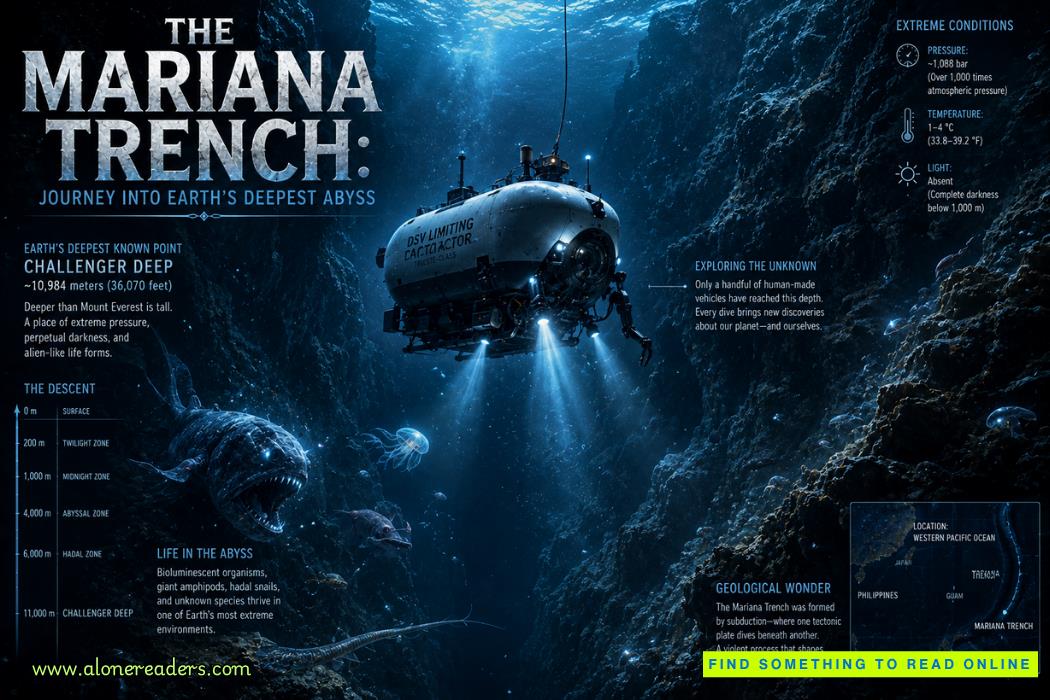
The oceans cover more than seventy percent of Earth's surface, yet humanity has explored only a small fraction of them. While mountains, deserts, and polar regions have been extensively mapped and studied, vast areas beneath the ocean remain largely unknown. Among all these unexplored regions, none inspires more fascination than the Mariana Trench. Located in the western Pacific Ocean, this immense underwater canyon represents the deepest known point on Earth and serves as one of the most extreme environments ever discovered.
Far below the reach of sunlight, beneath crushing pressures capable of destroying most machinery and life forms, the Mariana Trench remains a realm of mystery. It is a place where geological forces continuously reshape the planet, where strange creatures thrive in conditions once thought impossible, and where scientific discoveries challenge our understanding of life itself.
The Mariana Trench lies in the western Pacific Ocean, east of the Mariana Islands and south of Japan. Stretching for approximately 2,550 kilometers, it forms a crescent-shaped depression along the boundary between two massive tectonic plates.
The trench is part of a larger geological feature known as the Mariana Subduction Zone. Here, the Pacific Plate slowly descends beneath the smaller Mariana Plate. This process, known as subduction, has been occurring for millions of years and is responsible for creating the deepest ocean trench on the planet.
The trench is not simply a narrow crack in the seafloor. It is a gigantic geological structure with steep walls, deep valleys, and complex formations extending across vast distances. If viewed from space, it would appear as a long scar across the ocean floor, marking one of the most active tectonic regions on Earth.
Within the Mariana Trench lies its most famous feature: Challenger Deep.
Challenger Deep reaches a depth of approximately 10,900 to 11,000 meters below sea level, although exact measurements vary depending on the survey method used. To appreciate this scale, consider that Mount Everest, the highest mountain on Earth, stands about 8,849 meters above sea level. If Everest were placed inside Challenger Deep, its summit would still remain more than two kilometers underwater.
The immense depth creates one of the most hostile environments known. Temperatures hover just above freezing, sunlight never penetrates these depths, and water pressure exceeds 1,000 times the atmospheric pressure experienced at sea level.
At Challenger Deep, every square centimeter experiences a force equivalent to having dozens of large vehicles pressing upon it simultaneously.
The formation of the Mariana Trench is directly linked to plate tectonics.
Earth's outer shell is divided into large moving sections called tectonic plates. These plates constantly shift, collide, and separate over geological timescales. In the Mariana region, the dense Pacific Plate moves westward and sinks beneath the Mariana Plate.
As the heavier plate descends into Earth's mantle, it bends downward, creating the enormous depression that becomes the trench. This process also generates intense seismic activity and contributes to volcanic formation throughout the surrounding island chain.
The trench continues evolving today. Geological forces constantly alter its shape, making it a dynamic feature rather than a static landscape. Earthquakes regularly occur along the subduction zone, providing scientists with valuable insights into the mechanisms driving planetary evolution.
One of the defining characteristics of the Mariana Trench is the complete absence of sunlight.
Oceanographers divide the ocean into several depth zones. Beyond roughly 1,000 meters, sunlight effectively disappears. At the bottom of the Mariana Trench, darkness is absolute.
Without sunlight, photosynthesis cannot occur. Plants cannot grow, and the familiar food chains found in shallow marine ecosystems do not exist. Instead, life depends on alternative energy sources.
Organic material sinking from upper ocean layers, known as marine snow, provides a steady supply of nutrients. Dead organisms, microscopic particles, and biological waste gradually drift downward, feeding creatures living in the depths.
Some ecosystems also rely on chemical energy generated by geological processes, creating entirely different biological networks from those seen near the surface.
Pressure represents the greatest challenge in the Mariana Trench.
Every 10 meters of seawater adds approximately one atmosphere of pressure. At Challenger Deep, the pressure exceeds 1,100 atmospheres.
Such conditions would instantly crush ordinary submarines, vehicles, and equipment. Human bodies could not survive unprotected for even a moment.
Designing technology capable of operating in these depths requires extraordinary engineering. Submersibles must utilize specialized pressure-resistant materials, reinforced spheres, advanced life-support systems, and carefully designed electronics.
Even minor structural weaknesses can result in catastrophic failure under such extreme conditions.
The history of Mariana Trench exploration reflects humanity's determination to reach the most inaccessible places on Earth.
The Challenger Expedition
The trench derives its name from HMS Challenger, a British research vessel that conducted pioneering oceanographic surveys during the nineteenth century. Early depth measurements revealed the existence of an extraordinarily deep region in the Pacific Ocean.
The Trieste Dive
In 1960, Swiss engineer Jacques Piccard and United States Navy Lieutenant Don Walsh achieved one of the greatest feats in exploration history. Using the bathyscaphe Trieste, they descended to Challenger Deep.
The journey took nearly five hours. Upon reaching the bottom, they became the first humans ever to visit Earth's deepest known location. Despite limited visibility caused by sediment disturbance, their observations demonstrated that life could exist even under such extreme pressures.
Modern Exploration
Technological advancements have transformed deep-sea research. Sophisticated remotely operated vehicles and advanced submersibles now allow scientists to conduct detailed investigations.
In 2012, filmmaker and explorer James Cameron completed a solo descent to Challenger Deep aboard the Deepsea Challenger submersible. His mission collected valuable scientific data and produced unprecedented imagery from the trench floor.
Subsequent expeditions have continued expanding our understanding of this remarkable environment.
For decades, scientists assumed that extreme pressure would prevent complex life from surviving in the deepest ocean regions.
The Mariana Trench proved otherwise.
Numerous organisms have adapted to conditions that would be lethal to most life forms. These include specialized fish, crustaceans, worms, bacteria, and other microscopic organisms.
Snailfish
One of the most remarkable trench inhabitants is the Mariana snailfish. These small, translucent fish possess flexible bodies and unique biochemical adaptations that allow them to withstand immense pressure.
Their bodies contain molecules that stabilize cellular structures, preventing damage under extreme compression.
Amphipods
Large amphipods, shrimp-like crustaceans, thrive throughout the trench ecosystem. They consume organic debris that sinks from upper waters and play an important role in nutrient recycling.
Microbial Communities
Microscopic organisms represent some of the most successful inhabitants of the trench. Many derive energy from chemical reactions rather than sunlight, demonstrating the remarkable adaptability of life.
Their existence provides valuable clues about how life might survive in extreme environments elsewhere in the universe.
Many deep-sea organisms possess the ability to generate their own light.
This phenomenon, known as bioluminescence, results from chemical reactions within specialized cells. In the perpetual darkness of the deep ocean, bioluminescence serves multiple purposes.
Some species use light to attract prey. Others employ it to communicate, locate mates, or confuse predators.
The resulting environment can appear almost alien, with flashes of blue, green, and white light illuminating the darkness.
Scientists believe bioluminescence is among the most widespread adaptations in deep-ocean ecosystems.
The Mariana Trench is not merely a biological wonder; it is also a geological laboratory.
Scientists study the trench to better understand tectonic activity, earthquake generation, and the recycling of Earth's crust.
As oceanic plates descend into the mantle, enormous amounts of water and minerals are transported into Earth's interior. These materials influence volcanic activity and contribute to long-term planetary processes.
The trench also contains unusual rock formations, hydrothermal systems, and mineral deposits that provide insights into geological mechanisms operating deep beneath the surface.
Research conducted here helps scientists refine models of Earth's evolution and internal dynamics.
One of the most troubling discoveries in recent years is the presence of human-made pollution within the Mariana Trench.
Despite its extreme isolation, researchers have found plastic debris, synthetic fibers, chemical contaminants, and microplastics at astonishing depths.
Even organisms living near Challenger Deep contain traces of pollutants originating from human activities.
These findings highlight the global reach of environmental contamination. No corner of the planet remains completely untouched by modern civilization.
The discovery serves as a powerful reminder that ocean conservation is not limited to coastal regions but extends to the deepest parts of the world ocean.
The Mariana Trench occupies a unique position in scientific research.
It helps scientists study:
The trench also represents one of humanity's final frontiers. While spacecraft have explored distant planets and moons, much of our own ocean remains unmapped.
Each expedition reveals new species, unexpected geological formations, and previously unknown scientific phenomena.
The coming decades will likely transform our understanding of the Mariana Trench.
Advances in robotics, artificial intelligence, autonomous underwater vehicles, high-pressure sensors, and deep-ocean imaging systems are enabling increasingly detailed exploration.
Scientists hope to create comprehensive maps of the trench, identify new species, investigate microbial ecosystems, and better understand the geological processes shaping Earth's crust.
There is also growing interest in studying how deep-sea organisms survive under extreme conditions. Such research could lead to breakthroughs in biotechnology, medicine, materials science, and even space exploration.
The Mariana Trench remains one of the least explored places on Earth, yet it continues to provide discoveries with global scientific significance.
The Mariana Trench is far more than a record-breaking depression in the ocean floor. It is a living laboratory where geology, biology, chemistry, and engineering converge under the most extreme conditions found on our planet. Hidden beneath nearly eleven kilometers of water lies an environment defined by perpetual darkness, crushing pressure, and extraordinary resilience.
From the historic descent of the Trieste to modern robotic missions, humanity's exploration of the trench has repeatedly challenged assumptions about what is possible. Strange life forms flourish where survival once seemed impossible, geological forces reshape the planet beneath the waves, and new discoveries continue to emerge from the darkness.
As technology advances and exploration expands, the Mariana Trench will remain one of Earth's greatest scientific frontiers—a place that reminds us how much of our own world still awaits discovery.



 Château de Vincennes: France’s Forgotten Royal Fortress and Medieval Stronghold
 Château de Carcassonne: Europe’s Greatest Medieval Citadel and Fortress
 Château de Chenonceau: The Castle Built by Remarkable Women
 Château de Chambord: France’s Magnificent Renaissance Castle and Architectural Wonder
 Tehri Dam: India's Tallest Dam and the Debate Behind It
 Bhakra Nangal Dam: India's Temple of Modern Development