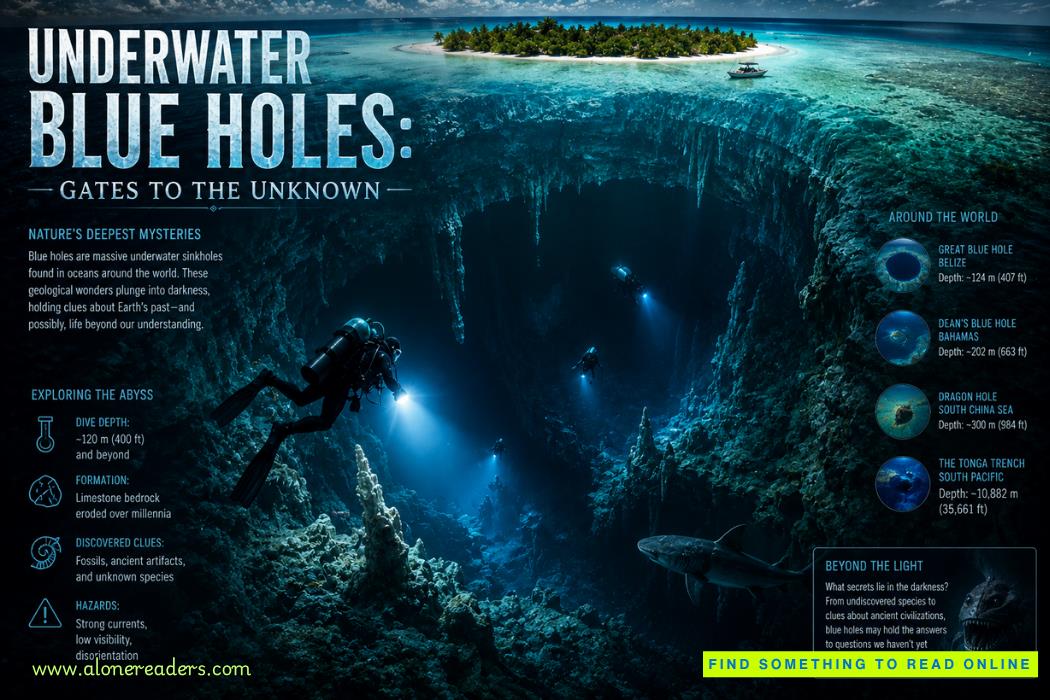
The world's oceans still contain vast regions that remain less explored than the surface of the Moon. Among the most mysterious features hidden beneath the sea are underwater blue holes—enormous vertical shafts that descend into darkness, often reaching depths far beyond what recreational divers can safely explore. These geological formations appear as dark blue circles when viewed from above, creating striking contrasts against the surrounding shallow waters. Their beauty is undeniable, but beneath their tranquil appearance lies an environment that challenges scientific understanding and continues to reveal unexpected discoveries.
Blue holes are not merely underwater caves or sinkholes. They are unique geological systems that preserve ancient environmental records, host unusual chemical conditions, and sometimes contain life forms adapted to some of the most extreme underwater environments on Earth. For marine scientists, geologists, archaeologists, and explorers, blue holes represent natural laboratories that provide rare glimpses into Earth's distant past.
A blue hole is a large underwater sinkhole or cave system that formed when sea levels were significantly lower than they are today. During past ice ages, much of Earth's water was locked in massive glaciers. Sea levels dropped dramatically, exposing large areas of continental shelves and carbonate platforms.
Rainwater slowly dissolved limestone and other soluble rocks, creating extensive cave networks underground. As glaciers melted and sea levels rose again, these cave systems became flooded. Some cave ceilings collapsed, creating deep vertical shafts that now connect directly to the ocean.
The term "blue hole" comes from their appearance when viewed from above. The surrounding shallow water reflects sunlight and appears light turquoise, while the deep opening absorbs light and appears as a dark blue or nearly black circle.
Some blue holes are only a few meters deep, while others extend hundreds of meters below the surface. Many remain only partially explored because of their depth, complexity, and dangerous conditions.
Formation During Ice Ages
Most marine blue holes originated during periods when sea levels were much lower than today. Over thousands of years, acidic rainwater dissolved limestone formations and enlarged underground chambers.
As the climate warmed and glaciers melted, rising oceans flooded these caves. Water entered passages that had once been dry, transforming terrestrial cave systems into submerged geological structures.
Collapse and Expansion
Many blue holes expanded through structural collapse. When cave ceilings weakened, enormous sections of rock fell inward, creating the wide openings visible today.
This process often produced nearly vertical walls, making blue holes resemble giant underwater wells descending into darkness.
Continuous Evolution
Although many blue holes formed thousands of years ago, they continue to evolve. Chemical weathering, ocean currents, sediment movement, and biological activity gradually alter their structure.
Scientists studying these formations gain valuable insight into long-term geological processes that operate on timescales far beyond human observation.
The Great Blue Hole, Belize
Perhaps the most famous blue hole on Earth, the Great Blue Hole lies off the coast of Belize within a coral reef system. Measuring approximately 300 meters across and more than 120 meters deep, it has become one of the world's most iconic diving destinations.
The nearly perfect circular shape is visible from aircraft and satellites, making it one of the most recognizable geological formations in the ocean.
Dean's Blue Hole, Bahamas
Dean's Blue Hole is among the deepest known blue holes in the world, plunging more than 200 meters below the surface.
It attracts elite freedivers who descend extraordinary depths using only a single breath. Its dramatic underwater walls create a spectacular environment that combines beauty with significant danger.
Dragon Hole, South China Sea
Dragon Hole is believed to be one of the deepest known marine blue holes, extending to depths exceeding 300 meters.
The hole contains multiple layers of water with distinct chemical compositions, making it an important location for marine research.
One of the most fascinating characteristics of many blue holes is the presence of sharply separated water layers.
Unlike most parts of the ocean where currents mix water continuously, some blue holes remain remarkably stratified.
Freshwater and Saltwater Boundaries
In some systems, freshwater entering from underground sources sits above denser seawater. The transition zone creates unusual visual distortions known as haloclines.
Divers often describe these boundaries as looking like underwater mirrors or shimmering curtains.
Oxygen-Rich and Oxygen-Free Zones
Many blue holes contain oxygenated upper layers but oxygen-depleted deeper sections.
Below a certain depth, oxygen levels may approach zero, creating environments unsuitable for most marine organisms. These conditions can persist for centuries because limited circulation prevents fresh oxygen from reaching deeper waters.
Some blue holes contain thick layers of hydrogen sulfide, a toxic gas produced by bacterial activity in oxygen-poor environments.
This layer often appears as a cloudy underwater fog.
Divers descending through it frequently report entering a surreal environment where visibility drops dramatically. Above the layer, marine life may flourish. Below it, the environment can appear almost alien.
The hydrogen sulfide layer acts as a chemical boundary separating two vastly different ecosystems.
For scientists, these layers provide valuable opportunities to study microbial life that survives under extreme conditions similar to those that may have existed on early Earth.
Natural Time Capsules
Blue holes serve as extraordinary archives of environmental history.
Sediments accumulate slowly on their floors, often remaining undisturbed for thousands of years. Each layer preserves information about past climates, storms, droughts, and sea-level changes.
Researchers extract sediment cores from blue holes much like historians reading pages from an ancient book.
Records of Ancient Hurricanes
In tropical regions, blue holes can preserve evidence of powerful storms that occurred centuries or even millennia ago.
Strong hurricanes transport distinctive sediments into these deep basins. By analyzing these deposits, scientists reconstruct hurricane activity long before modern weather records existed.
Such research improves understanding of long-term climate patterns and future storm risks.
The unusual chemistry of blue holes creates habitats unlike most marine environments.
Microbial Ecosystems
Many blue holes support specialized bacteria that thrive in low-oxygen or oxygen-free conditions.
These microorganisms play critical roles in nutrient cycling and chemical transformations.
Some scientists believe studying these microbes may help reveal how life adapted to harsh conditions during Earth's earliest history.
Unexpected Marine Species
Despite their challenging environments, blue holes often host unique communities of fish, crustaceans, and invertebrates.
Some species appear isolated from surrounding ecosystems, evolving distinct characteristics over long periods.
Because exploration remains limited, new species continue to be discovered in and around these underwater systems.
Blue holes occasionally preserve archaeological treasures that would not survive elsewhere.
Before rising sea levels flooded these caves, many were dry environments accessible to humans and animals.
Researchers have discovered:
The lack of oxygen in deeper sections often slows decomposition, allowing remarkable preservation of ancient materials.
These discoveries help scientists reconstruct human migration patterns and environmental conditions from thousands of years ago.
Although blue holes fascinate explorers, they rank among the most hazardous underwater environments.
Extreme Depth
Many blue holes descend beyond recreational diving limits. Greater depth increases pressure, nitrogen absorption, and decompression requirements.
Limited Visibility
Hydrogen sulfide layers, suspended sediments, and darkness can rapidly reduce visibility.
Disorientation becomes a serious risk, especially within cave passages.
Complex Cave Systems
Some blue holes connect to extensive underwater cave networks.
A wrong turn can leave divers trapped far from the entrance with limited air supplies.
Equipment Failure Risks
The deeper divers descend, the more critical equipment reliability becomes.
Even minor malfunctions can become life-threatening emergencies at extreme depths.
Because of these dangers, exploration typically requires highly specialized training and advanced technical diving equipment.
Surprisingly, blue holes may contribute to the search for life beyond Earth.
Scientists studying extreme microbial ecosystems within oxygen-poor environments gain insight into how life might survive on other worlds.
Conditions found in some blue holes resemble environments that may exist beneath the icy surfaces of distant moons.
Microbial communities thriving in darkness, high pressure, and unusual chemistry demonstrate that life can adapt to conditions once considered inhospitable.
These discoveries influence future missions searching for biological activity elsewhere in the solar system.
Modern exploration increasingly relies on advanced technology.
Remotely Operated Vehicles
Robotic systems equipped with cameras and sensors can reach depths beyond human limits.
Three-Dimensional Mapping
High-resolution sonar creates detailed digital models of underwater cave systems.
Environmental Sensors
Scientists monitor oxygen levels, salinity, temperature, and chemical composition throughout blue holes.
Autonomous Underwater Vehicles
These robotic explorers navigate dangerous environments independently while collecting valuable scientific data.
Such technologies are transforming blue holes from mysterious voids into measurable scientific frontiers.
Despite decades of exploration, blue holes remain among the least understood geological features on Earth.
New expeditions continue to discover deeper passages, unknown ecosystems, and valuable environmental records. Advances in robotics, underwater imaging, and geochemical analysis are accelerating research at an unprecedented pace.
Scientists increasingly recognize that blue holes are more than geological curiosities. They are climate archives, biological laboratories, archaeological repositories, and windows into Earth's history.
Every descent into one of these underwater chasms reveals new questions alongside new answers.
Underwater blue holes stand among the most mysterious places on our planet. Formed through ancient geological processes and hidden beneath modern oceans, they combine breathtaking beauty with profound scientific significance. Their dark depths contain records of past climates, evidence of ancient life, unusual chemical worlds, and ecosystems that challenge conventional understanding.
As technology continues to advance, these submerged gateways are gradually surrendering their secrets. Yet every discovery seems to deepen the mystery rather than solve it completely. In a world where much of the surface has been mapped and explored, blue holes remain true frontiers—silent, dark, and waiting to reveal what lies beyond the edge of the known world.



 Château de Vincennes: France’s Forgotten Royal Fortress and Medieval Stronghold
 Château de Carcassonne: Europe’s Greatest Medieval Citadel and Fortress
 Château de Chenonceau: The Castle Built by Remarkable Women
 Château de Chambord: France’s Magnificent Renaissance Castle and Architectural Wonder
 Tehri Dam: India's Tallest Dam and the Debate Behind It
 Bhakra Nangal Dam: India's Temple of Modern Development