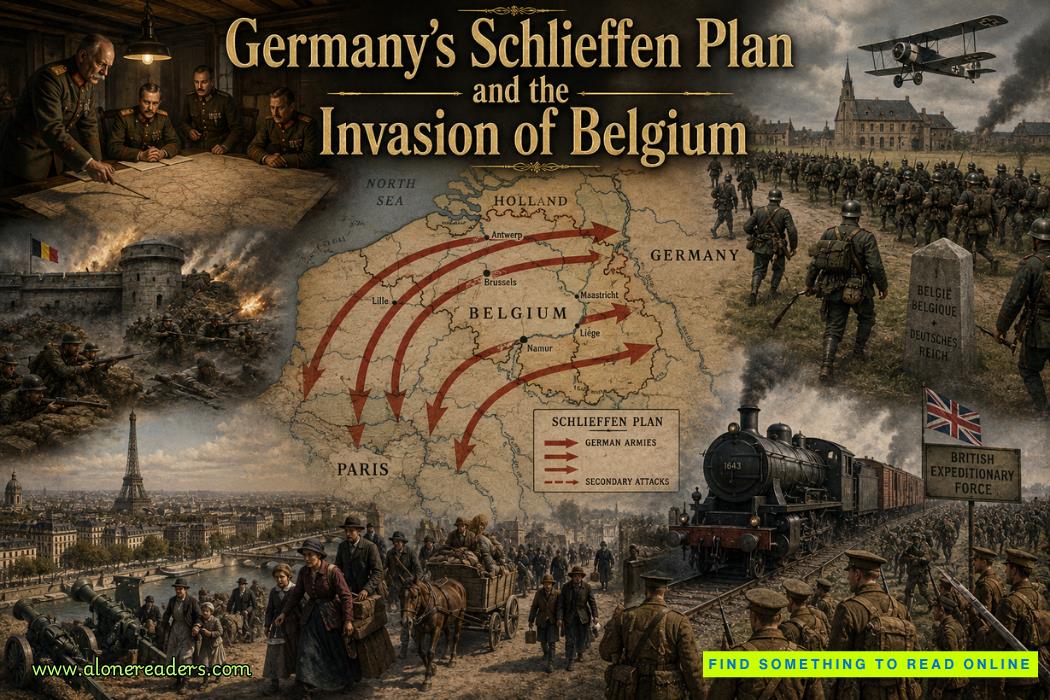
When World War I began in August 1914, Germany entered the conflict with a carefully prepared military strategy that had been developed over many years. German leaders understood that their country faced a unique strategic dilemma. Located in the heart of Europe, Germany risked fighting a two-front war against France in the west and Russia in the east. Such a conflict threatened to overwhelm even Germany's powerful army if both enemies attacked simultaneously. To solve this problem, German military planners devised an ambitious operational blueprint known as the Schlieffen Plan. The strategy aimed to defeat France rapidly before turning the full strength of the German Army eastward against Russia. Although brilliantly conceived on paper, the plan ultimately failed in practice, and its collapse transformed what Germany expected to be a short war into a prolonged global conflict lasting more than four years.
The origins of the Schlieffen Plan lay in Germany's geopolitical position after its unification in 1871. The newly established German Empire stood between two potential enemies. To the west was France, eager to recover the provinces of Alsace and Lorraine after its defeat in the Franco-Prussian War. To the east lay the vast Russian Empire, whose enormous population could mobilize millions of soldiers. German leaders feared that France and Russia, bound together by military alliance, would coordinate attacks from opposite directions. No European power wished to fight on two fronts simultaneously, as doing so required dividing troops, supplies, and command resources.
The architect of the strategy was Count Alfred von Schlieffen, who served as Chief of the German General Staff from 1891 to 1906. Schlieffen believed Germany could exploit one important advantage: Russia's enormous size meant its mobilization would take much longer than France's. Germany possessed an extensive railway network capable of moving troops rapidly, while Russian transportation infrastructure remained comparatively underdeveloped. Schlieffen estimated that Russia would require approximately six weeks to mobilize its full military strength, providing Germany with a valuable window of opportunity to eliminate France before concentrating on the eastern front.
The plan depended upon speed, precision, and overwhelming force. Rather than launching a direct assault across the heavily fortified Franco-German border, Schlieffen proposed a massive offensive through Luxembourg and Belgium, bypassing France's strongest defenses. The main German armies would sweep across northern Belgium, continue into northern France, and then swing south and east in a giant arc around Paris. The objective was to encircle the French Army from behind, trapping it against Germany's southern forces. If successful, France would be defeated within weeks, allowing Germany to transfer nearly its entire army eastward before Russia completed mobilization.
The strategy relied upon several important assumptions. First, Germany expected Belgium to offer only limited resistance or permit German troops to cross peacefully. Second, military planners believed Britain might remain neutral despite Belgium's treaty-protected neutrality. Third, Germany assumed France would concentrate its main forces near the common frontier rather than anticipating a wide flanking maneuver through Belgium. Finally, the entire operation depended upon maintaining an extremely strict timetable, with millions of soldiers, thousands of trains, horses, artillery pieces, and supply wagons moving according to carefully coordinated schedules.
When Schlieffen retired in 1906, his successor, General Helmuth von Moltke the Younger, inherited responsibility for implementing the strategy. Moltke generally accepted Schlieffen's concept but introduced several important modifications. Concerned about potential attacks elsewhere, he strengthened German forces in Alsace-Lorraine and reinforced the eastern frontier facing Russia. These adjustments reduced the strength of the crucial right wing responsible for sweeping through Belgium. Many historians continue debating whether these changes significantly weakened the original plan or whether the strategy itself contained fundamental flaws from the beginning.
Following Germany's declaration of war against France in early August 1914, the Schlieffen Plan entered its operational phase. On 2 August, German troops occupied Luxembourg without significant resistance. The following day, Germany presented Belgium with an ultimatum demanding free passage for its armies. German diplomats claimed the movement was a military necessity and promised compensation after the war. However, Belgium rejected the demand.
Belgium's decision reflected both national honor and international law. Since the Treaty of London of 1839, Belgium's neutrality had been guaranteed by the major European powers, including Britain, France, Prussia, Austria, and Russia. King Albert I declared that Belgium was "a nation, not a road." Accepting Germany's demands would surrender the country's independence without resistance. Consequently, Belgium chose to defend its sovereignty despite facing one of the strongest armies in Europe.
On 4 August 1914, German forces crossed the Belgian frontier, officially violating Belgian neutrality. This decision immediately transformed the political character of the war. Britain, which had guaranteed Belgium's independence under the 1839 treaty, demanded Germany withdraw its forces. When Germany ignored the ultimatum, Britain declared war on Germany later that same day, bringing the British Empire into the conflict. Germany had expected Britain either to remain neutral or intervene too slowly to influence the campaign. Instead, Britain's entry dramatically expanded the scale of the war.
German commanders initially expected Belgium's resistance to collapse quickly. Instead, Belgian soldiers fought with remarkable determination, particularly around the fortified city of Liège. The city's ring of modern forts delayed the German advance for nearly two weeks, disrupting carefully planned timetables. Although Germany eventually captured Liège using enormous 420-millimeter Krupp and Austrian Škoda siege guns, the delay proved strategically significant. Every day lost reduced Germany's chances of achieving the rapid victory upon which the entire Schlieffen Plan depended.
The German invasion also generated widespread international condemnation. Reports of harsh reprisals against Belgian civilians, destruction of towns, hostage executions, and the burning of cultural landmarks, including much of the historic library at Leuven, spread rapidly through newspapers worldwide. German commanders argued that civilian resistance, known as francs-tireurs, justified severe countermeasures. Regardless of the precise circumstances, these events profoundly damaged Germany's international reputation and strengthened Allied propaganda throughout the war.
While Belgium resisted, the British Expeditionary Force (BEF) landed in France. Although relatively small compared to the French and German armies, the BEF consisted of highly trained professional soldiers. British forces first engaged the Germans at the Battle of Mons on 23 August 1914. Despite eventually retreating, British rifle fire inflicted unexpectedly heavy casualties and demonstrated that German forces would face determined opposition throughout their advance.
Meanwhile, France implemented Plan XVII, its own offensive strategy emphasizing rapid attacks into Alsace and Lorraine. These assaults suffered devastating losses against prepared German defenses. Nevertheless, as German armies advanced through Belgium, French commanders recognized the main threat and gradually shifted forces northward to defend Paris. The flexibility of French rail transport enabled substantial troop redeployments, helping counter the German advance.
Another critical development occurred on the Eastern Front. German planners had expected Russia to mobilize slowly, yet Russian armies advanced into East Prussia much earlier than anticipated. Concerned about the threat, Moltke transferred several corps from the Western Front to reinforce the east. Although these troops arrived too late to participate in the famous German victory at the Battle of Tannenberg, their removal further weakened the already reduced right wing advancing toward Paris.
As German forces approached the French capital in early September, logistical difficulties became increasingly severe. The advancing armies had marched hundreds of kilometers, stretching supply lines to their limits. Railways damaged during the invasion required constant repair, roads became congested with troops and transport, horses grew exhausted, and soldiers suffered from fatigue after weeks of continuous marching. The rapid pace demanded by the Schlieffen Plan proved extraordinarily difficult to sustain in real battlefield conditions.
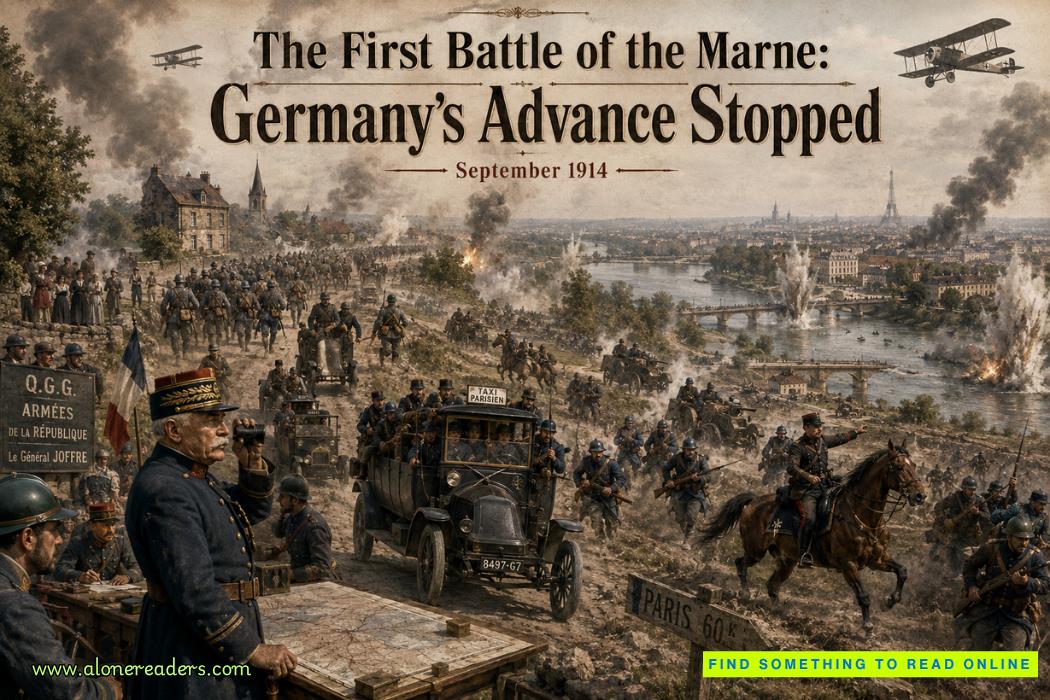
The decisive turning point arrived during the First Battle of the Marne, fought between 5 and 12 September 1914. Rather than sweeping west of Paris as originally intended, elements of the German First Army turned southeast, creating a dangerous gap between German armies. French commander General Joseph Joffre recognized the opportunity and ordered a major counteroffensive. French reserves, famously transported partly by Paris taxicabs, joined British forces in attacking the exposed German flank.
The resulting battle forced German commanders to halt their advance and retreat northward to the Aisne River. The hoped-for encirclement of Paris had failed, and France remained in the war. The Schlieffen Plan, designed to achieve a quick victory within weeks, had effectively collapsed.
Following the retreat from the Marne, neither side achieved a decisive breakthrough. Instead, both armies attempted to outflank one another in a series of operations known as the Race to the Sea. These maneuvers ultimately produced an unbroken line of trenches stretching from the English Channel to the Swiss frontier. The mobile campaign envisioned by Schlieffen gave way to trench warfare, which dominated the Western Front for the next four years.
Historians have long debated why the Schlieffen Plan failed. One explanation emphasizes Belgian resistance, which delayed German progress and disrupted operational schedules. Others point to Britain's unexpected and rapid intervention, Russian mobilization occurring sooner than anticipated, Moltke's modifications to the original plan, inadequate logistical planning, or unrealistic assumptions regarding troop endurance and battlefield conditions. Most modern scholars conclude that the failure resulted from a combination of these factors rather than a single decisive mistake.
The invasion of Belgium also produced far-reaching political consequences. Britain's participation transformed a continental war into a global conflict because the British Empire encompassed territories across every inhabited continent. Canada, Australia, New Zealand, India, South Africa, and numerous colonies entered the war alongside Britain. Belgium itself became a powerful symbol of resistance against aggression, with the phrase "Brave Little Belgium" appearing frequently in Allied newspapers and recruitment campaigns.
From a military perspective, the failure of the Schlieffen Plan fundamentally changed the nature of World War I. Germany now confronted the very situation it had sought to avoid: a prolonged two-front war against France, Britain, Russia, and eventually many additional Allied nations. Resources had to be divided between east and west, while economic exhaustion, manpower shortages, and naval blockades steadily weakened the Central Powers.
The plan nevertheless demonstrated remarkable organizational sophistication. Coordinating the movement of more than a million soldiers across Europe using early twentieth-century technology required extraordinary logistical preparation. Railway timetables, supply depots, communication systems, engineering units, and mobilization schedules represented some of the most advanced military planning of the era. Yet the campaign also illustrated the limitations of rigid operational plans when confronted with the unpredictable realities of war.
Ultimately, Germany's Schlieffen Plan remains one of history's most studied military strategies because its success or failure determined the opening phase of World War I. Conceived to deliver a swift and decisive victory, it instead produced a prolonged conflict that neither side had anticipated. The invasion of Belgium not only brought Britain into the war but also demonstrated that military calculations could not fully account for political commitments, national resistance, logistical challenges, and human determination. Its failure ensured that World War I would become not a brief campaign decided in weeks, but a devastating global struggle that reshaped the twentieth century.



 The Hundred Days Offensive: How the Allies Defeated Germany in World War I
 The Second Battle of the Marne: The Turning Point of World War I in 1918
 The Spring Offensive of 1918: Germany's Final Gamble to Win World War I
 The Treaty of Brest-Litovsk: How Russia Left World War I
 The Russian Revolution and World War I: How War Brought Down the Tsar
 The Zimmermann Telegram Explained: Germany's Secret Offer to Mexico in World War I










