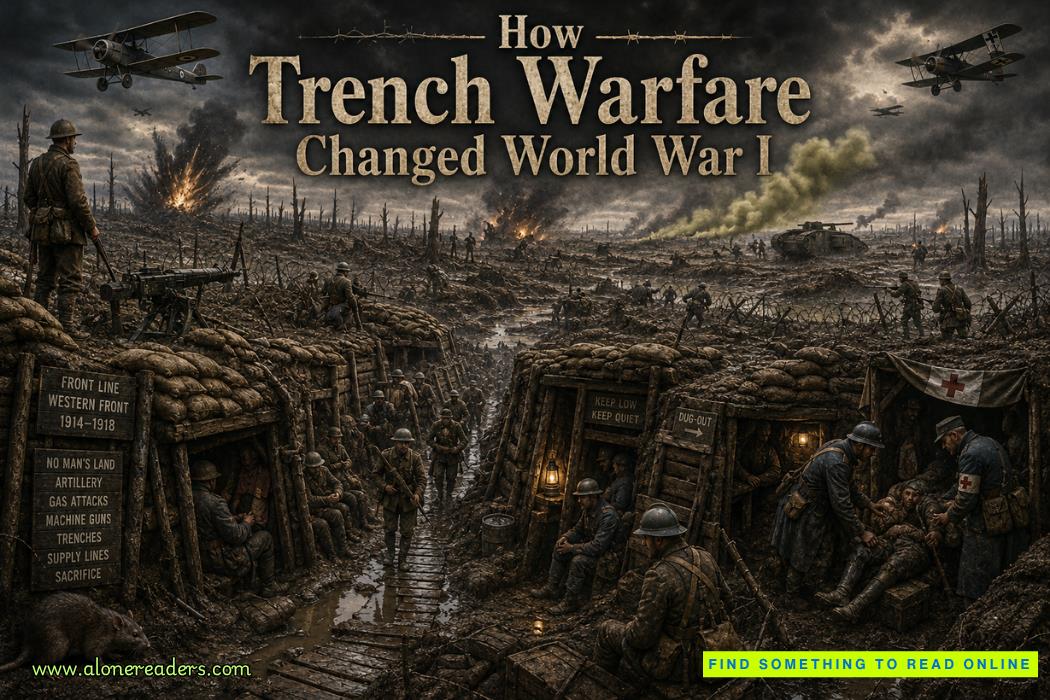
When Europe entered World War I in August 1914, political leaders, military commanders, and ordinary soldiers expected a short, fast-moving conflict. Germany believed the Schlieffen Plan would defeat France within weeks. France expected rapid offensive victories under Plan XVII, while Russia anticipated swift advances in the east. Instead, after only a few months of fighting, the armies became locked in a defensive deadlock unlike anything previously experienced. The rapid campaigns of 1914 ended with both sides digging thousands of miles of trenches stretching from the English Channel to the Swiss frontier. Trench warfare became the defining feature of World War I, transforming military strategy, daily life for soldiers, technological innovation, and the entire nature of modern warfare. Rather than deciding the war through swift maneuver, trench warfare created a brutal struggle of endurance, industrial production, and attrition that lasted more than four years.
The emergence of trench warfare was not the result of careful planning but rather a consequence of military technology outpacing battlefield tactics. During the nineteenth century, armies had often achieved victory through rapid advances, cavalry charges, and concentrated infantry assaults. By 1914, however, technological developments had dramatically increased the defensive power of armies. Machine guns could fire hundreds of rounds per minute, heavy artillery could bombard enemy positions from many kilometers away, rapid-fire rifles offered unprecedented accuracy, and barbed wire created deadly obstacles for attacking infantry. These innovations made defending a position far easier than capturing one, forcing both sides to seek protection underground.
The turning point came after the First Battle of the Marne in September 1914. Germany's advance toward Paris had been halted, and neither side possessed sufficient strength to outflank the other. During the subsequent Race to the Sea, both armies repeatedly attempted to move around their opponent's northern flank. Each maneuver was countered by corresponding defensive movements until a continuous front emerged. Soldiers began digging trenches as temporary defensive positions, but these quickly evolved into permanent fortifications. By late 1914, an interconnected trench system stretched approximately 700 kilometers across the Western Front, creating one of history's most formidable military barriers.
The trench system itself became extraordinarily sophisticated. It consisted of far more than a single ditch in the ground. The front-line trench served as the primary defensive position facing the enemy. Behind it lay support trenches, where reserve troops waited to reinforce the front or replace exhausted units. Further to the rear stood reserve trenches, which provided additional defensive depth and housed larger concentrations of soldiers. These trenches were connected by communication trenches, allowing troops, ammunition, food, and medical personnel to move relatively safely between positions without exposure to enemy fire.
Military engineers carefully designed trenches in a zigzag pattern rather than straight lines. This arrangement prevented explosions or enemy soldiers from affecting long stretches of trench simultaneously. If attackers entered one section, defenders could isolate them by fighting around each bend. The trench walls were strengthened using timber, sandbags, corrugated iron, and woven branches, while duckboards placed along the floor helped soldiers walk above the mud whenever possible.
Immediately in front of the trenches stretched the infamous No Man's Land, a devastated strip of ground separating opposing armies. Its width varied from less than fifty meters to several hundred meters depending on the location. The landscape became covered with shell craters, shattered trees, broken equipment, corpses, tangled barbed wire, and unexploded ammunition. Crossing this exposed area during an attack meant advancing under relentless machine-gun fire, rifle fire, artillery bombardment, and sniper observation. No Man's Land became one of the most dangerous places on Earth, symbolizing the horror and futility of trench warfare.
Daily life inside the trenches proved extraordinarily difficult. Soldiers rarely remained continuously on the front line, instead rotating between front-line positions, support trenches, and rest areas. Even so, periods spent in the trenches exposed them to constant danger. Heavy rain frequently flooded trenches, transforming them into rivers of mud. During winter, freezing temperatures caused frostbite and hypothermia, while summer heat encouraged disease and the spread of insects. Many soldiers later recalled that surviving the environment itself often seemed as challenging as facing the enemy.
Poor sanitation created additional hardships. Human waste, decaying food, dead animals, and stagnant water attracted enormous numbers of rats, some growing exceptionally large after feeding on battlefield remains. Soldiers also battled lice, which infested clothing and bedding, causing intense itching and spreading trench fever. Medical officers struggled to control infections despite regular delousing efforts. One particularly dreaded condition was trench foot, caused by prolonged exposure to cold, wet conditions. Without proper treatment, severe cases sometimes required amputation.
Food and water supplies reached the front through hazardous supply routes. At night, carrying parties transported ammunition, rations, engineering materials, and medical supplies along communication trenches. Meals often consisted of preserved meat, hard biscuits, canned vegetables, tea, coffee, and occasionally fresh bread. Although military logistics generally improved as the war continued, front-line soldiers frequently complained about monotonous diets, cold meals, and shortages during heavy fighting.
Psychological strain became another defining characteristic of trench warfare. Soldiers lived under the constant threat of artillery bombardment, sniper fire, poison gas attacks, and sudden raids. Many spent days or weeks unable to sleep properly because of explosions, alarms, and continuous tension. Over time, prolonged exposure to combat produced severe psychological trauma known during the war as "shell shock." Victims suffered trembling, paralysis, nightmares, memory loss, anxiety, and emotional collapse. Today, many of these symptoms are recognized as forms of post-traumatic stress disorder (PTSD).
The greatest military challenge of trench warfare was breaking the defensive stalemate. Traditional infantry assaults repeatedly failed because attackers had to leave the safety of their trenches, cross No Man's Land, cut through barbed wire, and assault well-protected enemy positions under devastating fire. Machine guns often inflicted catastrophic casualties within minutes, while artillery bombardments rarely destroyed every defensive position as planners hoped.
To overcome these obstacles, military commanders developed increasingly elaborate offensive tactics. Before major assaults, artillery conducted prolonged bombardments lasting days or even weeks. The objective was to destroy enemy trenches, cut barbed wire, eliminate artillery batteries, and weaken defenders psychologically. However, many soldiers survived inside deep underground dugouts, emerging once the bombardment ended to man their machine guns. Furthermore, artillery frequently churned the battlefield into deep mud, making infantry advances even more difficult.
Among the most significant technological developments was the introduction of poison gas. Germany first employed chlorine gas on a large scale during the Second Battle of Ypres in 1915. Later, both sides used phosgene and mustard gas. Although gas sometimes caused panic and inflicted severe injuries, improvements in gas masks gradually reduced its battlefield effectiveness. Nevertheless, chemical warfare added a terrifying new dimension to trench combat, forcing soldiers to remain constantly alert for gas alarms.
Another innovation intended to overcome trench defenses was the tank. Introduced by Britain during the Battle of the Somme in 1916, early tanks could cross trenches, crush barbed wire, and provide armored protection for advancing infantry. Although mechanically unreliable and relatively slow, tanks demonstrated the potential to restore battlefield mobility. Combined with aircraft, artillery coordination, and improved infantry tactics, tanks gradually changed the nature of warfare during the later years of the conflict.
Aircraft also evolved rapidly because of trench warfare. Initially used primarily for reconnaissance, airplanes photographed enemy trenches, identified troop movements, and directed artillery fire with increasing accuracy. Fighter aircraft emerged to prevent enemy observation, while bombers attacked railways, supply depots, and industrial targets. Control of the skies became increasingly important because information gathered from aerial reconnaissance often determined the success or failure of ground operations.
Some of the bloodiest battles in military history resulted directly from trench warfare. At Verdun in 1916, France and Germany fought for nearly ten months, suffering approximately 700,000 casualties without significant territorial changes. The Battle of the Somme, launched partly to relieve pressure on Verdun, became infamous after British forces suffered around 57,000 casualties on the first day alone. Passchendaele, also known as the Third Battle of Ypres, transformed into a nightmare of mud, shell craters, and relentless artillery bombardment. These battles illustrated how trench warfare often exchanged enormous human losses for only minimal territorial gains.
Despite its horrors, trench warfare encouraged important military adaptations. Commanders gradually abandoned mass infantry charges in favor of combined-arms operations, integrating artillery, infantry, engineers, tanks, and aircraft into coordinated offensives. Improved communication through field telephones, wireless equipment, signal lamps, carrier pigeons, and runners enhanced battlefield coordination. Small-unit tactics evolved, with specially trained assault troops infiltrating weak points rather than attacking heavily defended positions directly.
The economic demands of trench warfare were equally significant. Since quick victories proved impossible, success increasingly depended upon industrial production. Nations expanded factories to manufacture artillery shells, rifles, machine guns, tanks, uniforms, medical supplies, and millions of rounds of ammunition. Railways transported enormous quantities of equipment to the front, while civilian populations contributed through war industries, agricultural production, and financial support. Victory became as much an industrial achievement as a military one.
Trench warfare also transformed civilian society. Millions of women entered factories, transportation, agriculture, and government services as men fought at the front. Governments introduced rationing, censorship, propaganda campaigns, and centralized economic planning to sustain the war effort. Scientific research accelerated advances in medicine, surgery, communications, and engineering. Although born from necessity, many of these innovations continued influencing civilian life long after the war ended.
The stalemate finally began to break during 1918. Improved Allied coordination under General Ferdinand Foch, increasing numbers of tanks, more effective combined-arms tactics, and the arrival of fresh American troops shifted the balance against Germany. During the Hundred Days Offensive, Allied forces achieved sustained advances impossible during earlier years of trench warfare. Germany, weakened by blockade, manpower shortages, and declining morale, could no longer maintain its defensive positions. The Armistice signed on 11 November 1918 ended more than four years of brutal trench fighting.
The legacy of trench warfare extended far beyond World War I. Military planners around the world carefully studied its successes and failures, leading to major changes in doctrine during the interwar period. Future armies emphasized mobility, armored warfare, air power, mechanization, and rapid communication to avoid repeating the static conditions of the Western Front. The lessons learned in the trenches directly influenced the development of modern combined-arms warfare and shaped military strategy throughout the twentieth century.
Ultimately, trench warfare fundamentally changed World War I by transforming what was expected to be a short, decisive conflict into a prolonged war of attrition. It demonstrated the overwhelming defensive power of industrial-age technology while exposing the terrible human cost of outdated offensive tactics. Millions of soldiers endured unimaginable hardship in muddy trenches, facing constant danger from artillery, machine guns, disease, and psychological trauma. More than a century later, the trenches of the Western Front remain enduring symbols of sacrifice, endurance, and the devastating consequences of modern industrial warfare, reminding future generations that technological progress without corresponding strategic adaptation can produce catastrophic human suffering.




 The Hundred Days Offensive: How the Allies Defeated Germany in World War I
 The Second Battle of the Marne: The Turning Point of World War I in 1918
 The Spring Offensive of 1918: Germany's Final Gamble to Win World War I
 The Treaty of Brest-Litovsk: How Russia Left World War I
 The Russian Revolution and World War I: How War Brought Down the Tsar
 The Zimmermann Telegram Explained: Germany's Secret Offer to Mexico in World War I










