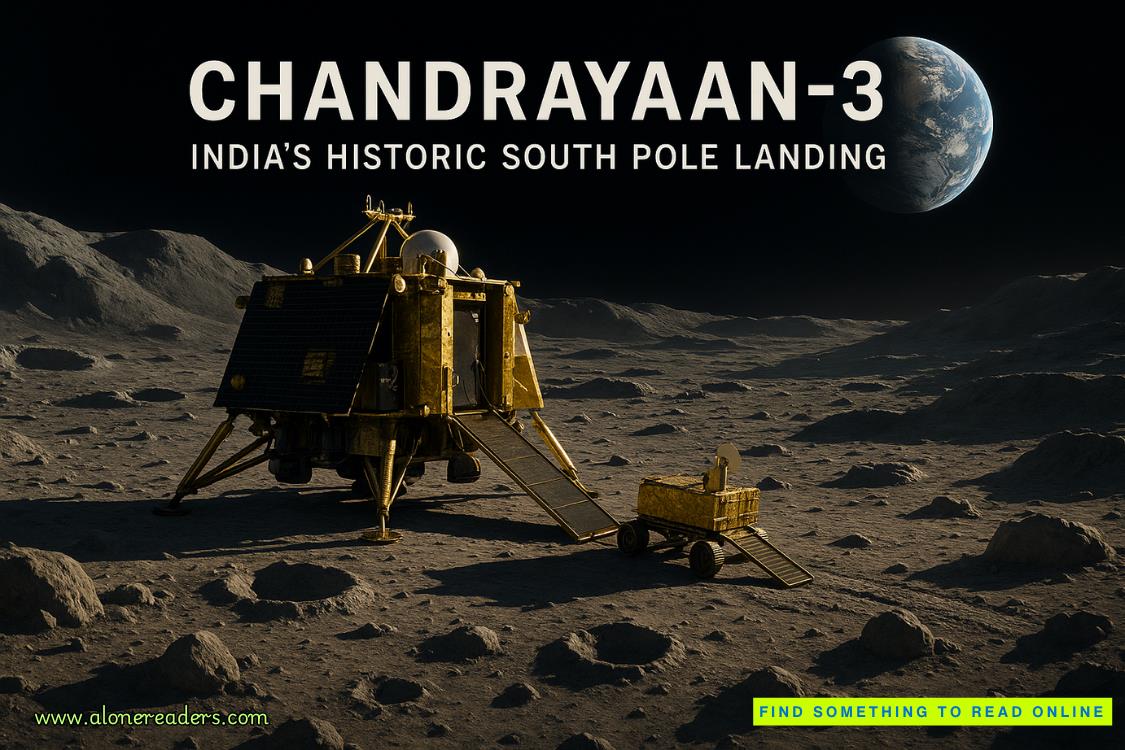
India’s Chandrayaan-3 mission stands as one of the most consequential milestones in modern space exploration, not only for the Indian Space Research Organisation but for the global scientific community. Its successful soft landing near the Moon’s south pole marked a decisive moment in lunar exploration, an area long considered technologically daunting and scientifically invaluable. Unlike symbolic achievements driven primarily by prestige, Chandrayaan-3 was engineered as a mission of methodical precision, technological validation, and targeted science objectives focused on one of the most complex regions of the lunar surface.
The Moon’s south pole has drawn intense interest from space agencies worldwide because of its unique geography and resource potential. Unlike equatorial regions, the south pole contains permanently shadowed craters that have not seen sunlight for billions of years. These regions are believed to harbor water ice trapped within the regolith, a discovery with enormous implications for future human exploration, in-situ resource utilization, and sustained lunar presence. Chandrayaan-3 was India’s strategic entry into this frontier, emphasizing reliability, autonomy, and robust engineering over experimental ambition.
Chandrayaan-3 was conceived after the partial failure of Chandrayaan-2 in 2019, when the Vikram lander lost communication during its final descent. Rather than retreating or drastically redesigning the mission, ISRO adopted a disciplined, failure-informed approach. Every subsystem was reevaluated, stress-tested, and simplified where necessary. The mission architecture was deliberately focused on a lander-rover combination without an orbiter, relying instead on the operational Chandrayaan-2 orbiter for communication relay and data support. This decision reduced complexity and cost while maximizing scientific return.
At the heart of the mission was the Vikram lander, redesigned with enhanced landing legs, improved sensors, redundant altimeters, and upgraded guidance algorithms. The lander’s propulsion system was refined to allow greater control during descent, particularly during the critical “rough braking” and “fine braking” phases. Chandrayaan-3 demonstrated a fully autonomous landing capability, an essential requirement for operations in regions where real-time human intervention is impossible due to communication delays.
The landing sequence itself was a masterclass in controlled descent engineering. From an altitude of approximately 30 kilometers, Vikram initiated a complex braking maneuver to reduce its velocity while adjusting orientation. Unlike previous missions that followed more rigid descent profiles, Chandrayaan-3 employed adaptive algorithms capable of responding to real-time sensor inputs. This allowed the lander to assess terrain hazards, adjust thrust vectors, and identify a safe touchdown zone within a challenging landscape marked by craters, slopes, and uneven regolith.
Upon successful landing, India became the first nation to achieve a soft landing near the lunar south pole and the fourth country overall to soft-land on the Moon. This achievement carried both symbolic and practical significance. Symbolically, it reinforced India’s status as a major spacefaring nation capable of executing complex deep-space missions with comparatively modest budgets. Practically, it validated technologies critical for future missions, including human exploration, sample return, and long-duration surface operations.
Deployed from Vikram was the Pragyan rover, a compact but sophisticated mobile laboratory designed for in-situ analysis of the lunar surface. Despite its small size, Pragyan carried advanced instruments capable of performing elemental composition studies through spectroscopic techniques. Its primary objective was to analyze the chemical makeup of lunar soil and rocks in the south polar region, providing insights into the Moon’s geological evolution and validating hypotheses generated from orbital observations.
The rover’s mobility system was specifically designed for the lunar south pole’s extreme conditions. Low solar angles, sharp temperature gradients, and uneven terrain required a robust yet lightweight design. Pragyan’s six-wheel configuration allowed it to traverse short distances safely while maintaining stability. Although its operational lifespan was limited to one lunar day, the data collected during this period proved invaluable for understanding surface composition and thermal behavior.
One of the most significant outcomes of Chandrayaan-3 was its contribution to lunar science beyond resource exploration. Measurements related to surface temperature variations, plasma interactions, and near-surface seismic activity expanded scientific understanding of the Moon as a dynamic celestial body rather than a geologically inert object. These findings help refine models of lunar formation, internal structure, and long-term evolution.
Equally important was the mission’s demonstration of cost-effective space exploration. Chandrayaan-3 was developed with a budget significantly lower than comparable lunar missions by other space agencies. This efficiency was achieved through indigenous technology development, iterative engineering practices, and a tightly scoped mission profile. The success of Chandrayaan-3 challenged long-held assumptions that high-impact space missions require exorbitant expenditure, offering an alternative model rooted in precision engineering and strategic restraint.
From a geopolitical perspective, Chandrayaan-3 subtly reshaped the landscape of international space cooperation and competition. As multiple nations and private entities race toward the Moon with ambitions of resource utilization and permanent bases, India’s success near the south pole positioned it as a credible partner and stakeholder in future lunar governance discussions. The mission underscored that technological competence, not just economic scale, determines leadership in space exploration.
The mission also had profound implications for India’s domestic scientific ecosystem. Chandrayaan-3 inspired renewed interest in aerospace engineering, planetary science, robotics, and applied physics. It validated decades of institutional knowledge within ISRO while simultaneously encouraging innovation among private aerospace startups, academic institutions, and research laboratories. The mission’s success demonstrated the tangible outcomes of sustained investment in science and engineering education.
Technologically, Chandrayaan-3 served as a proving ground for systems that will underpin future missions, including the planned Chandrayaan-4 sample return concept and India’s long-term human spaceflight ambitions. Precision landing, surface mobility, autonomous decision-making, and environmental resilience are not isolated capabilities but foundational technologies required for establishing a sustained human presence beyond Earth.
The south pole landing also reframed scientific priorities for lunar exploration. Instead of focusing solely on historical geology, missions like Chandrayaan-3 emphasized applied planetary science with direct relevance to human survival and infrastructure development in extraterrestrial environments. Understanding regolith behavior, thermal stability, and potential water distribution is essential for designing habitats, energy systems, and life-support mechanisms on the Moon.
Chandrayaan-3’s legacy extends beyond data points and engineering diagrams. It represents a philosophical shift in how space missions are approached—where setbacks are treated as data, ambition is balanced with realism, and national pride is grounded in demonstrable capability. The mission reinforced the principle that exploration is a cumulative process, built on iterative learning rather than isolated triumphs.
In the broader narrative of human exploration, Chandrayaan-3 occupies a critical chapter. As humanity prepares to return to the Moon not as a destination but as a staging ground for deeper space exploration, missions like Chandrayaan-3 provide the empirical foundation upon which future endeavors will rely. Its success near the lunar south pole is not an endpoint but a gateway, opening new possibilities for science, collaboration, and the enduring human quest to understand and inhabit the cosmos.



 Château de Vincennes: France’s Forgotten Royal Fortress and Medieval Stronghold
 Château de Carcassonne: Europe’s Greatest Medieval Citadel and Fortress
 Château de Chenonceau: The Castle Built by Remarkable Women
 Château de Chambord: France’s Magnificent Renaissance Castle and Architectural Wonder
 Tehri Dam: India's Tallest Dam and the Debate Behind It
 Bhakra Nangal Dam: India's Temple of Modern Development