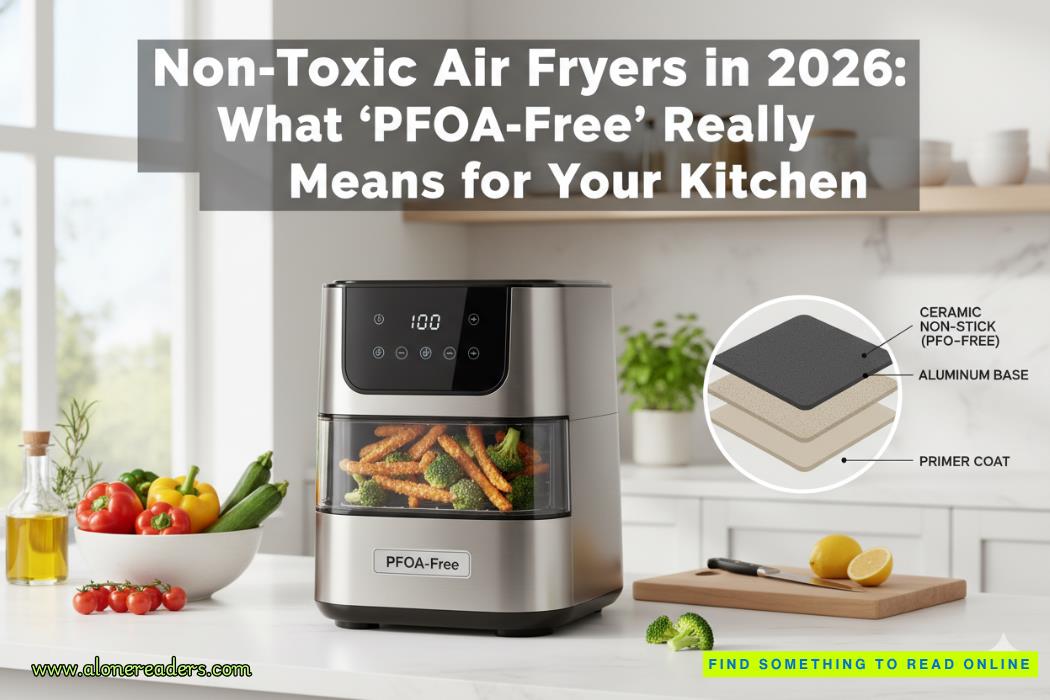
Air fryers have become a staple in modern kitchens, promising crispy textures with less oil and faster cooking times. But as awareness of chemical exposure grows, many consumers are asking a more serious question: Are air fryers actually safe?
The label “PFOA-free” is now everywhere—from product packaging to marketing campaigns. But in 2026, this claim is no longer enough on its own. Understanding what it truly means—and what it doesn’t—has become essential if you want a genuinely non-toxic cooking environment.
This article breaks down the science, the marketing, and the practical reality behind non-toxic air fryers so you can make informed decisions.
PFOA (perfluorooctanoic acid) was historically used in the manufacturing of non-stick coatings, particularly PTFE (commonly known as Teflon). It helped create smooth, durable surfaces that resist sticking and withstand high heat.
However, research over the past two decades linked PFOA exposure to several health concerns, including:
Due to these risks, PFOA has been largely phased out globally. By the mid-2020s, most reputable manufacturers eliminated it entirely.
But here’s the critical detail: removing PFOA doesn’t automatically make a product non-toxic.
In today’s market, “PFOA-free” simply means that a specific chemical—PFOA—is not used in the manufacturing process.
It does NOT mean:
Many air fryers still use PTFE-based coatings, just without PFOA. While PTFE itself is considered stable under normal cooking temperatures, it can degrade at very high heat (typically above 260°C), releasing fumes that may be harmful in poorly ventilated spaces.
So in 2026, “PFOA-free” is best understood as a baseline safety standard—not a premium guarantee.
To address growing consumer concerns, manufacturers have developed alternative coatings marketed as safer options. These include:
Ceramic-coated air fryers, in particular, have gained popularity. These coatings are made from inorganic minerals and do not rely on fluoropolymers like PTFE.
However, they come with trade-offs:
The key takeaway is that newer coatings reduce certain risks but introduce new considerations around durability and maintenance.
In 2026, the conversation has shifted from PFOA alone to PFAS (per- and polyfluoroalkyl substances), a broader group of thousands of synthetic chemicals.
Even if an air fryer is labeled “PFOA-free,” it may still contain other PFAS compounds unless explicitly stated otherwise.
Why this matters:
This is why you’ll now see terms like “PFAS-free” gaining traction—and why they are more meaningful than “PFOA-free” alone.
Air fryers operate by circulating hot air at high speeds, often reaching temperatures between 180°C and 200°C. While this is generally within safe limits for most coatings, certain factors can increase risk:
When coatings degrade, they can release microscopic particles or fumes. In most cases, occasional exposure is minimal, but repeated misuse can compound risks over time.
This makes proper usage just as important as material choice.
If you want to move beyond marketing claims and choose a genuinely safer appliance, focus on these criteria:
In 2026, transparency has become a major differentiator. Brands that openly disclose materials tend to be more trustworthy than those relying on vague claims.
There are a few persistent myths that need clarification:
“All air fryers are toxic.”
This is an exaggeration. Most modern air fryers meet safety standards when used correctly. The concern is about long-term exposure and material quality, not immediate danger.
“Ceramic is always safer.”
Not necessarily. While ceramic avoids PFAS, it can degrade faster and may still include additives depending on the manufacturer.
“Higher price means safer.”
Price often reflects brand positioning, not necessarily material safety. Some mid-range models offer better transparency than premium ones.
Even with the best air fryer, your habits matter. Here’s how to minimize potential risks:
Think of your air fryer as a system where both design and usage determine safety.
For most households, the shift toward non-toxic air fryers is less about fear and more about optimization.
You’re not just avoiding harmful chemicals—you’re:
In 2026, consumers are no longer satisfied with “good enough.” They want clarity, control, and confidence in everyday tools—and the kitchen is where that demand is most visible.
The industry is moving toward stricter regulations and clearer labeling. Expect to see:
As awareness grows, “PFOA-free” will likely become obsolete as a selling point—replaced by more meaningful and comprehensive safety indicators.
Choosing a non-toxic air fryer in 2026 isn’t about chasing perfection. It’s about understanding the details behind the labels and making decisions that align with your cooking habits and long-term health priorities.



 Work-Life Balance and Physical Health: How Daily Choices Shape the Body
 Overcoming Procrastination: Practical and Proven Strategies to Boost Productivity
 The Power of Positive Thinking: Transform Your Mindset, Transform Your Life
 Setting and Achieving Personal Goals: A Step-by-Step Specialist Guide
 Time Management Hacks: Proven Strategies for a Highly Productive Day
 Guru Purnima Quotes: Deep, Inspiring Messages to Honor Teachers and Spiritual Guides