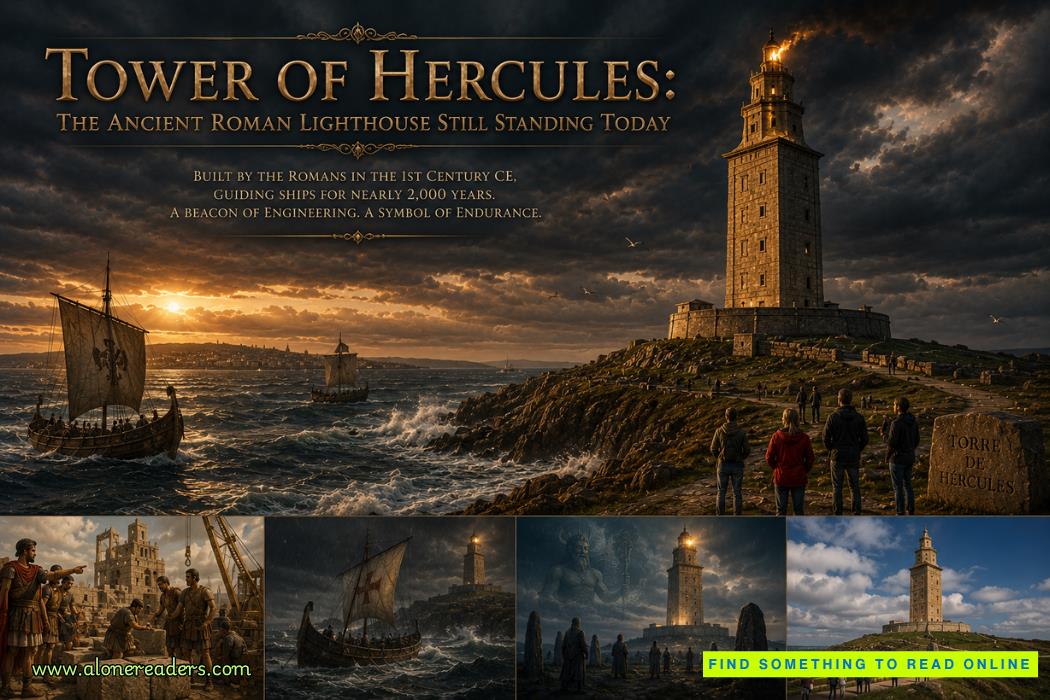
The history of maritime navigation is filled with legendary structures that once protected sailors from unseen coastlines, violent storms, and deadly reefs. Many ancient lighthouses vanished long ago, destroyed by earthquakes, war, erosion, or neglect. Yet among these lost wonders, one extraordinary monument continues to stand against the Atlantic winds almost two thousand years after its construction. The Tower of Hercules in northwestern Spain remains one of the most remarkable engineering survivals of the Roman world. More than simply an ancient lighthouse, it represents a continuous chain connecting Roman imperial expansion, medieval maritime trade, Atlantic exploration, and modern cultural heritage. It is the oldest functioning Roman lighthouse still standing anywhere on Earth.
Located near the city of A Coruña on the rugged coast of Galicia, the Tower of Hercules rises above cliffs facing the Atlantic Ocean. For centuries, sailors approaching the dangerous northwestern coast of the Iberian Peninsula relied upon its guiding light. The surrounding waters were historically feared for strong currents, rocky shorelines, and unpredictable weather systems generated by Atlantic storms. In such an environment, reliable coastal navigation could mean the difference between survival and catastrophe. The tower therefore became not merely an architectural achievement but a symbol of security, trade, and imperial power.
The origins of the Tower of Hercules date back to the height of the Roman Empire, most likely during the late first or early second century AD. Historians generally associate its construction with the reign of Emperor Trajan, though exact documentary evidence remains limited. Archaeological investigations suggest the lighthouse formed part of Rome’s broader effort to consolidate control over the northwestern Iberian coastline, a strategically valuable region connected to maritime commerce, mining operations, and military logistics.
Roman expansion into Hispania had transformed the Iberian Peninsula into one of the empire’s economically important territories. Galicia, although geographically remote from Rome itself, occupied a crucial position along Atlantic trade routes linking northern Europe, Britain, Gaul, and the western Mediterranean. Roman ships transporting metals, ceramics, wine, olive oil, and military supplies required safe passage through dangerous coastal waters. Establishing a lighthouse at A Coruña therefore served both commercial and strategic purposes.
Ancient inscriptions associated with the structure refer to an architect named Gaius Sevius Lupus, believed to have originated from present-day Portugal. His involvement illustrates the highly interconnected nature of Roman engineering culture, where architects, surveyors, and builders moved across provinces applying standardized construction techniques adapted to local environments. The lighthouse itself demonstrates this Roman mastery of practical engineering. Even after nearly two millennia of exposure to ocean winds, salt corrosion, and storms, the essential Roman core of the structure still survives.
The tower’s name, however, emerged much later through medieval mythology. According to local legend, the hero Hercules defeated the giant Geryon in this region and buried his severed head beneath the lighthouse. Medieval chroniclers connected the monument to this mythical narrative, eventually leading to the name “Tower of Hercules.” Although historically inaccurate, the legend became deeply embedded within Galician identity and reflects how ancient Roman monuments were reinterpreted through folklore long after the collapse of imperial authority.
One reason the Tower of Hercules became historically important was its geographic position at the edge of the Atlantic world. The northwestern Iberian coast represented a transitional zone between Mediterranean civilization and the open Atlantic Ocean. Roman navigators entering these waters encountered harsher weather systems, stronger tides, and longer stretches of exposed coastline compared to the relatively enclosed Mediterranean Sea. Lighthouses in such regions were indispensable.
The lighthouse also occupied an important position in the maritime communication network of the Roman Empire. Roman sea trade depended upon predictable navigation, and coastal beacons formed essential infrastructure supporting imperial commerce. Ships traveling between the Iberian Peninsula, Britain, and northern Gaul required reliable landmarks during both daytime and nighttime navigation. The Tower of Hercules functioned as one of the westernmost navigational markers within the Roman world, helping integrate distant Atlantic territories into Rome’s economic system.
Its importance did not disappear after the fall of Rome. Many Roman structures across Europe deteriorated during the political fragmentation of the early medieval period, yet the Tower of Hercules continued attracting attention because of its navigational value. Although maintenance became inconsistent, the structure remained visible and useful to mariners. Medieval Christian kingdoms, Viking raiders, fishermen, merchants, and later Atlantic explorers all recognized the strategic significance of this coastal beacon.
During the medieval era, the region surrounding A Coruña gradually evolved into a growing maritime center. Pilgrimage routes to Santiago de Compostela increased movement across Galicia, while Atlantic trade expanded between Iberia, England, France, and northern Europe. The lighthouse became associated not only with navigation but also with regional identity. Sailors approaching the coast viewed the tower as both a practical landmark and a symbol of arrival.
By the early modern period, the Atlantic Ocean had become central to global exploration and empire-building. Spain’s maritime ambitions stretched across the Americas, Africa, and Asia. In this changing world, the Tower of Hercules gained renewed significance. Although newer navigation technologies emerged, coastal lighthouses remained essential for guiding vessels through dangerous waters. The survival of the Roman tower allowed it to continue serving a practical maritime function centuries after the civilization that built it had vanished.
Architecturally, the Tower of Hercules represents one of the most fascinating surviving examples of Roman civil engineering. Unlike many ancient monuments preserved mainly as ruins, this lighthouse still retains much of its original structural essence beneath later renovations. The existing tower rises approximately 55 meters above sea level and dominates the surrounding coastline. While exterior modifications during the eighteenth century altered its visible appearance, the Roman internal masonry remains largely intact.
The original Roman design likely featured a square-based multi-level structure constructed from granite blocks sourced locally. Roman engineers excelled at combining durability with functional simplicity, and the lighthouse reflects this philosophy. Thick stone walls provided stability against coastal winds while supporting the vertical load of the tower itself. Interior chambers and stairways allowed workers to transport fuel upward to the beacon platform.
Ancient lighthouses required continuous human operation. Unlike modern automated systems, Roman beacon towers depended on laborers maintaining fires throughout the night. Wood, charcoal, or other combustible materials had to be carried to the upper platform repeatedly. The Tower of Hercules therefore functioned not merely as a static monument but as a living operational system requiring coordination, maintenance, and constant attention.
One particularly remarkable feature of the structure is its survival despite relentless environmental exposure. Atlantic coastlines create extremely corrosive conditions for buildings. Salt-laden winds gradually erode stone surfaces, while storms generate constant structural stress. Over centuries, countless coastal fortifications, ports, and towers disappeared under these conditions. Yet the Tower of Hercules endured because of the extraordinary strength of Roman construction methods combined with periodic restoration efforts by later societies.
The eighteenth-century renovation led by architect Eustaquio Giannini significantly reshaped the tower’s external appearance while preserving its Roman core. This restoration introduced a neoclassical exterior facade that still defines the monument today. Importantly, rather than demolishing the ancient structure, the renovation encased and protected much of the Roman masonry. This decision inadvertently contributed to the tower’s long-term preservation.
The lighthouse’s engineering importance extends beyond architecture alone. It demonstrates Rome’s advanced understanding of maritime infrastructure and geographic strategy. Building a durable lighthouse on an exposed Atlantic cliff required careful planning regarding visibility, structural stability, and accessibility. Roman surveyors selected a location maximizing the beacon’s visibility to approaching ships while ensuring the structure could withstand severe weather conditions.
Its role in navigation remained central throughout its existence. Before modern GPS systems, radar, or electronic communication, mariners depended heavily upon visible coastal landmarks. Lighthouses represented technological lifelines in an uncertain maritime environment. The Tower of Hercules served as a reference point helping sailors determine coastal proximity, avoid reefs, and navigate safely toward harbor entrances.
Navigation in ancient and medieval times involved a combination of astronomy, coastal observation, experience, and environmental awareness. During poor weather or nighttime travel, lighthouse beacons dramatically increased survival chances. The waters surrounding Galicia were especially dangerous because Atlantic storms could rapidly reduce visibility and drive ships toward rocky shores. A strong elevated beacon therefore provided essential warning and orientation.
The tower also played psychological roles for sailors enduring long Atlantic voyages. After days or weeks at sea, sighting a lighthouse represented relief, safety, and connection to civilization. In this sense, the Tower of Hercules functioned not only as infrastructure but also as a symbol of hope. Its light communicated stability in a world dominated by unpredictable oceans.
As maritime technology evolved, the lighthouse adapted alongside changing navigation systems. Improvements in optics, fuel systems, and illumination methods gradually enhanced its operational effectiveness. Yet despite technological modernization, the ancient structure itself remained the centerpiece of the site. Few engineering works anywhere in the world can claim such continuous functional relevance across nearly two thousand years.
In modern times, the Tower of Hercules has become one of Spain’s most celebrated historical landmarks. Its recognition as a UNESCO World Heritage Site in 2009 acknowledged both its exceptional preservation and its global cultural significance. UNESCO emphasized the monument’s status as the only fully preserved Roman lighthouse still used for maritime signaling purposes.
Today, visitors traveling to A Coruña encounter far more than an isolated ancient building. The surrounding landscape has been transformed into a cultural and recreational area featuring coastal walking paths, sculpture parks, archaeological remains, and panoramic ocean views. The tower dominates the scenery much as it did in Roman times, creating a powerful visual connection between antiquity and the present.
Tourism associated with the Tower of Hercules has grown steadily because the monument appeals to multiple interests simultaneously. History enthusiasts admire its Roman origins. Architecture specialists study its layered structural evolution. Maritime historians value its navigational legacy. Travelers seeking dramatic coastal scenery are drawn by the Atlantic environment surrounding the site.
Climbing the interior staircase offers visitors a direct physical encounter with history. Inside, sections of Roman foundations and structural elements remain visible, allowing tourists to appreciate the engineering sophistication of ancient builders. From the top, sweeping views of the Atlantic coastline reveal precisely why Roman planners selected this location nearly two millennia ago. The visual command over surrounding waters remains extraordinary.
The monument also holds immense symbolic value for Galicia itself. The Tower of Hercules appears prominently in the coat of arms of A Coruña and functions as a regional cultural icon. Its survival represents continuity across centuries of political transformation, from Roman imperial administration to medieval kingdoms, early modern empires, and contemporary Spain.
Local legends surrounding the tower continue contributing to its cultural atmosphere. Stories linking Hercules to the monument blend mythology with regional identity, creating an interpretive layer extending beyond strict historical analysis. Such legends demonstrate how ancient monuments often acquire new meanings across generations. The tower therefore exists simultaneously as Roman infrastructure, medieval legend, maritime landmark, and modern tourist destination.
Conservation efforts remain critically important because coastal environments continue threatening the structure. Salt exposure, tourism pressure, wind erosion, and climate-related environmental changes require ongoing preservation management. Specialists carefully monitor the monument to ensure that increased tourism does not damage the fragile historical fabric. Balancing public accessibility with long-term conservation presents a major challenge for heritage authorities.
The Tower of Hercules ultimately stands as a rare example of functional immortality in architecture. Many ancient monuments survive only as ruins disconnected from their original purposes. This lighthouse, however, continues serving the same essential role envisioned by Roman engineers nearly two thousand years ago: guiding vessels safely along a dangerous coastline. Its endurance transforms it from a mere archaeological relic into a living continuation of ancient maritime history.
Few structures anywhere in the world communicate the persistence of human engineering so powerfully. The lighthouse has witnessed Roman expansion, barbarian invasions, medieval trade, Viking activity, Atlantic exploration, imperial warfare, industrialization, and the digital age. Civilizations rose and collapsed around it, yet the tower remained fixed against the Atlantic horizon.
For modern visitors standing beneath its stone walls, the experience is more than historical sightseeing. The monument creates an almost surreal awareness of time itself. The same ocean winds felt by Roman sailors still strike the cliffs today. The same coastline visible to ancient navigators continues stretching into the Atlantic. And above it all, the Tower of Hercules still rises as a beacon of continuity, resilience, and human ambition.
In the broader story of world lighthouses, many towers achieved fame through size, beauty, or technological innovation. Yet the Tower of Hercules possesses something even rarer: uninterrupted survival. It remains a bridge between ancient engineering and the modern world, proving that exceptional design, strategic importance, and continuous adaptation can allow a structure to transcend the centuries.



 Château de Vincennes: France’s Forgotten Royal Fortress and Medieval Stronghold
 Château de Carcassonne: Europe’s Greatest Medieval Citadel and Fortress
 Château de Chenonceau: The Castle Built by Remarkable Women
 Château de Chambord: France’s Magnificent Renaissance Castle and Architectural Wonder
 Tehri Dam: India's Tallest Dam and the Debate Behind It
 Bhakra Nangal Dam: India's Temple of Modern Development