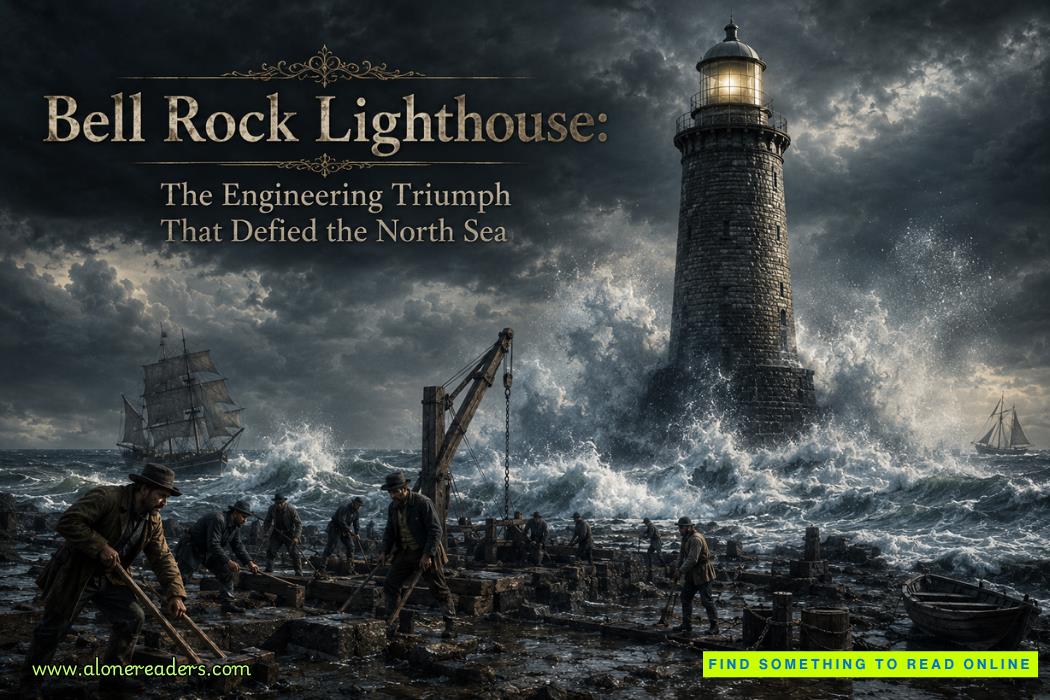
The history of the Bell Rock Lighthouse is one of the most extraordinary engineering stories ever written in the maritime world. Rising from the dangerous reefs of the North Sea off the coast of Scotland, the lighthouse became a symbol of human determination against one of nature’s harshest environments. Built on a reef that disappeared beneath the sea for most of the day, the structure was considered nearly impossible to construct during the early nineteenth century. Yet despite relentless storms, crushing tides, isolation, and the technological limitations of the era, engineers and workers succeeded in creating what would become one of the oldest surviving sea-washed lighthouses in the world. Bell Rock Lighthouse was not merely a navigational aid; it represented a turning point in civil engineering, maritime safety, and coastal infrastructure.
The reef upon which the lighthouse stands was historically known as the Inchcape Reef, a massive sandstone hazard located approximately eleven miles off the coast of Angus in eastern Scotland. For centuries, the reef had terrorized sailors navigating the North Sea routes between Scotland and northern Europe. During low tide, parts of the reef briefly emerged above water, but for most of the tidal cycle it remained submerged beneath the waves, invisible to approaching ships. This created one of the deadliest maritime traps in British waters. Countless vessels were destroyed upon impact with the hidden rocks, often during storms or fog when visibility became nearly nonexistent.
The danger of the reef became deeply embedded in Scottish maritime folklore. One famous legend tells of an abbot who supposedly installed a warning bell on the reef during the Middle Ages so sailors could hear the hazard during rough weather. According to the story, a pirate removed the bell out of spite, only to later perish on the same reef himself. This tale later inspired Robert Southey’s famous poem “The Inchcape Rock,” which helped immortalize the danger of Bell Rock in popular imagination. While parts of the legend remain uncertain, the deadly reality of the reef was undeniable. Historical shipping records documented devastating losses over centuries, making the reef notorious among mariners.
The event that ultimately accelerated the construction of the lighthouse occurred in 1799 when the British warship HMS York struck the reef and sank with the loss of hundreds of lives. The tragedy shocked Britain and intensified calls for a permanent navigational solution. Maritime commerce during this period was rapidly expanding due to industrialization and imperial trade, making safe navigation increasingly important. The North Sea represented a vital commercial artery connecting Scotland, England, Scandinavia, and continental Europe. Every ship lost on Bell Rock carried not only human tragedy but also economic consequences.
The man who transformed the impossible dream into reality was the Scottish engineer Robert Stevenson, grandfather of the famous writer Robert Louis Stevenson. Stevenson was already respected for his engineering skills, but Bell Rock would become the defining achievement of his career. When he proposed building a permanent stone lighthouse directly on the submerged reef, many critics considered the idea unrealistic or suicidal. No major lighthouse of this kind had ever been successfully constructed under such extreme conditions in open sea. Workers would have only a few hours each day to stand on the exposed reef before the tide swallowed the construction site again.
Stevenson approached the challenge with remarkable scientific precision and organizational discipline. Inspired partly by the successful Eddystone Lighthouse designed by John Smeaton off the coast of England, Stevenson adapted and expanded engineering techniques for even harsher conditions. He understood that the structure had to behave almost like a natural extension of the reef itself. Instead of resisting the sea with rigid vertical surfaces, the lighthouse would use a curved profile designed to deflect and absorb wave energy.
Construction officially began in 1807 and immediately revealed the severity of the undertaking. Workers could access the reef only during short low-tide windows, sometimes as brief as two or three hours. Every tool, stone block, timber beam, and supply had to be carefully transported by boat from the mainland. Sudden storms frequently interrupted operations, and dangerous seas could isolate the workers for days. Because traveling back and forth daily became impractical, Stevenson introduced a floating barracks system using anchored ships to house workers near the site. Eventually, temporary wooden structures were erected directly on the reef to allow workers to remain closer to the construction zone.
The engineering logistics were astonishing for the early nineteenth century. Massive interlocking granite and sandstone blocks were precisely cut onshore and numbered individually before transport. Each stone was designed to lock tightly into surrounding blocks using dovetail joints and marble plugs, creating extraordinary structural stability. This technique ensured the lighthouse would function almost as a single monolithic unit capable of surviving the immense forces of the North Sea. The precision required was extraordinary because even minor errors could weaken the entire structure.
The foundation phase represented the most dangerous stage of construction. Workers drilled and shaped the reef surface while racing against incoming tides. Waves frequently swept across the worksite with little warning, forcing rapid evacuations. Equipment was occasionally lost to the sea, and workers constantly faced the risk of drowning. Despite these conditions, Stevenson maintained strict operational discipline and detailed scheduling. His meticulous planning became one of the project’s defining strengths.
The lighthouse’s architectural design combined functionality with elegance. The tapered cylindrical tower rose approximately 115 feet above the reef and featured thick masonry walls capable of enduring relentless wave impacts. The lower portion of the structure was solid stone, providing immense weight and stability. Higher levels contained living quarters, storage areas, and operational rooms for lighthouse keepers. The graceful curved exterior became not only aesthetically striking but also structurally critical in minimizing wave resistance.
One of the most remarkable achievements of Bell Rock Lighthouse was its survival strategy against storm waves. During violent North Sea storms, waves could explode against the tower with tremendous force, sending spray hundreds of feet into the air. The lighthouse was intentionally designed so that waves would flow around and upward rather than strike flat surfaces directly. This hydrodynamic understanding represented a major leap in maritime engineering knowledge.
The lantern system itself was another technological triumph. Early illumination used an advanced array of parabolic reflectors and oil lamps designed to maximize visibility across dangerous waters. The powerful light became a lifeline for sailors navigating Scotland’s eastern coast. Before modern GPS and electronic navigation systems, lighthouse beams represented the difference between survival and catastrophe. Bell Rock’s light could pierce darkness, storms, and fog, warning ships away from the deadly reef below.
Construction was completed in 1810 after roughly three years of relentless labor. The successful illumination of the lighthouse marked a historic moment in engineering history. Many contemporaries viewed the completed tower with awe because it stood where logic had once suggested permanent construction was impossible. Stevenson himself regarded Bell Rock as his greatest achievement, and the structure rapidly gained international admiration among engineers and maritime authorities.
The lighthouse immediately transformed navigation in the region. Shipping losses around the Inchcape Reef declined dramatically, and confidence in North Sea trade routes improved substantially. Merchant vessels transporting coal, timber, textiles, grain, and industrial goods could navigate with far greater security. Naval operations also benefited because warships traveling along the Scottish coast no longer faced the same catastrophic risks. Bell Rock Lighthouse effectively turned one of Britain’s deadliest maritime hazards into one of its safest navigational corridors.
Life for lighthouse keepers at Bell Rock was extraordinarily demanding. The isolated tower stood surrounded by open sea, completely exposed to harsh weather conditions. Keepers often endured weeks of isolation during storms when supply boats could not approach. Daily responsibilities included maintaining the lantern apparatus, cleaning reflectors, monitoring fuel supplies, recording weather observations, and ensuring the light never failed. Any mistake could result in maritime disaster.
Storms at Bell Rock became legendary among lighthouse crews. During severe winter gales, waves sometimes engulfed large portions of the tower. The building could vibrate under the impact of enormous seas, while thunderous sounds echoed through the stone interior. Keepers described nights when the entire structure seemed surrounded by mountains of black water illuminated only by lightning and the rotating lantern beam. Yet the lighthouse consistently endured conditions that destroyed countless ships nearby.
The engineering success of Bell Rock influenced lighthouse construction worldwide. Stevenson’s techniques demonstrated that permanent masonry structures could survive even the most hostile marine environments. His methods inspired future offshore lighthouse projects across Europe and North America. The project also helped establish new standards in civil engineering project management, logistics, and maritime construction safety.
Beyond its engineering importance, Bell Rock Lighthouse became a cultural symbol of Scottish resilience and ingenuity. Artists, writers, and historians frequently portrayed the lonely tower rising from stormy seas as a testament to humanity’s struggle against nature. The lighthouse captured public imagination because it represented courage, intellect, and perseverance in one of the world’s harshest environments.
Technological modernization gradually changed the lighthouse over the following centuries. Oil lamps eventually gave way to more advanced lighting systems, including gas illumination and later electric technology. Automation reduced the need for permanent keeper presence, reflecting broader changes in lighthouse operations worldwide. Eventually, Bell Rock became fully automated, ending the long era of isolated human habitation within the tower.
Despite modernization, the lighthouse has retained much of its original architectural integrity. This durability is itself a remarkable achievement considering the relentless punishment delivered by the North Sea for more than two centuries. Many marine structures built long after Bell Rock have deteriorated more rapidly, highlighting the brilliance of Stevenson’s engineering decisions. The lighthouse remains one of the clearest demonstrations that intelligent design and craftsmanship can outlast generations.
In the modern era, Bell Rock Lighthouse holds immense historical and tourism value. Although direct public access is limited because of its offshore location and dangerous surroundings, the lighthouse attracts historians, maritime enthusiasts, photographers, and engineers from around the world. Boat tours from the Scottish coast occasionally allow visitors to observe the structure from nearby waters, offering dramatic views of the tower rising from the sea exactly as sailors have seen it for generations.
Museums and heritage organizations in Scotland preserve extensive materials related to the lighthouse’s history, including engineering drawings, construction records, models, and artifacts. The story of Robert Stevenson and his workforce continues to be studied in engineering schools as an example of visionary project execution under extreme environmental constraints. Bell Rock also remains operational, continuing its original mission of protecting ships navigating the North Sea.
Modern satellite navigation may have reduced reliance on traditional lighthouses, yet Bell Rock retains enduring symbolic power. Unlike digital systems hidden within electronics, the lighthouse stands physically visible against the sea, reminding observers of a time when navigation depended upon human ingenuity, courage, and mechanical precision. Its survival through centuries of storms reinforces its reputation as one of the greatest engineering achievements of the nineteenth century.
Perhaps the most extraordinary aspect of Bell Rock Lighthouse is not merely that it was built, but that it was built so early in industrial history. Workers possessed no helicopters, no modern cranes, no reinforced concrete, no advanced weather forecasting systems, and no computerized engineering simulations. Yet through mathematics, craftsmanship, disciplined organization, and sheer determination, they constructed a structure that still stands more than two hundred years later. That achievement transformed Bell Rock from a functional lighthouse into a monument of human capability.
Today, when viewed against the dark waters of the North Sea, Bell Rock Lighthouse still evokes the same emotions it inspired in nineteenth-century sailors: relief, admiration, and awe. Its light continues to shine over the dangerous reef beneath the waves, fulfilling the mission envisioned by Robert Stevenson generations ago. The tower remains not only a guardian of ships but also a permanent reminder that even the harshest natural obstacles can be overcome through intelligence, engineering innovation, and relentless perseverance.



 Château de Vincennes: France’s Forgotten Royal Fortress and Medieval Stronghold
 Château de Carcassonne: Europe’s Greatest Medieval Citadel and Fortress
 Château de Chenonceau: The Castle Built by Remarkable Women
 Château de Chambord: France’s Magnificent Renaissance Castle and Architectural Wonder
 Tehri Dam: India's Tallest Dam and the Debate Behind It
 Bhakra Nangal Dam: India's Temple of Modern Development