The history of maritime navigation is filled with tales of catastrophe, courage, and innovation, but few structures embody all three as completely as the Eddystone Lighthouse. Rising from a cluster of treacherous rocks in the English Channel, southwest of Plymouth in England, the lighthouse became one of the most important engineering achievements in maritime history. More than merely a navigational aid, it transformed the philosophy of lighthouse construction and fundamentally reshaped how coastal nations protected sailors from deadly waters. For centuries, the Eddystone Rocks represented terror to mariners. Hidden beneath violent Atlantic swells and positioned directly in a heavily traveled shipping route, the rocks destroyed countless vessels attempting to navigate between the English Channel and the open Atlantic Ocean. The eventual success of the lighthouse standing there was not simply an architectural triumph; it was a declaration that engineering could conquer even the most hostile environments on Earth.
Before the construction of the first lighthouse, the Eddystone Rocks were notorious among sailors. Located approximately fourteen miles south of Plymouth, the reef was submerged during high tides and exposed only partially during calmer conditions. Storms in the region were exceptionally violent, especially during winter months, when massive Atlantic waves crashed into the rocks with devastating force. Ships approaching England from Europe, the Mediterranean, or the Americas frequently encountered dangerous weather near this stretch of coast. Navigational technology during the seventeenth century was primitive by modern standards, and captains often depended on visual references to avoid disaster. Without a lighthouse warning of the hidden reef, vessels regularly smashed against the rocks, leading to catastrophic loss of life and cargo.
The increasing importance of maritime trade during the late seventeenth century placed enormous pressure on English authorities to address the danger. England’s growing naval power and expanding commercial empire depended heavily on secure shipping routes. Merchants, naval officers, and shipowners demanded a permanent navigational beacon on the Eddystone Rocks despite the extreme technical difficulties involved. Building any structure on a wave-battered reef exposed to the full fury of the Atlantic seemed nearly impossible. Yet necessity drove innovation.
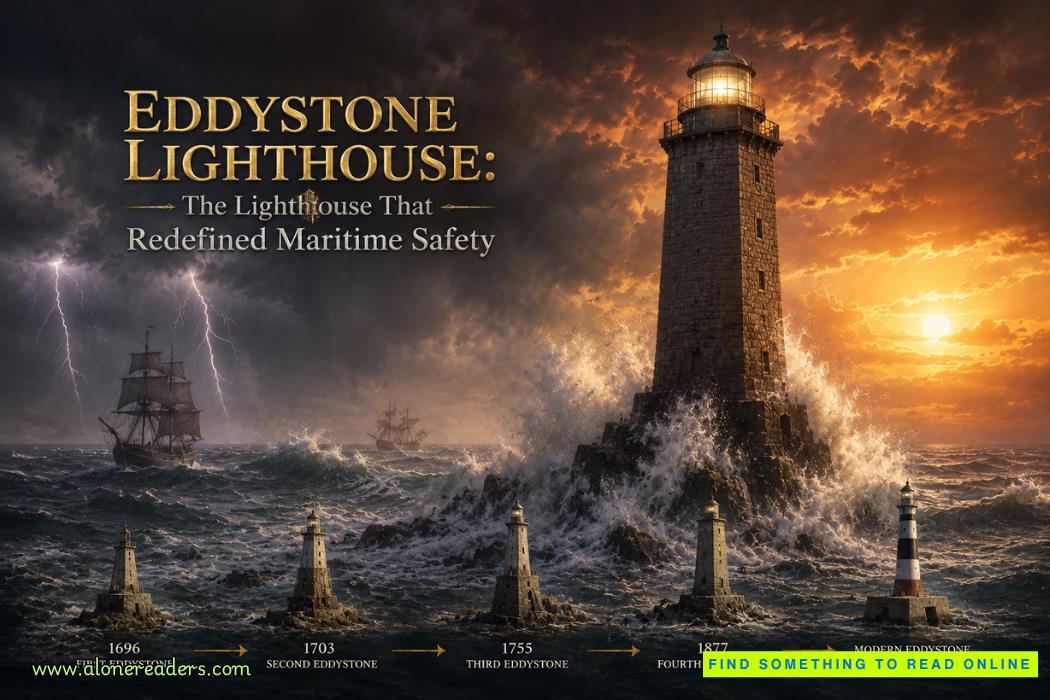
The first attempt to build a lighthouse on the Eddystone Rocks began in 1696 under engineer Henry Winstanley. Winstanley was not originally known as a lighthouse engineer. He was an eccentric inventor and businessman fascinated by mechanics and theatrical devices. Despite lacking experience in marine construction, he accepted the challenge with enthusiasm. His first lighthouse was a strange and elaborate wooden structure featuring decorative elements more appropriate for a palace than a survival-oriented maritime tower. Construction itself was extraordinarily dangerous. Workers could only access the rocks during calm weather and low tide, often remaining stranded for hours while waves crashed around them.
Winstanley’s lighthouse was completed in 1698 and later expanded in 1699. Although visually impressive, it suffered from serious structural weaknesses. The Atlantic storms relentlessly attacked the wooden framework, forcing constant repairs and modifications. Winstanley himself became obsessed with proving the lighthouse’s strength against nature. According to historical accounts, he once reportedly wished to be inside the lighthouse during the “greatest storm ever known” so he could witness its resilience firsthand. Tragically, his wish came true. In November 1703, England experienced one of the most devastating storms in its recorded history, now known as the Great Storm of 1703. The storm completely destroyed the lighthouse, sweeping Winstanley and everyone inside into the sea. No trace of them was ever found.
The destruction of the first lighthouse demonstrated an essential truth about maritime engineering: beauty and ambition alone could not defeat the ocean. The sea demanded structures designed not merely to stand proudly but to survive overwhelming natural violence. Yet despite the disaster, the need for a lighthouse remained urgent. Mariners still required protection from the deadly reef, and the failure only intensified the determination to find a lasting solution.
The second lighthouse was constructed by John Rudyard beginning in 1708. Learning from Winstanley’s mistakes, Rudyard adopted a far more practical design philosophy. His lighthouse was simpler, more compact, and engineered specifically to reduce wave resistance. Built largely from wood around a solid central core, the structure resembled the trunk of a tree, tapering upward to improve stability. This represented a major conceptual shift in lighthouse engineering. Instead of attempting to resist the sea through sheer ornamentation or complexity, Rudyard sought to harmonize structural form with environmental forces.
Completed in 1709, Rudyard’s lighthouse performed remarkably well compared to its predecessor. It stood for nearly fifty years and successfully guided countless ships through dangerous waters. During this period, the lighthouse became a symbol of England’s growing engineering capability and maritime confidence. However, the vulnerability of wood remained a persistent problem. In December 1755, disaster struck again when a fire broke out inside the structure. The blaze rapidly consumed the timber tower. The keeper on duty, Henry Hall, suffered severe injuries during the catastrophe and later became famous in medical history because molten lead from the lighthouse roof reportedly entered his body during the incident. He eventually died from his injuries, and the lighthouse was destroyed.
The repeated destruction of the Eddystone lighthouses forced engineers to confront a critical question: what kind of structure could truly survive in such an unforgiving environment? The answer emerged through the genius of John Smeaton, whose work on the third lighthouse would permanently transform civil engineering.
Smeaton approached the project scientifically rather than experimentally. Unlike his predecessors, he carefully studied the forces exerted by waves and analyzed natural forms capable of withstanding them. He became particularly inspired by the shape of oak trees, observing how their curved profiles distributed stress efficiently against strong winds. This insight led him to design a lighthouse with a broad base and smoothly tapering sides, creating what would become the classic lighthouse silhouette recognized around the world today.
Even more revolutionary was Smeaton’s decision to build the structure from stone instead of wood. This choice fundamentally altered lighthouse engineering. Stone offered superior durability, fire resistance, and weight stability, but constructing a masonry tower on isolated rocks in open sea conditions posed extraordinary challenges. Smeaton developed innovative interlocking stone techniques to ensure structural integrity. Massive granite blocks were carefully shaped so they locked together like pieces of a puzzle, allowing the tower to behave almost as a single solid unit against wave impacts.
Construction began in 1756 and demanded immense courage from the workers involved. Teams labored in dangerous tidal conditions where waves could suddenly engulf the worksite. Special tools, cranes, and lifting mechanisms had to be invented specifically for the project. Every stone required precise placement because errors could weaken the tower under storm pressure. Smeaton also pioneered the use of hydraulic lime mortar, capable of hardening underwater, which greatly improved the structure’s resistance to the marine environment.
When completed in 1759, Smeaton’s lighthouse represented a masterpiece of eighteenth-century engineering. Standing approximately seventy-two feet tall, the tower immediately demonstrated unprecedented resilience. For the first time in history, a lighthouse on the Eddystone Rocks appeared capable of long-term survival. More importantly, its design principles influenced lighthouse construction across the world. Engineers recognized that Smeaton had created not merely a successful lighthouse but a new engineering philosophy based on scientific understanding of environmental forces.
The importance of the Eddystone Lighthouse to maritime navigation cannot be overstated. The English Channel was among the busiest shipping lanes in the world, connecting Britain to continental Europe and global trade networks. Prior to reliable lighthouse protection, ships risked disaster whenever visibility deteriorated. Storms, fog, darkness, and strong currents frequently drove vessels toward the hidden reef. The lighthouse provided a consistent visual warning that dramatically reduced shipwrecks in the area.
Its influence extended beyond local navigation. The success of Smeaton’s design established new international standards for lighthouse engineering. Coastal authorities across Europe and North America studied the Eddystone model when planning their own maritime infrastructure. The tower demonstrated that offshore lighthouses could survive in environments once considered impossible for permanent construction. This realization led to a wave of lighthouse building during the eighteenth and nineteenth centuries, improving maritime safety on a global scale.
The lighthouse also contributed indirectly to advances in civil engineering and materials science. Smeaton’s methods inspired later engineers working on bridges, harbors, docks, and other marine structures. His careful study of forces, structural geometry, and material behavior represented an early form of modern engineering analysis. Many historians consider Smeaton one of the founders of professional civil engineering precisely because of the techniques he developed at Eddystone.
Over time, however, even Smeaton’s masterpiece encountered problems. The underlying rock formation beneath the lighthouse began to erode, threatening the tower’s long-term stability. By the late nineteenth century, engineers concluded that the structure would eventually become unsafe despite the tower itself remaining remarkably intact. Rather than risk catastrophic failure, authorities decided to replace it with a new lighthouse nearby.
The fourth and current Eddystone Lighthouse was designed by Sir James Douglass and completed in 1882. Built on a more secure section of rock, the new tower incorporated modern engineering advances while retaining the elegant curved profile pioneered by Smeaton. Constructed from granite and standing significantly taller than its predecessor, the lighthouse featured improved living quarters, more advanced lighting systems, and stronger foundations.
Technological progress transformed lighthouse illumination over the years. Early lighthouses relied on candles, coal fires, or simple oil lamps, providing limited visibility. Later innovations introduced Fresnel lenses, vastly increasing the intensity and reach of lighthouse beams. The Eddystone Lighthouse evolved alongside these advancements, becoming progressively more effective at guiding ships through dangerous waters. Eventually, automation reduced the need for permanent lighthouse keepers, reflecting broader technological changes in maritime navigation.
Despite the rise of GPS, radar, and satellite navigation systems, the Eddystone Lighthouse continues to hold enormous symbolic and operational significance. Modern vessels possess advanced electronic navigation equipment, but physical navigational markers remain important backup systems. More importantly, the lighthouse stands as a monument to centuries of maritime history and engineering achievement.
Today, the original Smeaton lighthouse tower no longer stands on the reef itself. When the new lighthouse replaced it, the upper portion of Smeaton’s structure was carefully dismantled and reconstructed on Plymouth Hoe, where it remains one of Britain’s most celebrated historical landmarks. Visitors can explore the tower and learn about its extraordinary history, including the engineering innovations that changed maritime construction forever.
The current lighthouse remains active offshore, continuing its role as a navigational beacon in the English Channel. Although access to the rock itself is highly restricted due to dangerous conditions, boat tours occasionally allow visitors to view the structure from nearby waters during favorable weather. The lighthouse has also become a major cultural symbol associated with endurance, ingenuity, and maritime heritage.
Tourism connected to the Eddystone Lighthouse extends beyond the tower itself. Plymouth’s maritime museums, coastal viewpoints, and historical exhibitions frequently highlight the lighthouse’s story as part of Britain’s naval legacy. Historians, engineers, and maritime enthusiasts continue studying the site because it represents a defining moment in the evolution of human engineering against nature.
What makes the Eddystone Lighthouse especially remarkable is not merely that it survived storms, but that it fundamentally changed how humanity approached dangerous marine environments. Before Eddystone, offshore construction was often based on trial, intuition, and courage. After Eddystone, engineers increasingly embraced scientific analysis, material innovation, and structural optimization. The lighthouse proved that careful observation of nature combined with disciplined engineering could overcome environments previously considered unconquerable.
Its story is also deeply human. The deaths of Winstanley and other workers reveal the immense risks faced by early engineers and sailors. The persistence shown after repeated destruction demonstrates society’s refusal to surrender vital maritime routes to natural hazards. Each generation improved upon the failures of the previous one, gradually refining techniques that would later support modern coastal engineering worldwide.
Even in the modern age, when satellites guide ships across oceans with astonishing precision, the image of the Eddystone Lighthouse standing against violent seas retains powerful emotional resonance. It represents human resilience facing overwhelming natural force. It symbolizes the determination to protect life through innovation. And perhaps most importantly, it reminds us that some of history’s greatest technological achievements emerged not from convenience, but from desperate necessity.
The Eddystone Lighthouse did more than illuminate dangerous waters. It illuminated the future of engineering itself.




 Château de Vincennes: France’s Forgotten Royal Fortress and Medieval Stronghold
 Château de Carcassonne: Europe’s Greatest Medieval Citadel and Fortress
 Château de Chenonceau: The Castle Built by Remarkable Women
 Château de Chambord: France’s Magnificent Renaissance Castle and Architectural Wonder
 Tehri Dam: India's Tallest Dam and the Debate Behind It
 Bhakra Nangal Dam: India's Temple of Modern Development