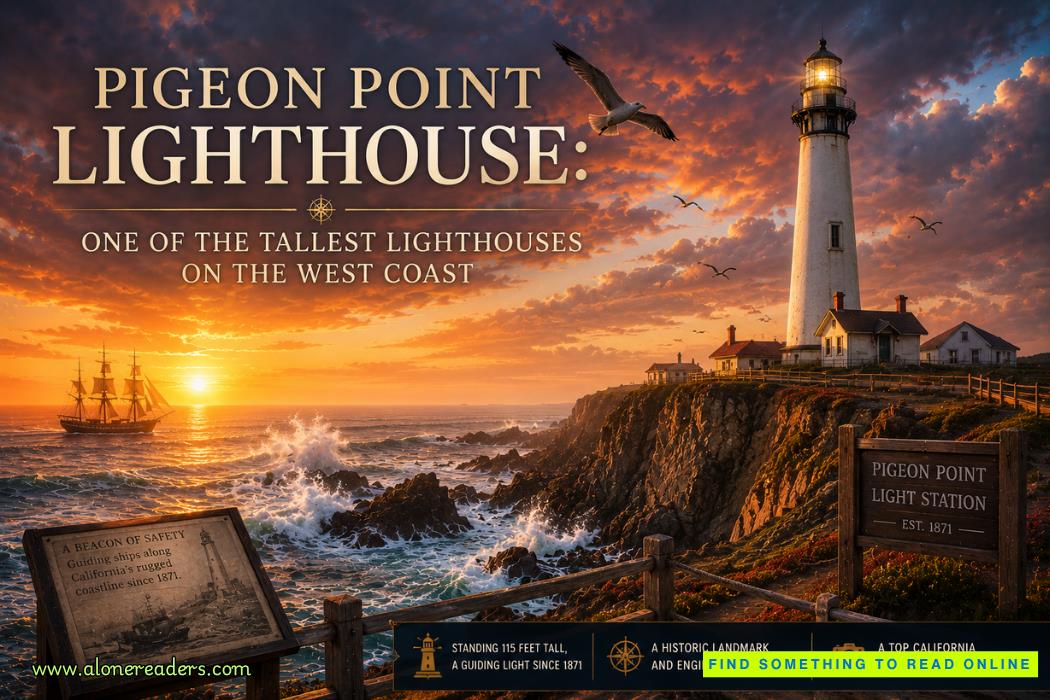
Pigeon Point Lighthouse occupies a unique place among the great maritime landmarks of North America. Rising above the rugged Pacific coastline south of San Francisco, it has stood for generations as a guardian of ships navigating one of the most challenging stretches of the American West Coast. For more than a century, sailors, fishermen, merchants, immigrants, naval crews, and coastal travelers have looked toward its powerful light as a symbol of safety amid fog, darkness, and turbulent seas. Today, it remains one of the most recognizable lighthouses in the United States and is widely celebrated as one of the tallest lighthouses on the West Coast, combining historical significance, engineering achievement, and scenic beauty in a single remarkable structure.
The origins of Pigeon Point Lighthouse are closely tied to the maritime expansion that transformed California during the nineteenth century. Following the California Gold Rush of 1848, maritime traffic along the Pacific coast increased dramatically. Ships carrying immigrants, supplies, machinery, food, and commercial goods traveled constantly between ports. San Francisco rapidly evolved into one of the busiest harbors in the world, attracting vessels from across North America, Europe, Asia, and South America. While this maritime growth brought prosperity, it also exposed serious navigational challenges. The California coastline was notorious for hidden reefs, rocky outcroppings, powerful currents, and dense fog banks that could appear without warning.
The specific location where Pigeon Point Lighthouse now stands gained tragic notoriety after the wreck of the carrier ship Carrier Pigeon in 1853. The vessel struck rocks near the point despite favorable weather conditions. Although most passengers survived, the incident highlighted the dangers facing ships approaching San Francisco from the south. The accident became significant enough that the area eventually adopted the name "Pigeon Point," preserving the memory of the ship whose misfortune helped inspire improved navigational safety measures.
Throughout the following years, maritime authorities recognized the urgent need for a powerful lighthouse along this section of coast. Numerous ships had either run aground or narrowly escaped disaster while navigating the shoreline. The increasing volume of commercial traffic made the situation even more concerning. After years of planning and government investment, construction of Pigeon Point Lighthouse began during the early 1870s. The tower was completed and officially illuminated in 1872, becoming one of the most important navigational aids on the Pacific coast.
From its earliest days, the lighthouse represented a significant engineering accomplishment. Standing approximately 115 feet tall, the tower immediately became one of the tallest lighthouse structures on the American West Coast. Its imposing height allowed the light to be visible from considerable distances offshore, giving mariners valuable warning as they approached dangerous coastal waters. The structure was designed to endure the harsh environmental conditions of the Pacific shoreline, including powerful winds, salt spray, storms, and continuous exposure to moisture.
The architecture of the lighthouse reflects the practical yet elegant design philosophy common to many nineteenth-century American lighthouses. Constructed primarily of brick and masonry materials, the tower features a tapered cylindrical form that provides both stability and visual distinction. Its bright white exterior creates a striking contrast against the darker cliffs and ocean backdrop. This highly visible appearance served a functional purpose, enabling sailors to identify the lighthouse during daylight hours even when its beacon was not required.
One of the most extraordinary features of Pigeon Point Lighthouse was its original Fresnel lens. Developed in France during the early nineteenth century, Fresnel lenses revolutionized lighthouse technology by dramatically increasing the efficiency and visibility of lighthouse beams. Instead of relying on massive quantities of fuel or oversized lamps, the innovative lens design concentrated and projected light with remarkable effectiveness. The first-order Fresnel lens installed at Pigeon Point represented the largest class of such lenses ever produced.
The lens itself was a masterpiece of optical engineering. Composed of hundreds of precisely manufactured glass prisms arranged in concentric patterns, it magnified and directed light into an intense beam visible for many miles across the Pacific. Mariners often described the light as one of the most powerful and distinctive signals along the California coast. The lens rotated through a clockwork mechanism powered by descending weights, creating a characteristic flashing pattern that allowed sailors to distinguish Pigeon Point from other lighthouses.
The operation of the lighthouse demanded constant attention and discipline. Lighthouse keepers lived on-site and devoted their lives to maintaining the beacon. Their responsibilities extended far beyond simply lighting a lamp each evening. They monitored weather conditions, cleaned delicate optical equipment, maintained mechanical systems, cared for buildings, and ensured that the light remained operational throughout the night. During periods of dense fog, they also managed fog-signal systems designed to provide audible warnings to ships unable to see the lighthouse.
Life as a lighthouse keeper was often isolated and demanding. Families stationed at Pigeon Point frequently lived far from major population centers. Storms could cut off access routes, and the responsibility of maintaining an essential navigational aid left little room for error. Yet these keepers played a critical role in protecting maritime commerce and saving lives. Their dedication transformed the lighthouse from a simple structure into a functioning safety system that operated continuously for decades.
The importance of Pigeon Point Lighthouse grew steadily as maritime traffic expanded throughout the late nineteenth and early twentieth centuries. California's economic development depended heavily on shipping. Agricultural exports, manufactured goods, mining products, and imported merchandise all moved through coastal ports. Every vessel approaching the San Francisco Bay region faced the challenges posed by coastal weather and geography. In this environment, reliable navigational aids were indispensable.
Perhaps the greatest challenge facing mariners along this coastline was fog. The meeting of cool ocean currents and warmer inland air frequently creates thick fog banks that can dramatically reduce visibility. Ships operating in such conditions historically faced enormous risks. Before the widespread adoption of modern radar and satellite navigation systems, visual landmarks and sound signals often represented the only reliable means of determining a vessel's position. Pigeon Point's elevated light and powerful fog signals therefore became essential components of maritime safety.
The lighthouse also played a valuable role during periods of technological transition. Throughout the twentieth century, maritime navigation evolved rapidly. Steam-powered ships replaced many sailing vessels. Radio communication became common. Electronic navigation systems emerged. Eventually, satellite-based positioning transformed maritime operations. Despite these advancements, traditional lighthouses continued to provide an important layer of redundancy and reliability. Mariners frequently relied upon multiple navigational methods simultaneously, and visual confirmation from a trusted lighthouse remained highly valued.
As technology advanced, modifications were made to the lighthouse to improve efficiency and reduce maintenance requirements. Automated systems gradually replaced many of the manual processes that lighthouse keepers once performed. Nevertheless, the historic tower retained much of its original character. Unlike many historic structures that underwent extensive modernization, Pigeon Point preserved its distinctive appearance and historical atmosphere, allowing visitors to experience a remarkably authentic example of nineteenth-century lighthouse engineering.
One of the reasons Pigeon Point continues to fascinate historians and engineers is the way it demonstrates the intersection of architecture, optics, mechanics, and maritime science. Every aspect of its design served a purpose. The height of the tower increased visibility. The tapered shape enhanced stability. The Fresnel lens maximized illumination efficiency. The location provided strategic coverage of a hazardous coastline. Together, these elements created a highly effective navigational system long before the arrival of modern electronic technologies.
The surrounding landscape further enhances the lighthouse's significance. Situated on dramatic cliffs overlooking the Pacific Ocean, the site offers spectacular views that showcase the natural beauty of California's coastline. Rocky shores, crashing waves, migrating whales, marine wildlife, and expansive ocean vistas create an environment that feels both powerful and timeless. The lighthouse appears almost inseparable from the landscape itself, standing as a permanent human presence within an ever-changing natural setting.
Over time, recognition of the lighthouse's historical importance led to preservation efforts designed to protect the structure for future generations. Historic preservation organizations, government agencies, engineers, and community advocates have worked together to ensure the lighthouse remains an enduring landmark. Maintaining such a structure presents unique challenges because coastal environments accelerate deterioration through exposure to salt, moisture, wind, and temperature fluctuations. Preservation projects have therefore focused on stabilizing the tower while preserving its historical authenticity.
Today, Pigeon Point Lighthouse enjoys a reputation that extends far beyond its original navigational function. It has become one of California's most beloved historic attractions. Visitors travel from around the world to photograph the tower, explore the surrounding coastline, and learn about maritime history. The lighthouse serves as both a cultural landmark and an educational resource, helping modern audiences understand the vital role lighthouses played before the age of electronic navigation.
Tourism has become an increasingly important aspect of the site's identity. Travelers are drawn not only by the lighthouse itself but also by the surrounding natural environment. Coastal hiking opportunities, wildlife observation, photography, and scenic ocean views make the area attractive throughout the year. Seasonal whale migrations provide additional opportunities for visitors to experience the dynamic relationship between the Pacific Ocean and the California coastline.
Photography enthusiasts consider Pigeon Point one of the most picturesque lighthouse locations in North America. The combination of the tall white tower, dramatic cliffs, crashing surf, and frequently changing coastal weather creates endless opportunities for compelling images. Sunrise and sunset are particularly popular times to visit, as shifting light conditions can transform the appearance of both the lighthouse and the surrounding landscape.
The educational value of the lighthouse should not be underestimated. Through exhibits, guided programs, and interpretive materials, visitors gain insight into maritime commerce, coastal navigation, engineering innovation, and the daily lives of lighthouse keepers. These stories help connect modern audiences with a period when navigation depended heavily on human skill, mechanical ingenuity, and carefully maintained infrastructure.
What makes Pigeon Point especially remarkable is its ability to embody multiple layers of historical significance simultaneously. It represents the growth of California, the expansion of global maritime trade, advances in engineering and optics, the dedication of lighthouse keepers, and the ongoing effort to preserve important cultural landmarks. Few structures manage to combine technological achievement, practical utility, historical relevance, and visual beauty as successfully as this iconic lighthouse.
More than 150 years after its first illumination, Pigeon Point Lighthouse continues to inspire admiration. Although modern ships navigate using sophisticated electronic systems unimaginable to nineteenth-century mariners, the tower remains a powerful symbol of maritime safety and human ingenuity. Its enduring presence reminds visitors that countless lives and fortunes once depended upon the reliability of a single beam of light shining across a dark and uncertain sea.
In the broader history of lighthouse construction, Pigeon Point occupies a distinguished position. Its impressive height, sophisticated optical systems, strategic location, and enduring legacy have secured its place among the great lighthouses of the world. For historians, engineers, sailors, travelers, and lighthouse enthusiasts alike, it stands as a compelling reminder of an era when navigation demanded courage, precision, and trust in the guiding light that awaited beyond the horizon. Even today, the sight of this towering beacon rising above the Pacific coast continues to capture the imagination, ensuring that the legacy of Pigeon Point Lighthouse will endure for generations to come.




 Château de Vincennes: France’s Forgotten Royal Fortress and Medieval Stronghold
 Château de Carcassonne: Europe’s Greatest Medieval Citadel and Fortress
 Château de Chenonceau: The Castle Built by Remarkable Women
 Château de Chambord: France’s Magnificent Renaissance Castle and Architectural Wonder
 Tehri Dam: India's Tallest Dam and the Debate Behind It
 Bhakra Nangal Dam: India's Temple of Modern Development