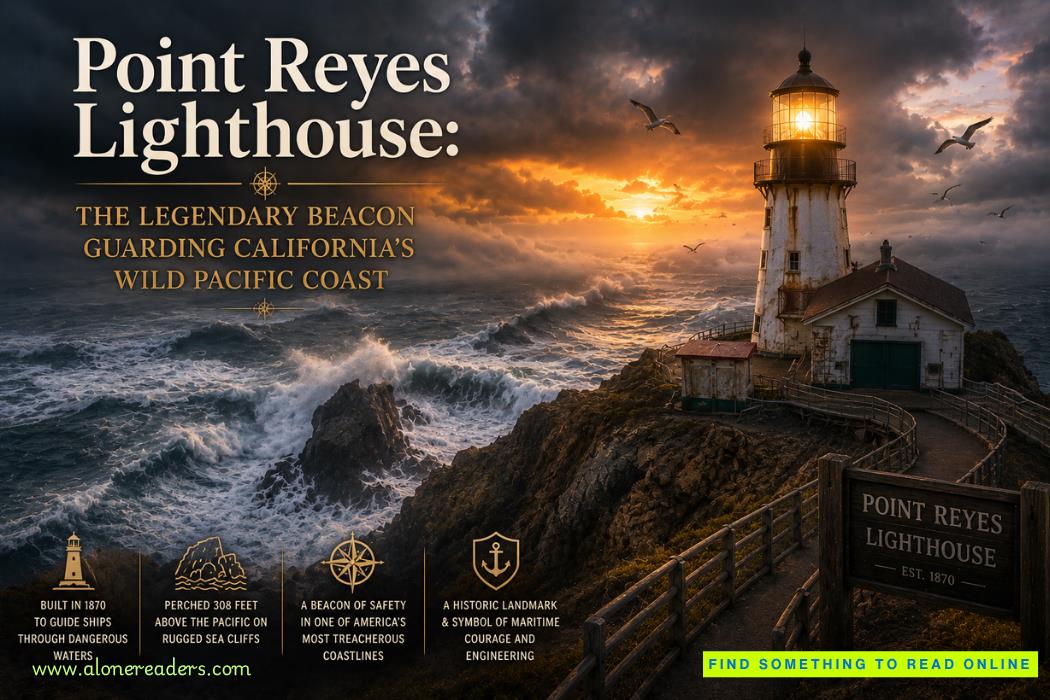
Point Reyes Lighthouse stands among the most iconic and dramatic lighthouses ever constructed on the Pacific Coast of North America. Perched on a windswept headland overlooking the vast Pacific Ocean in northern California, it has become a symbol of maritime endurance, engineering determination, and the relentless struggle between human navigation and the forces of nature. While many lighthouses are admired for their beauty, Point Reyes Lighthouse is remembered equally for the harsh environment in which it operated. Built on one of the foggiest and windiest stretches of coastline in the United States, the lighthouse served as a vital guardian for generations of sailors navigating dangerous waters where storms, hidden rocks, and dense fog posed constant threats.
The story of Point Reyes Lighthouse begins long before the structure itself was built. The Point Reyes Peninsula extends prominently into the Pacific Ocean, creating a natural landmark that ships traveling along the California coast could not ignore. During the nineteenth century, maritime commerce expanded rapidly along the western coast of the United States. Following the California Gold Rush, shipping traffic increased dramatically as vessels transported people, supplies, and valuable cargo between ports. San Francisco emerged as one of the most important ports on the Pacific Coast, attracting ships from around the world.
Unfortunately, the waters surrounding Point Reyes were notorious for shipwrecks. Powerful currents, submerged rocks, unpredictable weather, and dense fog frequently caused navigational errors. Mariners often referred to the region as a graveyard for ships. The dangers were compounded by the fact that vessels approaching San Francisco from the north had to navigate around the Point Reyes headland before reaching the safety of the bay. As maritime accidents increased, pressure mounted on government authorities to establish a lighthouse that could warn ships of the hazardous coastline.
The process of constructing a lighthouse at Point Reyes proved surprisingly complicated. Government officials initially sought to build the structure on the highest point of the peninsula, where the light would theoretically be visible over a greater distance. However, negotiations with local landowners delayed progress for years. By the time the land issue was resolved, engineers had discovered a significant problem. The highest elevations of Point Reyes were frequently concealed by thick fog. A lighthouse located above the fog layer would often be invisible to ships sailing below it.
This realization led engineers to make an unusual decision. Rather than placing the lighthouse on the highest available ground, they chose a lower location closer to sea level. The selected site was situated on a rocky cliff approximately 300 feet below the headland's summit. Although this reduced the theoretical visibility range of the light, it increased the likelihood that sailors would actually see it through the persistent fog. This decision demonstrated a practical understanding of local environmental conditions and remains one of the most fascinating aspects of the lighthouse's design.
Construction finally began in the late nineteenth century, and the lighthouse entered service in 1870. The completed structure was relatively modest in appearance compared to some of the grand masonry towers built on the East Coast. Yet its simplicity concealed sophisticated engineering adapted specifically to the challenges of the location. The lighthouse consisted of a sturdy tower integrated with a keeper's dwelling, allowing lighthouse personnel to maintain continuous operation despite harsh weather conditions.
One of the most important technological features of Point Reyes Lighthouse was its Fresnel lens. Developed in France during the early nineteenth century, Fresnel lenses revolutionized lighthouse illumination around the world. These remarkable lenses utilized concentric rings of glass prisms to focus and magnify light with extraordinary efficiency. The Point Reyes lighthouse received a first-order Fresnel lens, the largest category used in lighthouse service. This enormous optical device weighed several tons and represented the pinnacle of lighthouse technology at the time.
The lens transformed a relatively small light source into a powerful beacon visible from great distances. Mariners could identify the lighthouse through its unique flash pattern, enabling them to determine their location even during poor visibility. The precision craftsmanship involved in manufacturing the lens was extraordinary. Thousands of carefully shaped glass elements worked together to create a brilliant beam that could pierce darkness and guide ships away from danger.
The environmental conditions at Point Reyes were among the most severe faced by any lighthouse keepers in the United States. Strong winds regularly swept across the headland with remarkable force. Winter storms battered the cliffs with rain and ocean spray. Thick fog often enveloped the lighthouse for extended periods, reducing visibility to only a few yards. Records from the station reveal that fog could persist for more than one hundred days each year, making reliable warning systems essential.
Because the light alone could not always penetrate dense fog, the station employed powerful fog signals. Initially, these warnings consisted of steam-powered fog horns capable of producing deep, resonant blasts audible many miles away. The sound echoed across the ocean, alerting mariners to the presence of dangerous coastline even when the lighthouse itself remained hidden. The operation of these fog signals required constant attention and considerable labor from lighthouse keepers.
Life for the keepers was demanding and often isolated. Reaching the lighthouse required descending a steep staircase carved into the cliffside. Supplies, equipment, and fuel had to be transported down these stairs under frequently challenging conditions. During storms, waves could crash violently against the rocks below while fierce winds swept across the headland. Yet despite these hardships, the keepers maintained an unwavering commitment to their responsibilities.
The daily routine involved cleaning and maintaining the Fresnel lens, monitoring weather conditions, operating fog signals, recording observations, and ensuring that the light remained operational throughout the night. Before the advent of automation, even a brief interruption could potentially place ships at risk. Consequently, lighthouse service demanded exceptional discipline and dedication.
The strategic importance of Point Reyes Lighthouse became increasingly evident as maritime commerce expanded during the late nineteenth and early twentieth centuries. Ships carrying lumber, agricultural products, manufactured goods, and passengers relied upon coastal navigation routes that passed near the headland. Fishing vessels also depended upon the lighthouse as a navigational reference point when returning to harbor.
The waters near Point Reyes occupy a unique position where major ocean currents interact with the coastline. These currents contribute to frequent fog formation while also influencing marine traffic patterns. The lighthouse therefore served not merely as a local warning beacon but as a crucial navigational aid for vessels operating throughout a broad region of the Pacific Coast.
Numerous maritime incidents occurring before the lighthouse's construction demonstrated the need for such protection. Shipwrecks had claimed vessels and lives along the coast, underscoring the hazards faced by mariners. Although no lighthouse could eliminate all risks, Point Reyes significantly improved navigational safety by providing a reliable point of reference in an otherwise challenging environment.
Technological advances gradually transformed lighthouse operations during the twentieth century. Improvements in navigation, communications, and automation reduced the need for permanent lighthouse staff. Radio navigation systems, radar, and eventually satellite-based technologies offered mariners new methods for determining position. Despite these developments, traditional lighthouses continued to play valuable roles as visual backups and symbols of maritime heritage.
Point Reyes Lighthouse underwent modernization as part of this broader transformation. Automated systems reduced maintenance requirements, and eventually the era of resident lighthouse keepers came to an end. While automation increased efficiency, it also marked the conclusion of a distinctive chapter in maritime history. The image of dedicated keepers tending lights through storms and fog became part of the cultural legacy associated with historic lighthouses.
Today, Point Reyes Lighthouse remains one of California's most celebrated historic landmarks. Located within the protected landscape of Point Reyes National Seashore, the site attracts visitors from around the world. The surrounding environment is renowned for its spectacular natural beauty, including rugged cliffs, expansive ocean views, diverse wildlife, and dramatic weather conditions.
Visitors descending the famous staircase experience a glimpse of the isolation once faced by lighthouse keepers. The journey down hundreds of steps provides breathtaking views of the Pacific Ocean while emphasizing the challenging terrain that lighthouse personnel navigated daily. At the bottom, the restored lighthouse offers a tangible connection to the maritime past.
The original Fresnel lens remains one of the site's most impressive attractions. Seeing the massive lens up close allows visitors to appreciate the extraordinary engineering and craftsmanship that characterized nineteenth-century lighthouse technology. Interpretive exhibits explain the science behind the lens and the operational history of the station, providing valuable educational opportunities.
Wildlife observation has become another major attraction associated with the lighthouse. The surrounding coastline supports a rich variety of marine life and bird species. During certain seasons, visitors may observe migrating whales passing offshore. Gray whales, in particular, have become closely associated with Point Reyes, and the lighthouse area serves as one of California's premier whale-watching locations.
The site's combination of natural and historical significance creates a uniquely compelling visitor experience. Tourists are not simply viewing an old structure; they are encountering a place where geography, weather, engineering, and human determination intersect. The same winds, fog, and ocean vistas that challenged nineteenth-century mariners continue to shape the experience of modern visitors.
Conservation efforts have played a critical role in preserving the lighthouse for future generations. Coastal environments can be extremely destructive to historic structures due to constant exposure to salt spray, moisture, and wind. Preservation specialists have worked carefully to maintain the lighthouse while protecting its historical authenticity. These efforts ensure that visitors can continue to experience one of the most important maritime landmarks on the Pacific Coast.
The enduring fascination with Point Reyes Lighthouse stems partly from its dramatic setting but also from what it represents. It embodies an era when navigation depended upon human vigilance, mechanical ingenuity, and a profound understanding of nature. The lighthouse stands as a monument to the countless engineers, builders, keepers, and mariners whose lives were connected to the sea.
Even in an age dominated by GPS technology and sophisticated electronic navigation systems, Point Reyes Lighthouse retains symbolic power. Its lantern may no longer serve as the primary guide for ships, yet it continues to illuminate an important chapter of maritime history. The structure reminds us that before satellites and digital maps, sailors relied upon carefully placed beacons to navigate some of the world's most dangerous waters.
More than a century and a half after its first light shone across the Pacific, Point Reyes Lighthouse remains a powerful testament to human perseverance. Standing against storms, fog, and relentless ocean winds, it continues to watch over the California coast much as it did in 1870. For historians, engineers, travelers, and maritime enthusiasts alike, the lighthouse represents far more than a navigational aid. It is a lasting symbol of innovation, courage, and the enduring relationship between humanity and the sea. Through its remarkable history, unique engineering solutions, and continued role as a cherished historic destination, Point Reyes Lighthouse has secured its place among the greatest and most legendary lighthouses in history.



 Château de Vincennes: France’s Forgotten Royal Fortress and Medieval Stronghold
 Château de Carcassonne: Europe’s Greatest Medieval Citadel and Fortress
 Château de Chenonceau: The Castle Built by Remarkable Women
 Château de Chambord: France’s Magnificent Renaissance Castle and Architectural Wonder
 Tehri Dam: India's Tallest Dam and the Debate Behind It
 Bhakra Nangal Dam: India's Temple of Modern Development