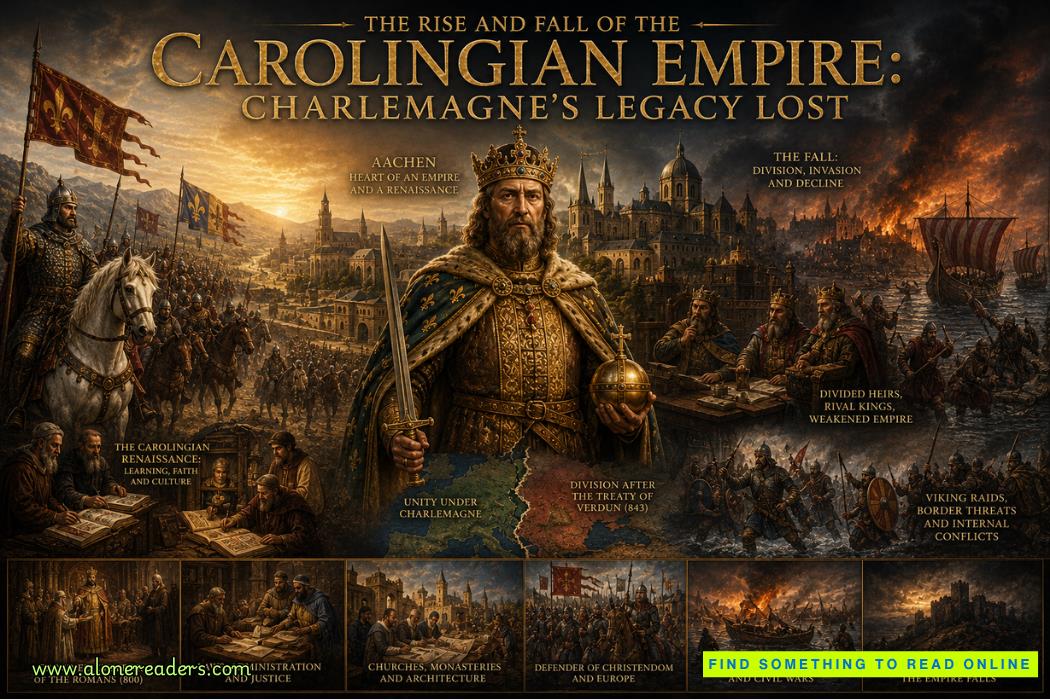
The story of the Carolingian Empire is one of the most remarkable political transformations in European history. Emerging from the remnants of the Frankish kingdoms during the Early Middle Ages, the Carolingians built a vast realm that stretched across much of Western and Central Europe. Under the leadership of Charlemagne, the empire reached unprecedented heights of military power, cultural achievement, and political influence. For a brief period, it appeared that Western Europe had regained the unity and strength once associated with ancient Rome.
Yet the Carolingian Empire's greatness proved surprisingly fragile. Within decades of Charlemagne's death, the empire fractured into competing kingdoms. Civil wars, succession disputes, foreign invasions, and weakening central authority gradually dismantled what had once been the most powerful state in Europe. The empire's collapse reshaped the continent and laid the foundations for future kingdoms such as France and Germany.
The rise and fall of the Carolingian Empire illustrates a recurring theme in history: the difficulty of preserving a great empire after the death of an extraordinary ruler.
The origins of the Carolingian dynasty can be traced to the Frankish Kingdoms that emerged after the collapse of the Western Roman Empire. By the seventh century, the Merovingian kings formally ruled the Franks, but real authority increasingly rested with powerful officials known as Mayors of the Palace. Among these officials, the family that would become the Carolingians steadily accumulated influence and military strength.
A decisive turning point came with Charles Martel, one of the most capable leaders of the age. He consolidated power across the Frankish realms and gained lasting fame through his victory against invading Muslim forces at the Battle of Tours in 732. Although historians debate the battle's broader significance, it greatly enhanced Charles Martel's prestige and established his family as the dominant force in Frankish politics.
Charles Martel's success laid the groundwork for future expansion. He strengthened military institutions, secured alliances among the Frankish nobility, and increased the resources available to the ruling family. More importantly, he transformed the Carolingians into the effective rulers of the Frankish world.
The next step came under Pepin the Short, Charles Martel's son. In 751, Pepin formally deposed the last Merovingian king and assumed the royal title with the support of the papacy. This event marked the official beginning of the Carolingian dynasty.
Pepin's alliance with the Pope became one of the most important political partnerships of the Middle Ages. In exchange for papal support, Pepin launched military campaigns in Italy against the Lombards and donated conquered territories to the Church. These lands became the foundation of the Papal States.
The alliance brought legitimacy to Carolingian rule while giving the papacy a powerful military protector. This partnership would profoundly influence European politics for centuries.
The greatest figure in Carolingian history was undoubtedly Charlemagne, who inherited the Frankish throne in 768. Over the following decades, he transformed a regional kingdom into a vast empire.
Charlemagne combined military skill, political intelligence, and relentless ambition. He spent much of his reign campaigning against neighboring peoples and rival states. His armies conquered the Lombard Kingdom in Italy, subdued Bavaria, incorporated territories in Central Europe, and conducted lengthy wars against the Saxons.
The Saxon Wars were particularly significant. Lasting more than thirty years, they resulted in the integration of northern Germany into the Carolingian realm. These campaigns involved both military conquest and religious conversion, as Charlemagne sought to spread Christianity alongside political control.
By the end of his reign, Charlemagne ruled territory extending from the Atlantic Ocean to Central Europe and from the North Sea to northern Italy. His empire encompassed diverse peoples, languages, and traditions.
The culmination of Charlemagne's achievements occurred on Christmas Day in the year 800. During a ceremony in Rome, the Pope crowned him Emperor.
This event carried immense symbolic importance. To many contemporaries, it represented the revival of imperial authority in Western Europe. Charlemagne was presented as the protector of Christianity and the heir to the Roman imperial tradition.
Although the new empire differed significantly from ancient Rome, the coronation reinforced Charlemagne's prestige and elevated the Carolingian state above all other kingdoms in Western Europe.
Military conquest alone did not define Carolingian success. Charlemagne also presided over a period of remarkable intellectual and cultural development often known as the Carolingian Renaissance.
Recognizing the importance of education and administration, Charlemagne encouraged learning throughout his empire. Scholars from across Europe gathered at his court, particularly in Aachen, which became the empire's political and cultural center.
Monasteries and cathedral schools expanded educational opportunities. Manuscripts were copied and preserved with greater care than before. Classical texts that might otherwise have disappeared survived because Carolingian scholars reproduced them.
One of the most enduring achievements of this period was the development of Carolingian minuscule, a clear and standardized writing system that improved communication and record keeping. Many modern lowercase letters trace their origins to this script.
The Carolingian Renaissance helped preserve knowledge during a period often characterized by political instability. Its influence continued long after the empire itself had disappeared.
Despite its achievements, the Carolingian Empire faced serious structural challenges. The empire's vast size made administration difficult. Communication across such extensive territories was slow and often unreliable.
Charlemagne attempted to address these problems through a network of local officials, counts, and royal envoys known as missi dominici. These representatives monitored provincial administration and reported directly to the emperor.
However, the system depended heavily upon Charlemagne's personal authority. Local nobles obeyed because they respected and feared the emperor. The effectiveness of the administration relied on his presence and leadership.
This created a dangerous weakness. The empire possessed strong institutions, but many of those institutions were ultimately tied to one individual.
When Charlemagne died in 814, the challenge of succession immediately became apparent.
His surviving son, Louis the Pious, inherited the empire. Unlike his father, Louis was deeply religious and personally conscientious, but he lacked Charlemagne's political and military dominance.
Louis attempted to maintain imperial unity while also providing territories to his sons. This effort produced constant conflict.
The Frankish tradition of dividing inheritance among heirs clashed with the imperial ideal of maintaining a unified realm. Louis repeatedly altered succession arrangements in response to changing family circumstances. Each change created new rivalries and intensified competition among his sons.
The result was a series of civil wars that weakened the empire from within. Nobles frequently shifted their loyalties between rival claimants, further undermining central authority.
By the time Louis died in 840, the empire was already moving toward fragmentation.
The struggle among Louis's sons culminated in one of the most significant agreements in medieval European history: the Treaty of Verdun in 843.
The treaty divided the empire into three major regions. Charles the Bald received the western territories, Louis the German received the eastern lands, and Lothair retained a central kingdom along with the imperial title.
Although intended to resolve dynastic conflict, the treaty accelerated political fragmentation.
Western Francia gradually evolved into medieval France. Eastern Francia developed into the foundation of Germany. The middle kingdom proved unstable and was repeatedly divided among competing rulers.
The Treaty of Verdun is often viewed as the moment when the unified Carolingian Empire effectively ceased to exist.
Internal division was only one of the empire's problems. During the ninth century, Europe faced increasing pressure from external enemies.
Viking raiders launched devastating attacks along rivers and coastlines. Their ships allowed them to penetrate deep into Carolingian territory, striking monasteries, towns, and trading centers.
At the same time, Magyar groups threatened eastern frontiers, while Muslim forces conducted raids in parts of the Mediterranean.
A strong and unified empire might have resisted these threats more effectively. Instead, fragmented kingdoms struggled to coordinate their defenses.
Local nobles increasingly assumed responsibility for protecting their own territories. As a result, regional lords gained military power while royal authority declined.
This process contributed significantly to the development of feudal structures across Europe.
As central authority weakened, counts, dukes, and local magnates accumulated greater independence. Many positions that had once depended upon royal appointment became effectively hereditary.
Kings found themselves increasingly dependent on powerful nobles for military support. In return, those nobles demanded privileges, land, and autonomy.
The transformation was gradual but profound. Political power shifted away from imperial institutions and toward local centers of authority.
By the late ninth century, much of the former Carolingian world was characterized by decentralized governance rather than strong imperial administration.
The decline of the Carolingian Empire did not occur through a single catastrophic event. Instead, it resulted from the interaction of several factors.
Succession disputes weakened unity. Civil wars consumed resources. Administrative structures relied too heavily on personal leadership. Foreign invasions exposed military vulnerabilities. Local nobles gained increasing independence.
Each problem reinforced the others.
What had once been a powerful empire slowly fragmented into competing kingdoms and principalities.
By the tenth century, the Carolingian imperial project had largely vanished. Although Carolingian rulers continued to hold power in some regions for a time, the empire that Charlemagne created no longer existed.
Yet the empire's disappearance did not mean its influence ended.
In many ways, the Carolingian legacy proved more durable than the empire itself.
The Carolingians helped define the political map of Western Europe. The emergence of France and Germany can be traced directly to the division of Carolingian territories.
The relationship between monarchy and Christianity was profoundly shaped by Carolingian precedents. Future rulers across Europe looked to Charlemagne as a model of Christian kingship.
Educational reforms associated with the Carolingian Renaissance preserved classical knowledge that might otherwise have been lost. Monastic scholarship, manuscript preservation, and administrative literacy continued to influence European society for centuries.
The imperial ideal also survived. Later rulers of the Holy Roman Empire viewed themselves as heirs to Charlemagne's legacy. His memory became a powerful symbol of European unity, authority, and civilization.
Even today, Charlemagne occupies a unique place in European historical memory. He is claimed by multiple national traditions and is often described as a foundational figure in the development of Europe.
The rise and fall of the Carolingian Empire remains one of history's most compelling examples of how quickly political fortunes can change. Within a single century, the Carolingians rose from powerful nobles to rulers of a vast empire and then witnessed the fragmentation of their achievements.
Their success was built upon military excellence, strategic alliances, administrative innovation, and cultural renewal. Their decline resulted from dynastic conflict, structural weaknesses, external pressures, and the challenge of governing an immense and diverse realm.
Perhaps the most important lesson of the Carolingian experience is that great empires require more than conquest to survive. Charlemagne's extraordinary leadership created a powerful state, but no system was established that could reliably preserve unity after his death.
Nevertheless, the Carolingian Empire left an enduring mark on European civilization. Its political institutions, educational reforms, religious partnerships, and cultural achievements helped shape the medieval world. Although Charlemagne's empire disappeared, the foundations it created influenced Europe for centuries, ensuring that his legacy, while politically lost, was never truly forgotten.
At a Glance: The Carolingian Empire
| Category | Details |
|---|---|
| Dynasty | Carolingian Dynasty |
| Peak Leader | Charlemagne |
| Period of Dominance | Eighth to Ninth Century |
| Capital | Aachen |
| Founder of Dynasty | Pepin the Short |
| Key Predecessor | Charles Martel |
| Greatest Achievement | Creation of a unified Western European empire |
| Cultural Achievement | Carolingian Renaissance |
| Major Event | Charlemagne crowned Emperor in 800 |
| Turning Point | Death of Charlemagne in 814 |
| Major Division | Treaty of Verdun (843) |
| Main Causes of Decline | Succession disputes, civil wars, Viking invasions, weakening central authority |
| Successor States | France, Germany, and several smaller kingdoms |
| Lasting Legacy | Preservation of learning, foundation of medieval Europe, inspiration for later empires |



 The Hundred Days Offensive: How the Allies Defeated Germany in World War I
 The Second Battle of the Marne: The Turning Point of World War I in 1918
 The Spring Offensive of 1918: Germany's Final Gamble to Win World War I
 The Treaty of Brest-Litovsk: How Russia Left World War I
 The Russian Revolution and World War I: How War Brought Down the Tsar
 The Zimmermann Telegram Explained: Germany's Secret Offer to Mexico in World War I