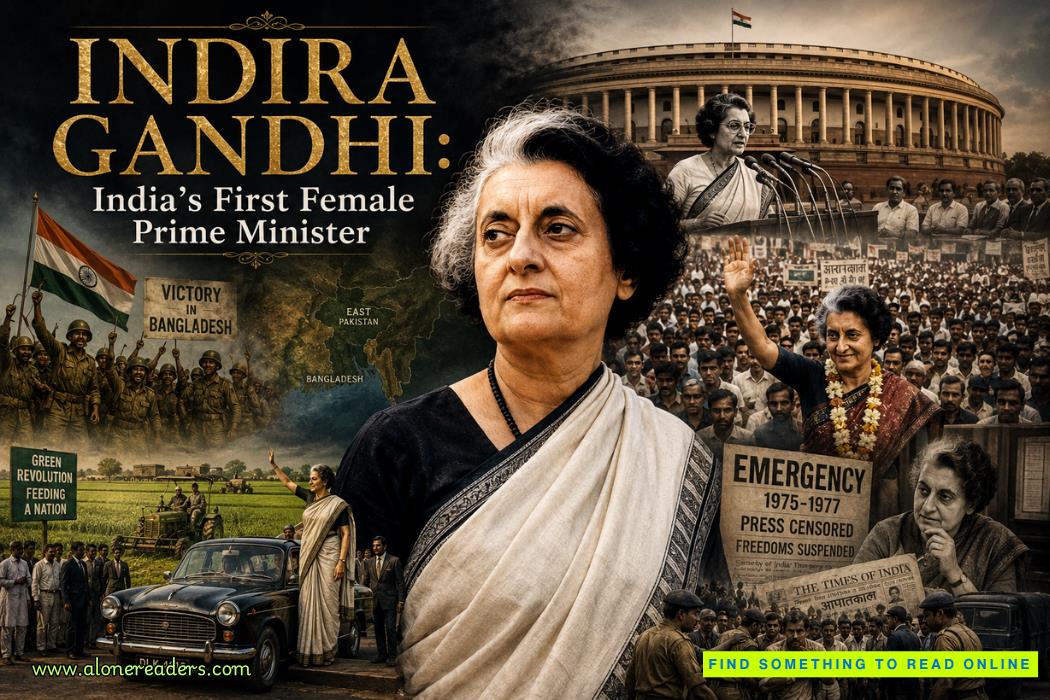
Indira Gandhi remains one of the most influential, controversial, and transformative political leaders in modern history. As India’s first female Prime Minister, she shattered gender barriers in a nation where political leadership had long been dominated by men. Yet her significance extends far beyond being a pioneering woman in politics. During her years in power, she reshaped India’s domestic politics, strengthened its international standing, led the nation through war and crisis, and left a legacy that continues to influence Indian political discourse decades after her death.
Few leaders evoke such sharply divided opinions. To some, she was the embodiment of decisive leadership who guided India through difficult times and transformed it into a stronger regional power. To others, she represented the dangers of concentrated political authority, particularly during the controversial Emergency period. Regardless of perspective, it is impossible to discuss twentieth-century India without recognizing the profound impact of Indira Gandhi.
Born on November 19, 1917, in Allahabad, India, Indira Priyadarshini Nehru was born into one of the most influential political families in the country. Her father, Jawaharlal Nehru, would later become independent India’s first Prime Minister, while her grandfather, Motilal Nehru, was a prominent lawyer and nationalist leader. Politics was not merely something discussed in her household—it was the very environment in which she grew up.
Her childhood coincided with India’s struggle for independence from British rule. The Nehru family home frequently hosted political meetings involving major leaders of the independence movement. As a result, Indira developed an understanding of politics at an unusually young age. She witnessed arrests, protests, political campaigns, and the sacrifices made by those fighting for freedom.
Unlike many children of elite families, Indira’s upbringing was marked by instability. Her father spent long periods in prison because of his role in the independence movement. These separations profoundly shaped her personality. The letters her father wrote from prison became an important source of education and inspiration. Through these letters, she learned about history, politics, philosophy, and leadership.
Her formal education took place in several institutions, including schools in India and abroad. She studied at Visva-Bharati University and later attended University of Oxford. Although her academic journey was interrupted by health issues and political developments, the exposure to international perspectives broadened her worldview and prepared her for future leadership.
In 1942, she married Feroze Gandhi. Despite sharing the surname Gandhi, Feroze Gandhi was not related to Mahatma Gandhi. The marriage produced two sons, Rajiv Gandhi and Sanjay Gandhi, both of whom would later play significant roles in Indian politics.
Following India’s independence in 1947, Indira Gandhi gradually became more involved in public affairs. While her father served as Prime Minister, she often acted as a political confidante and informal adviser. Her experience observing the workings of government from close quarters gave her insights that few politicians could match.
Her rise within the ruling political party accelerated during the 1950s and 1960s. She became increasingly active in party organization and administration. In 1959, she was elected president of the Indian National Congress, a position that signaled her growing influence.
When Prime Minister Lal Bahadur Shastri died unexpectedly in 1966, the ruling party faced a leadership crisis. Many senior politicians viewed Indira Gandhi as a compromise candidate whom they could influence. They underestimated her political instincts and determination.
At the age of forty-eight, Indira Gandhi became India’s first female Prime Minister. Critics initially dismissed her as inexperienced and dependent on powerful party leaders. Some opponents mockingly referred to her as a “goongi gudiya,” or “dumb doll.” However, she quickly proved that she possessed an independent political vision and remarkable strategic skills.
One of her earliest challenges involved addressing widespread poverty and economic inequality. She promoted policies aimed at expanding state control over key sectors of the economy. Among her most significant decisions was the nationalization of major banks in 1969. This move was designed to extend banking services to rural areas and support economic development.
The bank nationalization policy dramatically increased her popularity among poorer voters. It reinforced her image as a leader willing to challenge established economic interests. At the same time, it intensified conflict with conservative elements within her own party.
The political battle eventually led to a major split within the Congress Party. Rather than retreating, Indira Gandhi consolidated her position and emerged stronger. The slogan “Garibi Hatao,” meaning “Remove Poverty,” became the centerpiece of her political message.
The defining moment of her leadership arrived in 1971. India faced an unprecedented refugee crisis as millions of people fled violence in East Pakistan. The humanitarian and political pressures created immense challenges for the Indian government.
Indira Gandhi responded with a combination of diplomatic outreach and strategic planning. She traveled extensively to build international support while preparing India for potential military conflict. Her government also signed a significant treaty with the Soviet Union, strengthening India’s geopolitical position.
When war broke out between India and Pakistan in December 1971, Indian forces achieved a rapid and decisive victory. The conflict resulted in the creation of the independent nation of Bangladesh.
The victory transformed Indira Gandhi into an international figure of enormous stature. Many Indians regarded her as a national hero. Her leadership during the crisis enhanced India’s reputation as a major regional power and demonstrated her ability to make difficult strategic decisions under pressure.
Another significant achievement associated with her tenure was the Green Revolution. Although the movement involved the efforts of scientists, policymakers, and farmers, her government played a crucial role in supporting agricultural modernization.
The adoption of high-yield crop varieties, expanded irrigation systems, and increased fertilizer use dramatically boosted agricultural production. India, once heavily dependent on food imports, moved closer to self-sufficiency. This transformation reduced the risk of widespread famine and strengthened national food security.
Her administration also pursued scientific and technological advancement. One of the most notable milestones occurred in 1974 when India conducted its first nuclear test. Known as “Smiling Buddha,” the test signaled India’s emergence as a nuclear-capable state.
Supporters viewed the nuclear program as an assertion of national sovereignty and strategic independence. It demonstrated India’s growing scientific capabilities and enhanced its international standing.
Despite these achievements, Indira Gandhi’s political career became increasingly controversial during the mid-1970s. Economic difficulties, inflation, unemployment, and political opposition created mounting challenges. Large-scale protests emerged across various parts of the country.
The situation intensified when a court found her guilty of electoral irregularities in a parliamentary election. Rather than resigning, she chose a dramatic course of action.
On June 25, 1975, she declared a national Emergency. This decision remains one of the most debated episodes in Indian history.
During the Emergency, civil liberties were suspended, opposition leaders were arrested, press freedoms were restricted, and government authority expanded significantly. Supporters argued that these measures restored order, reduced political instability, and improved administrative efficiency.
Critics, however, viewed the Emergency as an attack on democratic institutions. They argued that it represented an unprecedented concentration of power in the hands of a single leader.
Particularly controversial were programs associated with her son, Sanjay Gandhi. Urban clearance initiatives and sterilization campaigns generated widespread resentment among affected communities.
The Emergency fundamentally altered public perceptions of Indira Gandhi. While some admired her decisiveness, others feared the implications of unchecked political authority. The period became a lasting symbol of the tension between governance and democracy.
In 1977, she unexpectedly called national elections. Many observers believed she expected an easy victory. Instead, voters delivered a stunning rebuke. The Congress Party suffered a major defeat, and Indira Gandhi lost power.
The election demonstrated the resilience of Indian democracy. Despite the restrictions imposed during the Emergency, voters ultimately exercised their right to remove a powerful leader from office.
Yet Indira Gandhi’s political story did not end there. Her opponents struggled to maintain unity, and public dissatisfaction with the new government gradually increased. Demonstrating remarkable political resilience, she rebuilt her support base and positioned herself for a comeback.
In 1980, she returned to power after winning another national election. The comeback underscored her enduring popularity and political skill. Few leaders in modern history have experienced such a dramatic fall and subsequent return.
However, her second period in office proved increasingly difficult. India faced rising regional tensions, economic challenges, and growing security concerns.
One of the most serious issues emerged in the state of Punjab. Separatist movements and militant activity escalated during the early 1980s. The situation eventually culminated in a controversial military operation known as Operation Blue Star in June 1984.
The operation targeted armed militants who had established positions within the Golden Temple, the holiest site in Sikhism. While the operation succeeded militarily, it caused significant damage and generated deep anger among many Sikhs worldwide.
The political consequences were profound. Tensions increased dramatically, and concerns about retaliation grew.
On October 31, 1984, Indira Gandhi was assassinated by two of her Sikh bodyguards. The assassination shocked India and the world. Her death triggered widespread unrest and communal violence, leaving a painful chapter in the nation’s history.
Her funeral attracted enormous crowds, reflecting both her influence and the emotions surrounding her death. After her assassination, her son Rajiv Gandhi succeeded her as Prime Minister, continuing the family’s role in Indian politics.
The legacy of Indira Gandhi remains extraordinarily complex. She was simultaneously a nation-builder, reformer, wartime leader, political strategist, and controversial figure. Few political leaders have inspired such intense admiration and criticism.
Supporters emphasize her achievements in strengthening India’s international position, expanding agricultural production, promoting technological progress, and demonstrating that women could successfully lead one of the world’s largest democracies. They view her as a symbol of strength, determination, and national pride.
Critics focus on the Emergency, concerns about authoritarian tendencies, and the centralization of political power. They argue that some of her decisions weakened democratic norms and established precedents that remain relevant in contemporary political debates.
What cannot be disputed is her historical significance. She governed India for nearly sixteen years across two terms, making her one of the country’s longest-serving prime ministers. During that time, she shaped the trajectory of Indian politics, economics, foreign policy, and national identity.
For women around the world, her rise carried profound symbolic importance. At a time when female heads of government were still relatively rare, Indira Gandhi demonstrated that women could lead major nations through war, crisis, and transformation. Her success challenged traditional assumptions about gender and political leadership.
Even today, historians continue to study her decisions, supporters continue to celebrate her achievements, and critics continue to debate her controversies. This enduring discussion reflects the magnitude of her impact.
Indira Gandhi was not merely India’s first female Prime Minister; she was one of the most consequential political leaders of the twentieth century. Her life embodied the possibilities and dangers of power, the challenges of governing a vast and diverse nation, and the capacity of a single individual to influence the course of history. Whether viewed as a visionary stateswoman or a deeply controversial ruler, her story remains inseparable from the story of modern India itself.





 The Hundred Days Offensive: How the Allies Defeated Germany in World War I
 The Second Battle of the Marne: The Turning Point of World War I in 1918
 The Spring Offensive of 1918: Germany's Final Gamble to Win World War I
 The Treaty of Brest-Litovsk: How Russia Left World War I
 The Russian Revolution and World War I: How War Brought Down the Tsar
 The Zimmermann Telegram Explained: Germany's Secret Offer to Mexico in World War I










