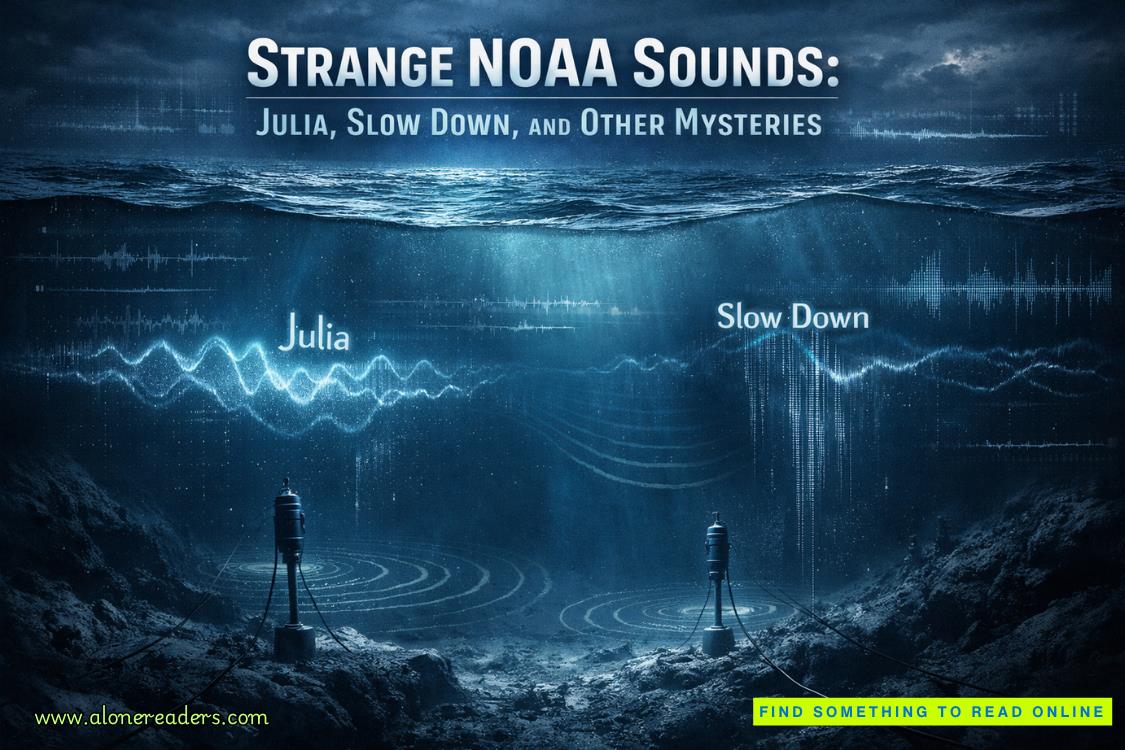
The modern mystery of strange NOAA sounds begins not with folklore or internet conspiracy, but with a relatively obscure scientific discipline known as ocean hydroacoustics. In the vast, opaque world beneath the waves, sound travels far more efficiently than light. For this reason, scientists have long relied on sound to understand what happens in the deep ocean, from tracking earthquakes to monitoring ice movement and marine life. In the early 1990s, a network of highly sensitive underwater microphones, called hydrophones, began capturing signals that did not resemble anything researchers expected. These sounds were not random noise. They were structured, powerful, and in some cases eerily expressive, earning informal names like Julia and Slow Down that would later ignite public fascination.
Julia is one of the most famous of these signals, recorded in 1999 across multiple hydrophones thousands of kilometers apart. What made Julia remarkable was not just its audibility over such an enormous distance, but its acoustic signature. The sound rose in frequency over time, forming a sweeping, almost vocal pattern that stood out clearly from background ocean noise. From an acoustic analysis perspective, Julia exhibited characteristics consistent with a large-scale physical process rather than a biological source. The frequency range, duration, and propagation suggested an origin tied to massive movement, not to whales, submarines, or volcanic eruptions in the conventional sense. This alone made Julia a scientific puzzle worth serious attention.
To understand why Julia mattered so much, it is important to grasp how sound behaves underwater. Low-frequency sounds can travel thousands of kilometers through a natural channel in the ocean known as the SOFAR channel, where sound speed is minimized due to pressure and temperature gradients. When a powerful event occurs within or near this channel, the resulting sound can propagate with very little energy loss. Julia’s detection across such distances implied an event of extraordinary scale. Yet no corresponding earthquake or known explosion matched the timing. This absence of an obvious source forced researchers to look elsewhere for explanations.
The most plausible scientific interpretation of Julia points to large ice-related events in the Southern Ocean. When massive icebergs fracture, scrape against the seafloor, or collide with other ice structures, they can produce long, sweeping acoustic signals. Unlike brittle ice cracking, these interactions involve prolonged friction and deformation, which can generate rising tonal sounds remarkably similar to Julia. Detailed modeling later supported the idea that Julia likely originated from iceberg-seafloor interaction near Antarctica. This explanation, while grounded in physics, did little to dampen public imagination, largely because the sound itself felt unsettlingly intentional, almost as if the ocean were speaking.
Another infamous signal, Slow Down, was recorded in 1997 and quickly became one of the most debated NOAA sounds ever captured. Unlike Julia’s rising frequency, Slow Down exhibited a gradual decrease in pitch over several minutes, giving the impression of a massive object decelerating. This characteristic alone made it acoustically unusual. Most natural ocean sounds are impulsive or repetitive, but Slow Down unfolded slowly, with a smooth, deliberate structure that defied easy categorization at the time. Its name, chosen for descriptive convenience, inadvertently fueled speculation far beyond the scientific community.
From an analytical standpoint, Slow Down shares several traits with sounds produced by large ice sheets under stress. When ice undergoes gradual fracturing or sustained deformation, the emitted acoustic energy can decrease in frequency as the system relaxes. In simpler terms, as tension is released, the sound “slows down.” The duration of the signal suggests a prolonged mechanical process rather than a sudden event. This aligns well with the hypothesis of ice shelf movement or iceberg grounding events. However, the scarcity of direct observational data from the remote Southern Ocean meant that certainty remained elusive for years.
What truly elevated these sounds into the realm of mystery was their public release. When audio clips became available online, stripped of technical context, listeners encountered something deeply unfamiliar. The human brain is wired to find patterns and meaning in sound, especially those that resemble vocalizations. Julia’s sweeping tone and Slow Down’s drawn-out descent triggered intuitive responses that science alone struggled to counteract. Some listeners described the sounds as mournful, others as mechanical, and a few as outright unnatural. In this gap between scientific explanation and emotional perception, speculation thrived.
It is important to emphasize that NOAA never classified these sounds as unidentified in the sense of being inexplicable. From the beginning, researchers framed them as unknown at the time of detection, pending further analysis. Over years of study, the accumulation of data from satellite imagery, ice dynamics, and acoustic modeling steadily narrowed the range of plausible sources. Ice-related mechanisms consistently emerged as the best fit. Yet the persistence of mystery highlights a broader truth about ocean science: the deep sea remains one of the least directly observed environments on Earth.
Beyond Julia and Slow Down, NOAA’s hydrophone arrays have recorded numerous other unusual sounds, many of which never achieved the same notoriety. Some are impulsive, sharp, and brief, linked to underwater earthquakes or volcanic activity. Others are rhythmic and biological, produced by whales or large fish. A small subset, however, occupies a gray area where multiple explanations overlap. These signals tend to be low-frequency, long-duration, and geographically remote. Each one adds a piece to the larger puzzle of how dynamic and acoustically active the ocean truly is.
One reason these mysteries persist in public discourse is the sheer scale involved. Events capable of generating sounds detectable across ocean basins are almost unimaginable in everyday experience. Icebergs the size of cities, grinding slowly against the seafloor, operate on spatial and temporal scales that feel alien. When such processes are translated into sound, they take on an emotional weight that raw data lacks. The ocean, already perceived as vast and unknowable, becomes an active presence rather than a passive backdrop.
From a scientific perspective, the study of these sounds has had tangible benefits. Understanding ice-generated acoustics helps researchers monitor climate-related changes in polar regions where direct measurement is difficult. Acoustic signatures can reveal iceberg movement, ice shelf instability, and even long-term trends in glacial dynamics. In this sense, mysterious sounds are not curiosities but valuable signals carrying information about planetary processes unfolding far from human eyes.
The cultural impact of NOAA sounds also reveals something important about how science is communicated. When complex data enters the public sphere without sufficient framing, it often takes on a life of its own. Names like Julia and Slow Down, while useful shorthand among researchers, inadvertently anthropomorphized the signals. This made them more memorable but also more susceptible to misinterpretation. The lesson here is not that such names were mistakes, but that storytelling power must be matched with explanatory depth.
Despite decades of research, the fascination with strange ocean sounds has not faded. If anything, it has intensified as new generations encounter the recordings online. This enduring interest speaks to a deep human curiosity about hidden systems and distant forces. The ocean covers most of the planet, yet remains largely inaccessible. Sounds like Julia and Slow Down serve as rare messages from that hidden world, reminders that immense processes are constantly unfolding beneath the surface.
In the end, the true mystery of NOAA sounds is not that they exist, but that they reveal how much remains unseen. Each strange signal marks a boundary between what is known and what is still being discovered. As monitoring technology improves and polar observation becomes more sophisticated, future sounds may be identified more quickly and with greater confidence. Until then, Julia, Slow Down, and their lesser-known counterparts will continue to occupy a unique space where rigorous science meets profound wonder, echoing through the deep as both data and story.



 Château de Vincennes: France’s Forgotten Royal Fortress and Medieval Stronghold
 Château de Carcassonne: Europe’s Greatest Medieval Citadel and Fortress
 Château de Chenonceau: The Castle Built by Remarkable Women
 Château de Chambord: France’s Magnificent Renaissance Castle and Architectural Wonder
 Tehri Dam: India's Tallest Dam and the Debate Behind It
 Bhakra Nangal Dam: India's Temple of Modern Development










