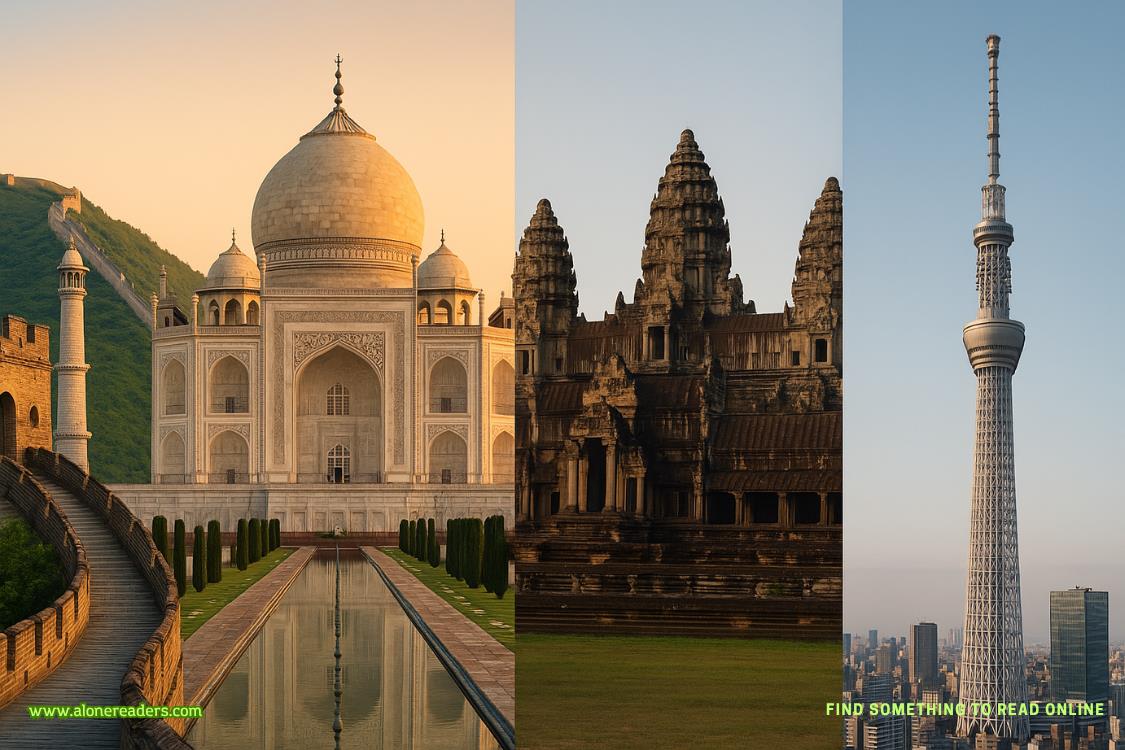
Asia’s immense landmass cradles a dizzying variety of civilizations, histories, and creative philosophies, making it the ultimate showcase for both ancient and modern architectural marvels. Unlike any other continent, Asia’s built environment is not just a display of grandeur or technological prowess—it’s a living narrative that intertwines dynastic legacies, religious symbolism, local craftsmanship, and bold innovation.
In this article, we will journey through some of Asia’s most iconic architectural wonders, from mystical temples and imperial palaces to cutting-edge skyscrapers. Each site is explored in depth, revealing not just its visual splendor but also its historical and cultural resonance.
Origins and Expansion
The Great Wall of China is far more than a single wall; it is a complex system of fortifications stretching over 21,000 kilometers, built and rebuilt between the 7th century BCE and the 17th century CE. It reflects the cumulative effort of several dynasties—most famously the Ming Dynasty—who harnessed advanced engineering and local labor to defend the empire’s northern frontiers.
Architectural Significance
What sets the Great Wall apart is its adaptability to the diverse landscapes it traverses: mountains, deserts, grasslands, and river valleys. Construction techniques varied accordingly—rammed earth in the west, fired bricks in the east, and stonework in mountainous regions. Watchtowers, barracks, and signal beacons punctuate the Wall, forming an integrated defense mechanism.
Cultural Legacy
Beyond its military function, the Great Wall symbolizes the unification of China, the resilience of its people, and the monumental scale of imperial ambition. Today, restored sections like Badaling and Mutianyu attract millions of visitors, while remote stretches remain hauntingly atmospheric and untamed.
Historical Context
Commissioned by Emperor Shah Jahan in memory of his beloved wife Mumtaz Mahal, the Taj Mahal in Agra, India, is the world’s most famous mausoleum. Completed in 1653, it stands as the ultimate expression of Mughal architectural refinement, blending Persian, Islamic, and Indian motifs.
Architectural Features
The Taj Mahal’s iconic silhouette—the onion-shaped dome flanked by four minarets—rises from a perfectly symmetrical charbagh (Persian-style garden). Its marble facades are inlaid with semi-precious stones forming intricate floral and geometric patterns. Light plays a magical role here: at dawn, dusk, and under a full moon, the marble shimmers in hues of pink, gold, or blue.
Enduring Symbolism
While universally recognized as a symbol of love, the Taj Mahal is also a marvel of structural engineering. The foundation is stabilized by wells dug into the riverbank, and the minarets are designed to tilt slightly outward—so that in an earthquake, they would fall away from the mausoleum.
From Hindu Cosmology to Buddhist Pilgrimage
Angkor Wat, the largest religious monument in the world, was originally built in the early 12th century by King Suryavarman II as a Hindu temple dedicated to Vishnu. Over centuries, it transformed into a Buddhist pilgrimage site, reflecting Cambodia’s evolving spiritual landscape.
Architectural Complexity
Constructed from sandstone blocks quarried miles away, Angkor Wat’s layout is a microcosm of Hindu cosmology: five central towers represent the mythical Mount Meru, surrounded by concentric galleries and a vast moat symbolizing the cosmic ocean. The galleries are adorned with thousands of bas-reliefs depicting scenes from the Ramayana and Mahabharata.
A Living Heritage
Despite centuries of neglect and encroaching jungle, Angkor Wat has endured. Modern restoration efforts have stabilized the structure, and today, it is both a source of national pride and an active center of religious ritual.
Designing for the Future
Tokyo Skytree, completed in 2012, stands at 634 meters and is the world’s tallest tower and the second tallest structure overall. It was conceived not just as a broadcasting tower but as a symbol of Tokyo’s resilience and ambition in the 21st century.
Innovative Engineering
The Skytree employs a central reinforced concrete shaft surrounded by a steel frame, inspired by traditional Japanese pagodas which have survived centuries of earthquakes. Its tripod base morphs elegantly into a cylindrical shaft, minimizing wind resistance and maximizing stability. The tower’s “Skytree White” exterior and LED illumination evoke the changing colors of the sky.
Social Impact
More than a technological marvel, Skytree has rejuvenated the Sumida district, attracting millions of tourists and supporting a thriving commercial complex with shops, restaurants, and an aquarium.
Architectural Vision
Marina Bay Sands, completed in 2010, is not just a luxury resort but a dramatic reimagining of urban space. Designed by Moshe Safdie, it consists of three 55-story towers connected at the top by a 340-meter SkyPark. Its bold silhouette has become synonymous with Singapore’s global city aspirations.
Engineering Marvels
Constructing the SkyPark—a cantilevered platform longer than the Eiffel Tower is tall—was a feat of precision engineering. The structure houses the world’s largest rooftop infinity pool, offering breathtaking views of the city.
Cultural and Economic Significance
Marina Bay Sands is more than an architectural icon; it represents Singapore’s ambition to become a cultural and financial hub. It has catalyzed a new waterfront district, integrating museums, theaters, and public spaces.
Historical Backdrop
Beijing’s Forbidden City, constructed between 1406 and 1420, was the political heart of China for almost five centuries. Housing 24 emperors of the Ming and Qing dynasties, it is the world’s largest palace complex, covering 180 acres with nearly 1,000 buildings.
Architectural Mastery
The Forbidden City exemplifies Chinese palatial architecture: axial symmetry, meticulous use of color (imperial red and yellow), and strict spatial hierarchy. The wooden structures, raised on marble platforms, are elaborately decorated with glazed tiles, carved screens, and mythical animal motifs.
Symbolism and Preservation
Every detail serves a symbolic function, from the number of roof tiles (a sign of rank) to the arrangement of halls for ceremonial versus private use. Despite fires and upheavals, the complex is remarkably intact, preserved as a UNESCO World Heritage site and a window into dynastic power.
A New National Identity
Once the world’s tallest buildings (1998–2004), the Petronas Twin Towers in Kuala Lumpur rise 452 meters above the city. Designed by César Pelli, the towers blend Islamic motifs with high-tech aesthetics, symbolizing Malaysia’s multicultural identity and rapid development.
Structural Innovation
The towers feature a steel and glass façade with repeating geometric patterns inspired by Islamic art. The double-decker Skybridge connects the two towers at the 41st and 42nd floors—a daring engineering solution for stability and evacuation.
Urban Impact
The towers have redefined Kuala Lumpur’s skyline and serve as a focal point for business, shopping, and tourism, reflecting the city’s cosmopolitan ambitions.
Ancient Origins, Enduring Spirit
Shwedagon Pagoda in Yangon is Myanmar’s most sacred Buddhist site, believed to be over 2,600 years old. Legend holds that it enshrines relics of four Buddhas, including strands of Gautama Buddha’s hair.
Architectural Splendor
The stupa’s core is brick covered in gold plates, crowned by a diamond-studded spire. Over 27 metric tons of gold leaf have been applied by generations of devotees, creating a radiant monument visible across the city.
Spiritual and Social Role
Beyond its visual grandeur, Shwedagon remains a center of pilgrimage, meditation, and national identity, with annual festivals drawing millions.
Symbolism and Innovation
New Delhi’s Lotus Temple, completed in 1986, serves as the mother temple for the Bahá’í faith in Asia. Designed by Iranian architect Fariborz Sahba, it’s shaped like a blooming lotus—India’s national flower and a universal symbol of purity.
Engineering Excellence
Twenty-seven marble-clad “petals” form nine sides, creating a seamless fusion of modernist aesthetics and spiritual symbolism. The structure has no internal columns, relying on a complex system of concrete ribs for support.
Inclusivity and Modernity
Unlike many religious monuments, the Lotus Temple is open to all, regardless of faith, reflecting the Bahá’í principle of unity. Its tranquil gardens and meditative spaces have made it a haven for millions seeking peace in the heart of Delhi.
Asia’s architectural wonders are more than touristic checklists; they are touchstones of civilization, creativity, and resilience. Each site represents a unique blend of artistry, engineering, and spiritual aspiration, offering not just visual delight but deep insight into the cultures that created them. As Asia continues to innovate, from ancient temples to eco-cities and smart skyscrapers, its built heritage stands as an ever-evolving dialogue between past, present, and future.



 Unique Australian Wildlife and Where to Find Them: A Complete Travel Guide
 Island Hopping in the Philippines: Ultimate Travel Guide to Paradise Adventures
 Hong Kong Skyline: Best Spots for Stunning Panoramic Views
 The Enchanting Lijiang: A Complete Guide to Its Ancient Alleys, Culture, and Travel Costs
 San Diego: The Ultimate Family Vacation Destination (Beaches, Wildlife, and Budget-Smart Fun)
 Unveiling the Mysteries of the Kazan Kremlin: A Complete Travel Guide to Russia’s Historic Gem