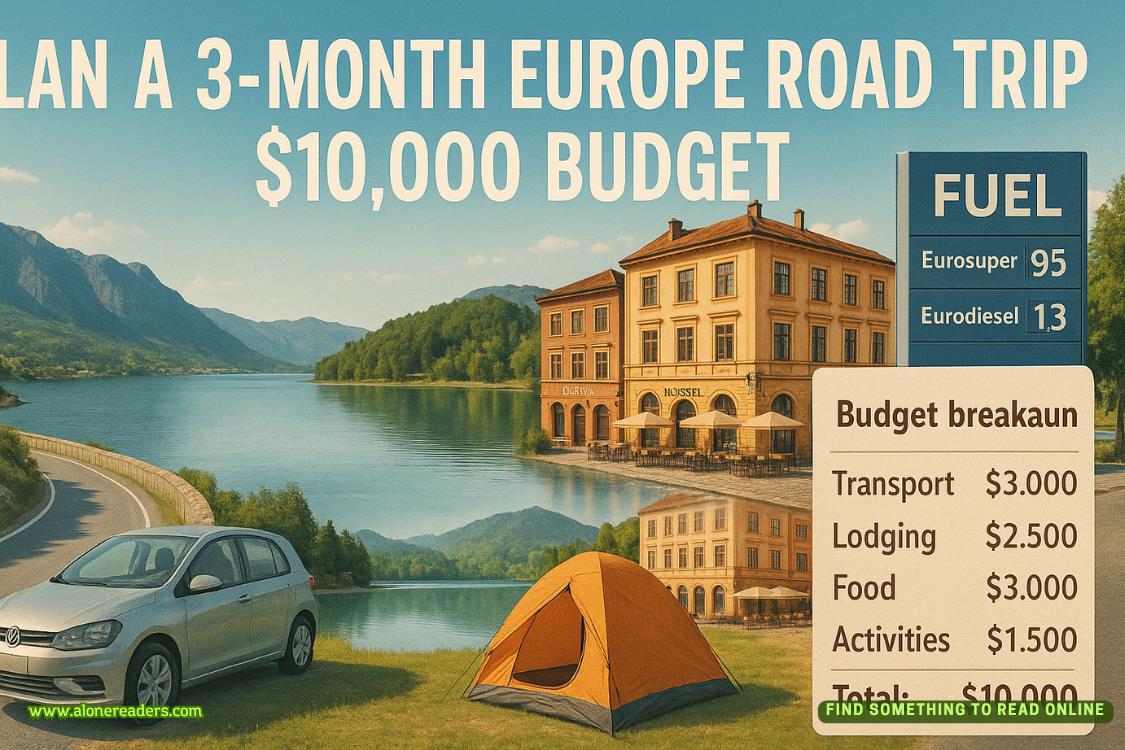
Embarking on a 90-day road trip across Europe with a budget of roughly USD 10,000 (≈ €9,200) is ambitious—but entirely feasible with rigorous planning and smart choices. In this article we dive deep into how you can stretch every euro, prioritise value-rich destinations, time your travel smartly, and optimise transport, lodging, food and sightseeing so you see a wide swath of Europe without blowing your budget. This isn’t about generic travel fluff: it will cover strategic regional cost differences, concrete allocation of funds, route design, timing to save, and tactical “hacks” tailored for a long haul drive across the continent. If you’ve always dreamed of motor-roaming Europe for three months, this guide will help make it real.
You have ~€9,200 across 90 days—which works out to about €102 per day. Traditional estimates for a comprehensive 3-month road trip float closer to ~€10,910, meaning there’s a gap of about €1,710 to bridge.
To close that gap, you must: allocate disproportionately to lower-cost regions (mainly Eastern Europe and the Balkans), travel in shoulder season (when rates are lower), mix camping and budget hostels rather than hotel-only stays, self-cater half your meals, and rely on free or very low-cost attractions. With this disciplined approach you can make the €9,200 target realistic.
To make this more than a lofty target, here’s how to split the €9,200 budget (approx) across major cost categories:
Transportation – €2,500-2,800 (≈ 27% of budget)
You’ll use a long-term car lease (for example short-term offers available in France) rather than standard daily rentals. Expect to pay around €28-31 per day for 90 days. Add fuel (~€800-1,000), tolls (~€300-400), and parking (~€200-300). Fuel prices in Europe vary widely but budget-friendly countries like Bulgaria, Poland or Spain offer lower rates.
Accommodation – €2,000-2,250 (≈ 24% of budget)
Blend camping and hostel stays: for instance 60 nights camping at ~€18/night (~€1,080) and 30 nights in hostels at ~€30/night (~€900). Use a camping discount card (e.g., one that gives €5-12/night off in low season). Eastern European hostels may run as low as €12-30 for dorm beds, whereas Paris or Rome may cost €50-60 for the same.
Food & Dining – €2,400-2,700 (≈ 29%)
Self-cater half your meals using discount supermarkets (Aldi, Lidl, etc). Estimate ~€15/day groceries. For restaurant meals allocate ~€15/day. Grocery costs in Eastern Europe can be 40-60 % cheaper than Western Europe.
Activities & Miscellaneous – ~€1,500 (≈ 16%)
Many city attractions are free; budget ~€500 for paid entries, SIM/data ~€50-80, travel insurance ~€150-200, plus a ~€700 buffer for emergencies/shopping.
To get greatest value, focus 60-70% of your time in Eastern Europe and the Balkans where daily costs may run €40-65 instead of €80-120 in Western Europe. Then reserve the remaining time for Western/Classic Europe highlights.
Recommended 90-Day Route
Travelling in the shoulder seasons—April-May or September-October—yields huge advantages: accommodation 20-30 % cheaper, fewer crowds, still pleasant weather in many regions. Avoid July-August if you want to stick to the budget: peak-season rates and high tourist volumes push costs up.
Transportation Tips
Book train or bus tickets in advance; use budget bus providers for intercity travel (~€5-15). For car travel, calculate tolls in advance (they can add up—e.g., Rome to Paris or Paris to Madrid). Consider toll-free route variants if time allows.
Accommodation Hacks
Use Booking.com or similar for advance deals, consider house-sitting in a couple of places, and make full use of a discount camping card for many nights.
Food Savings
Self-catering works especially well in Eastern Europe. Buy local-brand supermarket goods, refill your bottle for water rather than buying bottled, and avoid tourist trap restaurants with inflated prices.
Sightseeing for Free
Many major cities have excellent free walking tours (tip-based) and many museums offer free admission on select days (e.g., first Sunday of the month). These allow you to enjoy culture without the cost.
Visa & Documentation
Check your passport validity—at minimum three months past departure. If driving, check whether your home country licence suffices or if you need an International Driving Permit. If you venture into non-Schengen zones or spend more than 90 days, ensure compliance.
Travel Insurance
For a three-month period budget around €150-200 for comprehensive travel insurance covering medical treatment, cancellation and liability.
Connectivity & Tech
90-day SIM/data cards cost roughly €25-60 depending on data allowance. Use eSIM or local SIMs with 20-50 GB for your trip.
Packing List
Pack layered clothing for varying climates, good walking shoes, a rain jacket, reusable water bottle, day backpack, phone with offline maps, car-specific essentials (vehicle papers, spare tyre, GPS mount, European power adapter).
| Region | Daily Budget | Accommodation | Food | Transport |
|---|---|---|---|---|
| Eastern Europe | ~€55 | ~€20/night | ~€20/day | ~€10/day |
| Balkans | ~€65 | ~€25/night | ~€22/day | ~€12/day |
| Southern Europe | ~€75 | ~€30/night | ~€25/day | ~€15/day |
| Western Europe | ~€95 | ~€45/night | ~€35/day | ~€20/day |
Suppose you spend approximately 60% of your time in low-cost regions and 40% in higher-cost ones. A representative week might break down as:
Your goal of exploring a broad swath of Europe for three months on a $10,000 budget is absolutely achievable—but not by accident. The key components are:
If you follow this strategy, you’ll end up with a rich, varied European journey—several countries, coastlines, mountains, historic cities—without blowing your budget. The trick is to embrace the value zones, accept fewer nights in the most expensive destinations, and channel your savings into experiences rather than extravagance. With this roadmap you’re not just saving money: you’re unlocking freedom, flexibility and depth of experience. Europe doesn’t have to be prohibitively expensive—it just rewards smart planning. Bon voyage.



 Unique Australian Wildlife and Where to Find Them: A Complete Travel Guide
 Island Hopping in the Philippines: Ultimate Travel Guide to Paradise Adventures
 Hong Kong Skyline: Best Spots for Stunning Panoramic Views
 The Enchanting Lijiang: A Complete Guide to Its Ancient Alleys, Culture, and Travel Costs
 San Diego: The Ultimate Family Vacation Destination (Beaches, Wildlife, and Budget-Smart Fun)
 Unveiling the Mysteries of the Kazan Kremlin: A Complete Travel Guide to Russia’s Historic Gem