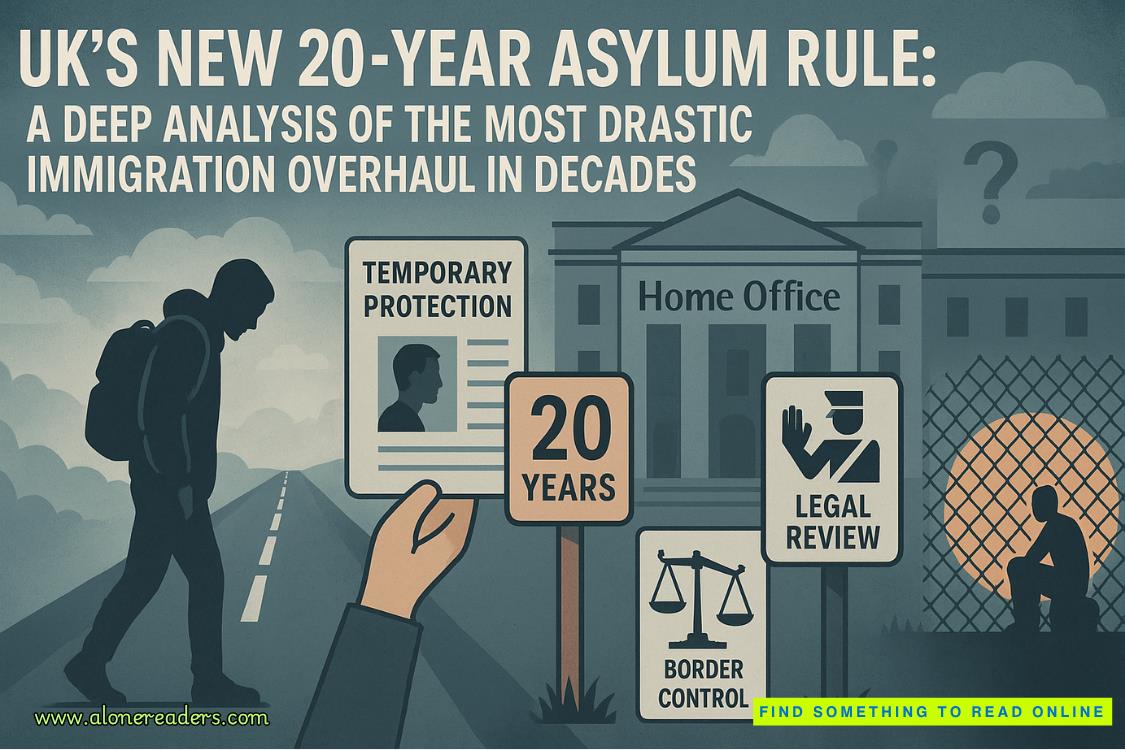
The United Kingdom is preparing to introduce one of the most far-reaching reforms to its asylum framework in modern history: a 20-year wait before refugees can apply for permanent residency. This marks a dramatic expansion from the long-established five-year route, signaling a fundamental shift in how the country intends to handle asylum, irregular migration, and long-term integration. Unlike previous policy adjustments, this change affects the very foundations of refugee stability, pushing protection away from permanence and toward an extended, review-based temporary status.
This new structure—grounded in temporary protection, repetitive assessments, reduced stability, and increased scrutiny—reflects a broader European turn toward deterrence-driven asylum systems. But with it comes profound questions: What does it mean for human lives shaped by prolonged uncertainty? How will it influence integration, employment, and mental well-being? And will it achieve the government’s stated goals of discouraging irregular entry?
This article explores these questions through a deeply analytical lens, breaking down the policy architecture, motivations, practical effects, and broader implications for the UK’s immigration landscape.
Temporary Protection Instead of Permanent Security
Under the new framework, refugees will initially be granted a 30-month (2.5-year) temporary protection status. This status must be regularly renewed, and during each renewal, authorities will reassess whether the individual continues to qualify for protection under international conventions. This contrasts sharply with the previous approach, where a five-year grant typically led smoothly into permanent settlement.
A 20-Year Continuous Presence Requirement
The central feature of the overhaul is the 20-year wait before an asylum recipient can apply for permanent residency. During this long period, protection is not guaranteed, not stable, and not predictable, as the Home Office reserves the right to review the safety of the person’s home country at any point.
Risk of Return at Any Stage
An especially significant element of the new structure is the provision that individuals may be returned to their country of origin if that country is deemed safe at any point during the 20-year window. This creates an environment where refugees live with constant concern that even short-term improvements in their home country’s political conditions could trigger removal.
Legal vs. Irregular Arrivals
The UK’s shift clearly draws a line between those who enter legally and those considered irregular arrivals.
This distinction aims to discourage irregular migration pathways, though its real-world effectiveness remains uncertain.
The Danish Influence
The UK government openly cites Denmark as a model. Denmark has one of Europe’s strictest asylum policies, built on the idea that refugee protection should be temporary, not a gateway to permanent migration unless conditions in the home country truly never improve.
The UK seeks to mirror three core Danish principles:
Aligning With “Stricter European Standards”
While many EU states still maintain shorter routes to settlement, several have recently tightened their policies to discourage irregular entry and reduce long-term welfare burdens. The UK’s 20-year model, however, stands out even among the toughest jurisdictions as one of the longest waits for permanent residency in the developed world.
Economic and Social Integration Under Uncertainty
A 20-year temporary status fundamentally changes how refugees can build a life. Key disruptions include:
Temporary protection may allow work, but the lack of permanence creates structural barriers that hinder integration.
Housing and Support Dependent on Conduct and Contribution
The government has hinted that asylum-related support—such as housing or subsistence assistance—may be withdrawn if refugees do not contribute economically, fail to integrate, or engage in criminal activity. This establishes a conditional model where protection, support, and long-term prospects are tied directly to economic productivity and legal compliance.
Pressure on Mental Health and Family Stability
For refugees, safety is only one part of rebuilding life; predictability is another. A 20-year period of repeated reviews creates:
Families with children born or raised in the UK may find themselves in situations where parental protection is withdrawn even though the child knows no other country.
Deterring Irregular Migration
A primary driver of the policy is discouraging migrants from using irregular routes—especially small boats crossing the English Channel. The government argues that by making long-term settlement harder for irregular arrivals, fewer people will choose dangerous journeys.
Reducing the “Pull Factor”
The UK believes that quicker settlement routes act as a “pull factor.” A 20-year wait, subject to constant review, is meant to make the UK less attractive compared to other European destinations.
Managing Long-Term Public Spending
Long-term settlement routes require welfare, housing, and integration resources. By extending temporary status, the government claims it will ensure individuals become economically self-sufficient rather than dependent on long-term state support.
Consistent Assessments Based on Country Conditions
The policy allows return when countries become safe, reinforcing the idea that asylum is a temporary humanitarian measure, not a permanent immigration route. The government argues that returning individuals when safe ensures protection remains aligned with international principles.
Prolonged Uncertainty Undermines Integration
Experts overwhelmingly argue that stability is essential for integration. Without settlement security:
Ironically, a policy meant to improve integration through “responsibility and contribution” may create the opposite outcome by unsettling the foundations needed to integrate successfully.
Potential Increase in Statelessness Risk
Legal observers warn that returning individuals to “safe countries” may become contentious if the definition of safety shifts politically rather than objectively. People could be forced to return to countries where conditions remain unstable or discriminatory, leading to humanitarian complications.
Backlogs and Administrative Burden
Frequent reassessments every 30 months for potentially hundreds of thousands of individuals will require massive administrative resources. Critics suggest this may:
Ethical and Humanitarian Considerations
A 20-year wait is, by global standards, one of the most restrictive frameworks introduced among wealthy nations. Many humanitarian organizations argue that it places already vulnerable individuals in extended limbo, contradicting the UK’s historical commitments to refugee protection.
Previous System (Before Overhaul):
New System (After Overhaul):
This marks a fundamental transformation from an integration-based model to a deterrence-based one.
The 20-year asylum pathway suggests that the UK is transitioning into a two-tier humanitarian protection system:
This approach aligns with political commitments to reduce small boat crossings and assert stronger border control. However, it also risks:
Most importantly, it redefines what it means to be protected in the UK—not as a step toward nationhood or belonging, but as a conditional, continuously reassessed permission to remain.
The UK’s new 20-year asylum rule is not just a policy adjustment; it is a philosophical reorientation of the nation’s approach to refuge, protection, and long-term residence. By shifting from a five-year route to a two-decade journey marked by temporary protection, periodic reviews, potential deportation, and conditional support, the country has embraced one of the strictest asylum models in the Western world.
Whether this strategy will deter irregular migration or simply create a generation living in uncertainty remains one of the most critical questions ahead. What is clear, however, is that this overhaul will fundamentally reshape refugee experiences, integration dynamics, and the wider debates surrounding immigration and humanitarian responsibility in the United Kingdom for decades to come.



 Qatar Temporary Work Visa 180 Days 2026: Complete Eligibility, Application Process, Documents, Costs, Extension Rules, and Employment Guide
 Canada Intra-Company Transfer Work Permit 2026: Complete Guide to Eligibility, Requirements, Application Process, and Employer Responsibilities
 UK Study English Language Visa 2026: Complete Guide to Eligibility, Requirements, Costs, Application Process, and Student Life
 UK Expansion Worker Visa Intra-Company 2026: Complete Guide to Eligibility, Sponsorship, Costs, Business Expansion, and Application Process
 High-End Talent Category A Work Permit China 2026: Complete Eligibility, Benefits, Application Process, and Expert Guide
 Cultural Activities Visa Japan 2026 Guide: Complete Eligibility, Requirements, Application Process, and Expert Tips










