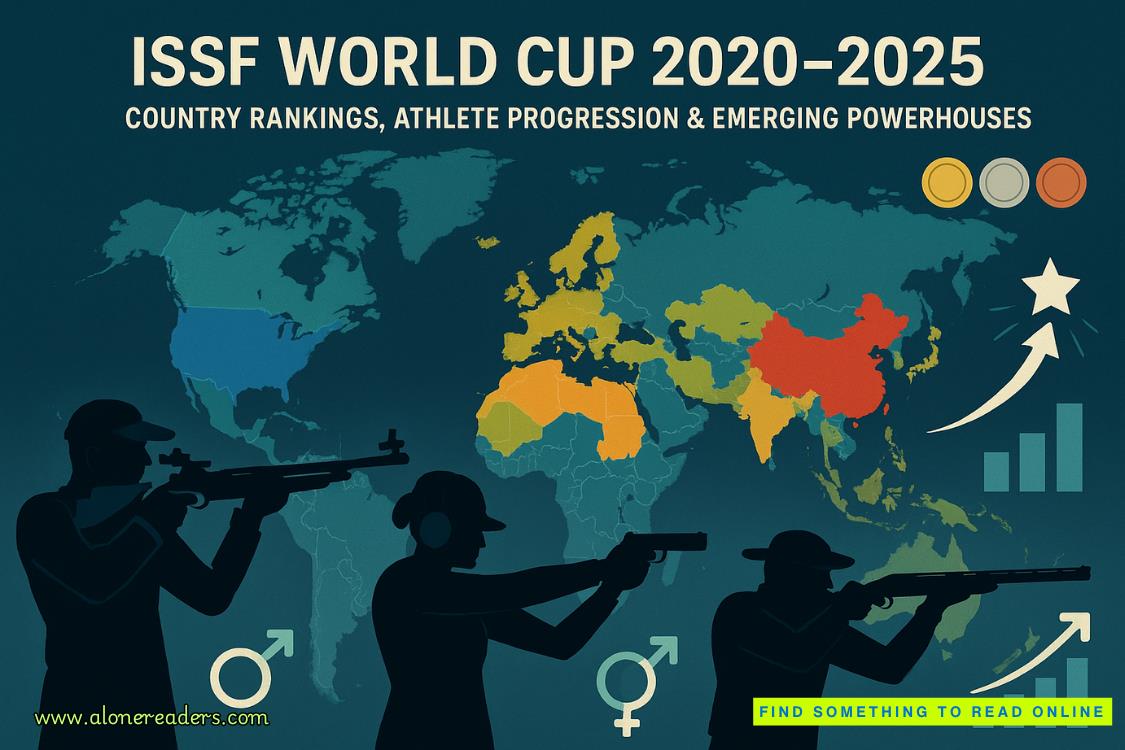
The ISSF World Cup landscape has undergone a dynamic transformation over the past five years, reshaping competitive hierarchies, revealing new powerhouses, and redefining how nations approach event specialization. From pandemic-era disruptions to the resurgence of large-scale competitions, the 2020–2025 cycle has been one of the most strategically significant periods in modern shooting sport history. The latest data from the 2025 season—paired with athlete trajectories and nation-wise trends—shows not only who dominates today, but who is set to control the next Olympic cycle.
At the forefront stands China, the undisputed leader with 42 medals in 2025, continuing a trend of unchallenged superiority. Despite the pressure of improving rivals, China’s model of balanced event investment, combining rifle, pistol, and shotgun development, has created a systems-oriented formula that is extremely difficult to replicate. Instead of relying on star individuals, China has formed wide performance bands, ensuring depth across multiple disciplines. Their five-year average of 39.2 medals solidifies them as the sport’s structural benchmark, not merely a seasonal performer.
Behind them rises the biggest story of 2025—India’s breakthrough performance, marking a powerful +15.8% growth year with 22 medals, securing second place globally. What makes India’s rise significant is not just medal count, but structural shifts: they are no longer dependent on isolated brilliance but now field an emerging system capable of producing multiple high-performing shooters each season. Names like Sift Kaur Samra represent not just breakthrough talent, but indicators of program maturity. India’s focus on pistol events and technical precision disciplines has proven highly efficient. Their projected reach of 25–30 medals by 2027 suggests long-term sustainability rather than short-term momentum.
The United States, historically a powerhouse, is reshaping its identity. Sitting at third place with 19 medals in 2025, their growth rate of +18.8% signifies a strong return to form. However, their strategy differs from Asia’s balanced model—the USA is increasingly specializing in shotgun events, particularly trap and skeet, signaling a clear national direction. This specialization, while narrowing overall scope, has improved consistency in medal return efficiency. The United States appears to be prioritizing Olympic-focused disciplines rather than broad medal dispersal, using tactical depth over structural breadth.
Meanwhile, Europe retains formidable influence, though traditional hierarchies within the continent are shifting. Norway, Czech Republic, and Italy have become the most progressive performers, with Norway rising to 11 medals (+37.5% growth) and Czech Republic achieving an impressive +60% surge. These countries are becoming models of efficient national development—building small but highly focused programs that maximize success in rifle disciplines. Their athlete progression patterns also suggest future leaders are already emerging, with Ole Martin Halvorsen, Jiří Přívratský, and others potentially shaping the next cycle of European dominance.
Some nations, however, reflect market correction. South Korea and Germany, both once reliable shooting powerhouses, show notable declines—South Korea down 57.9%, Germany down 46.2%. While their historical benchmarks remain strong, the shift towards Asian and Central European competitiveness demands organizational reform to stay relevant. These nations still maintain elite shooters, but lack the systemic growth shown by their rivals. Their decline is not a collapse but a signal—an inflection point that requires strategic redirection.
The dynamics of event specialization are now clearer than ever:
• China remains the only nation with a fully balanced performance structure across rifle, pistol, and shotgun
• India is now heavily pistol-focused, winning most of its recent medals in precision events
• USA has strategically leaned toward shotgun
• Australia shows emerging strength specifically in trap, building a niche-based approach to success
• Germany and Norway continue to excel in rifle, but lack depth in mixed and multi-event formats
Over five years, athlete progression data reveals a compelling insight—sustained excellence is achievable with career spans of 20+ years, confirming that shooting remains one of the few elite sports where longevity remains a competitive asset. Legends like Ralf Schumann (39 career golds) and Kimberly Rhode (21 golds, shotgun focus) illustrate that seasoned experience still has a place in elite competition. Veteran presence is not fading—it is transforming into mentoring roles, influencing new trajectories.
The rise of younger athletes, however, suggests a new era is forming. Sheng Lihao, Anna Janssen, Liu Yukun, and Sift Kaur Samra represent a shift similar to generational turnovers in global tennis and athletics. The shooting sport no longer depends solely on experience—today, it rewards fast developmental acceleration, particularly from nations with strong junior pipelines. This shift favors nations with structured coaching academies and early specialization programs.
One of the most significant transformations has unfolded in gender participation. Five years ago, parity seemed distant; today, women now represent 43.75% of competitive participation, signaling an extremely strong trajectory toward full balance. With mixed team events improving visibility and medal accessibility, women now represent nearly half of podium placements in many rifle and pistol events. If current trends continue, the sport could reach 50% parity by 2028, establishing shooting as one of the most gender-progressive Olympic disciplines.
The turning point of this progression remains tied to global disruption. The COVID-19 impact in 2020 created the lowest medal distribution in modern ISSF history, with reduced event count and significant competitive instability. Yet by 2023, performance rebounded sharply, particularly in countries with structured training ecosystems. China, India, and Ukraine showed notable recovery trajectories, while smaller countries used the disruption to build strategic improvements rather than struggle for survival. The pandemic disruption ultimately accelerated modernization—creating a more level field for emerging nations.
From a long-term strategic lens, eight key insights shape the global direction of ISSF shooting:
• China remains structurally unbeatable—but challengers are multiplying
• India is shifting from promise to genuine power status
• Europe remains relevant, but new intra-European dynamics are forming
• Event specialization is no longer occasional—it is a proven strategy
• Athlete careers can now span multiple Olympic cycles, enhancing ROI on training
• Rapid-growth nations must build sustainable academies or risk decline
• Gender parity is no longer idealistic—it is now statistically approaching reality
• The next three years will likely define the next decade of performance hierarchy
The geopolitical story emerging behind the medals is clear: shooting is no longer dominated by four or five nations—it is becoming global. With Guatemala, Poland, and Argentina entering the medal scene, and over 30 nations projected to score medals by 2027, the sport is transitioning from elite exclusivity to broader accessibility. Technological improvements, digital training facilities, and academy-style national coaching programs are accelerating growth where it was never seen before.
The past five years were about recovery. The next five will be about consolidation and supremacy. Nations that can combine youth development, event specialization, technological support, and gender equality initiatives will not merely compete—they will define the future architecture of the ISSF World Cup. The race is no longer for medals alone; it is for structural power. The 2025 data does not simply reflect winners—it shows the blueprint of those building the next decade of dominance.



 First NFL Game in Southern Hemisphere: Eagles Triumph Over Packers 34-29 in São Paulo
 Olympic Highlights: Young Athletes Steal the Show at Paris 2024
 The Evolution of E-Sports: From Niche Hobby to Mainstream Sport
 2024 Copa America in the USA: A Landmark Event for CONMEBOL and CONCACAF Teams
 Optimize Your Athletic Performance: Essential Nutrition Tips for Sports Enthusiasts
 Mastering Mindfulness in Sports: Elevating Your Mental Game