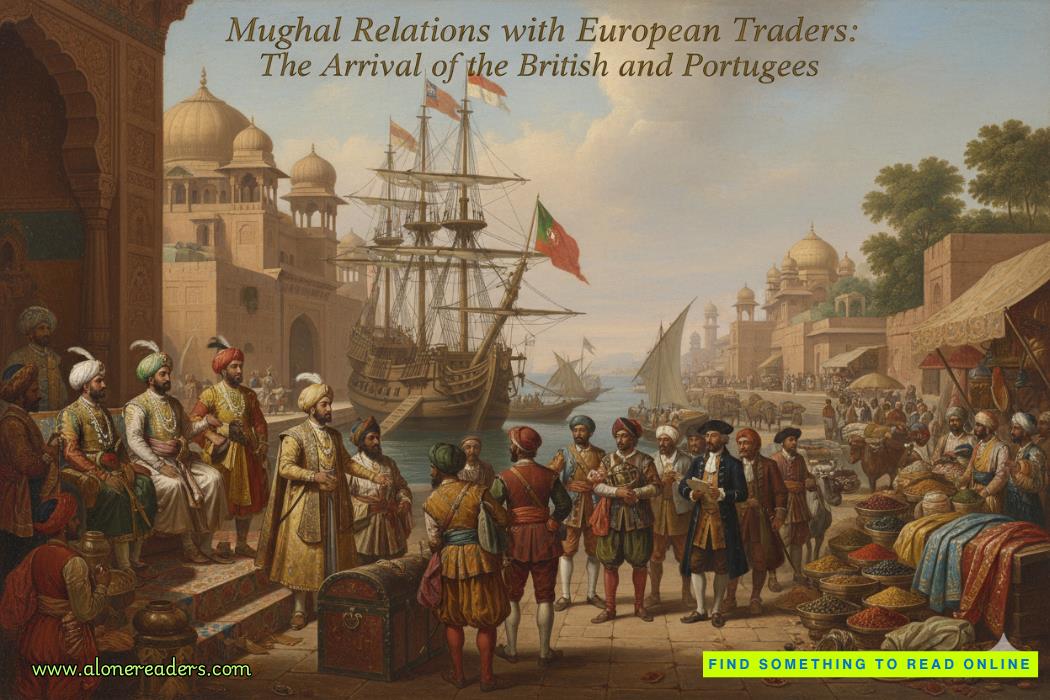
The relationship between the Mughal Empire and European traders marks a turning point in the history of South Asia, where commerce, diplomacy, and imperial ambition intersected in complex and often unexpected ways. When the Portuguese first arrived on the western coast of India at the close of the fifteenth century, followed later by the British East India Company in the early seventeenth century, the Mughal Empire was at the height of its power, wealth, and administrative sophistication. Yet, these encounters would gradually reshape not only the economic landscape of the subcontinent but also its political destiny.
The Portuguese were the first Europeans to establish a significant presence in India, arriving under Vasco da Gama in 1498. By the time the Mughal Empire was founded by Babur in 1526, the Portuguese had already secured strategic ports along the western coast, particularly Goa, which became the center of their operations. Their initial interest lay in controlling the lucrative spice trade, but they soon extended their influence into maritime dominance across the Indian Ocean. Unlike the later British, the Portuguese pursued a more aggressive and often coercive approach to trade, using naval power to enforce monopolies and extract concessions.
During the reign of Emperor Akbar, the Mughal Empire began to take a more structured interest in foreign relations, including interactions with European traders. Akbar’s court was known for its intellectual openness and diplomatic curiosity. Portuguese traders and Jesuit missionaries were invited to his court, where they engaged in theological debates and cultural exchanges. However, while Akbar showed interest in European knowledge and religion, he remained cautious about granting them significant political or territorial privileges. The Portuguese were allowed to trade, but always under the oversight of Mughal authorities, reflecting the empire’s strong control over its internal affairs.
The Portuguese presence in India was marked by a combination of commercial ambition and religious zeal. Their efforts to spread Christianity often created tension with local populations and rulers. In Mughal territories, however, their influence remained limited to coastal regions and specific trading enclaves. The Mughal Empire, with its vast land-based power, did not feel directly threatened by the Portuguese naval dominance, but it was aware of the potential risks posed by foreign control of maritime trade routes. This awareness would later influence how the Mughals dealt with other European powers.
The arrival of the British East India Company in 1600 introduced a new dynamic into Mughal-European relations. Unlike the Portuguese, the British initially adopted a more diplomatic and less confrontational approach. Their primary objective was to secure trading rights and establish commercial footholds within the Mughal Empire. In 1615, Sir Thomas Roe was sent as an ambassador to the court of Emperor Jahangir, marking a significant moment in Anglo-Mughal relations. Roe’s mission was to obtain permission for the British to trade freely and establish factories in key locations.
Jahangir, known for his appreciation of art and foreign curiosities, received Roe with interest but also with caution. The Mughal court was accustomed to dealing with foreign envoys and understood the importance of maintaining sovereignty while benefiting from international trade. Roe’s diplomatic efforts were largely successful, and the British were granted permission to establish trading posts in Surat and other locations. This marked the beginning of a long and evolving relationship between the Mughal Empire and the British.
What distinguished the British from the Portuguese was their strategic patience and adaptability. While the Portuguese relied heavily on naval force, the British focused on building alliances, understanding local customs, and integrating themselves into existing trade networks. They presented themselves as humble merchants rather than imperial contenders, a strategy that allowed them to gain the trust of Mughal officials. Over time, however, this commercial presence would transform into political influence.
Trade between the Mughals and European traders was centered on high-value commodities such as textiles, spices, indigo, and precious stones. Indian textiles, in particular, were in great demand in Europe, and the Mughal Empire became a key supplier in global trade networks. The British and Portuguese competed fiercely for access to these goods, often clashing with each other in maritime conflicts. The Mughal Empire, meanwhile, maintained a policy of controlled engagement, allowing trade but limiting foreign interference in internal matters.
Despite this careful balance, the growing presence of European traders began to have subtle but significant effects on the Mughal economy and administration. The influx of silver from Europe helped to stabilize the Mughal currency system, but it also increased dependence on foreign trade. Moreover, the establishment of European trading posts created semi-autonomous zones that operated under different legal and administrative frameworks. While these were initially small and tightly regulated, they would later become centers of colonial power.
The decline of the Mughal Empire in the late seventeenth and early eighteenth centuries created opportunities for European traders to expand their influence. Internal conflicts, succession struggles, and regional fragmentation weakened central authority, making it easier for foreign powers to negotiate favorable terms. The British East India Company, in particular, capitalized on these conditions, gradually shifting from trade to territorial control. The Portuguese, on the other hand, began to lose their dominance, overtaken by more organized and economically driven competitors.
One of the most important aspects of Mughal-European relations was the contrast in long-term vision. The Mughals viewed trade as a means of enhancing imperial prosperity, while European powers increasingly saw it as a gateway to political dominance. This difference in perspective shaped the trajectory of their interactions. The Mughals, confident in their strength, underestimated the strategic ambitions of European traders, particularly the British, who were quietly building the foundations of an empire.
Cultural exchange also played a role in these interactions. European goods such as clocks, firearms, and artwork were introduced into the Mughal court, influencing tastes and technologies. At the same time, Indian products and artistic styles found their way into European markets, contributing to a growing fascination with the East. These exchanges, while often overshadowed by political developments, highlight the complexity of Mughal-European relations as more than just economic transactions.
By the early eighteenth century, the balance of power had begun to shift decisively. The British East India Company had established a strong presence in key regions and was increasingly involved in local politics. The Mughal Empire, weakened by internal divisions, was no longer able to exert the same level of control over foreign traders. This marked the beginning of a new phase in Indian history, where European powers would play a dominant role.
The story of Mughal relations with European traders is therefore not just about trade, but about the gradual transformation of power. It reveals how initial interactions based on mutual benefit can evolve into relationships marked by inequality and domination. The Portuguese and British arrived as traders, but their legacy would extend far beyond commerce, shaping the political and cultural landscape of India for centuries to come.
Understanding this period provides valuable insight into the mechanisms of early globalization, where distant empires became interconnected through trade and diplomacy. It also serves as a reminder of the importance of strategic awareness in international relations. The Mughal Empire, despite its grandeur and strength, was ultimately unable to fully anticipate or counter the long-term ambitions of European powers. This gap between perception and reality would have profound consequences, paving the way for the colonial era.



 The Hundred Days Offensive: How the Allies Defeated Germany in World War I
 The Second Battle of the Marne: The Turning Point of World War I in 1918
 The Spring Offensive of 1918: Germany's Final Gamble to Win World War I
 The Treaty of Brest-Litovsk: How Russia Left World War I
 The Russian Revolution and World War I: How War Brought Down the Tsar
 The Zimmermann Telegram Explained: Germany's Secret Offer to Mexico in World War I