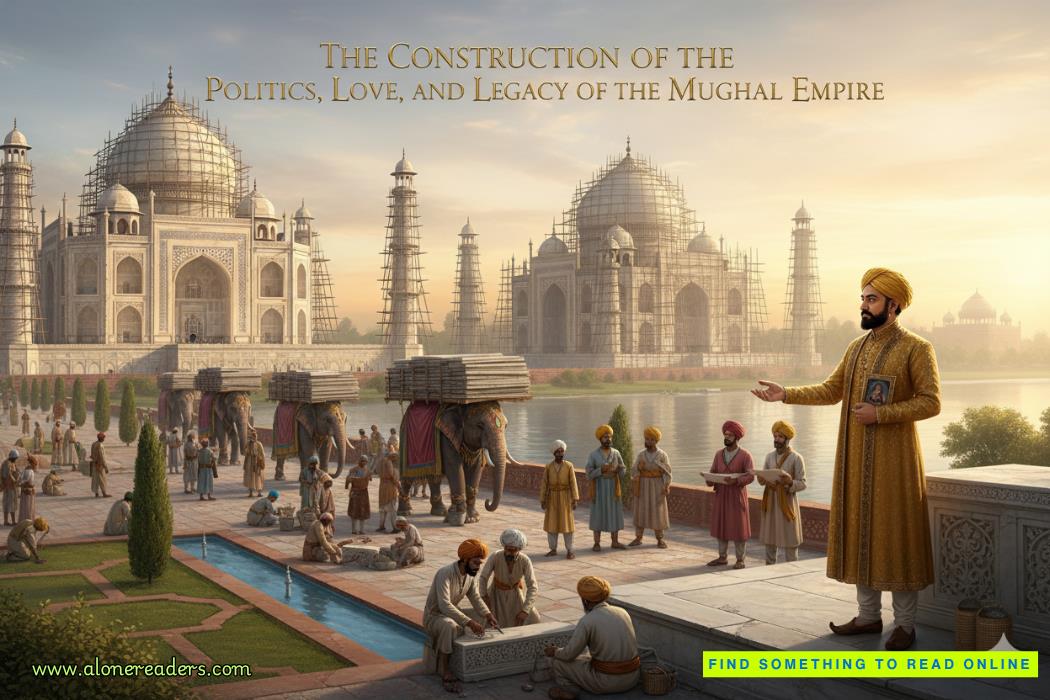
The Taj Mahal stands not merely as an architectural masterpiece but as a multilayered historical narrative where love, imperial authority, economic power, and artistic ambition intersect. Often romanticized as a monument of eternal love, its construction reveals a far more complex story rooted in the political and cultural dynamics of the Mughal Empire during the 17th century.
Commissioned by Emperor Shah Jahan in 1632 following the death of his beloved wife Mumtaz Mahal, the Taj Mahal was conceived as a mausoleum that would immortalize both personal grief and imperial grandeur. Yet, to understand its construction fully, one must move beyond the popular narrative of romance and examine the deeper forces that shaped its creation. The monument was not simply an emotional tribute—it was also a calculated display of dynastic power, legitimacy, and aesthetic supremacy.
At the time of its construction, the Mughal Empire was at its zenith. Shah Jahan ruled over a vast and wealthy territory, benefiting from a stable administrative system and a flourishing economy. This stability allowed him to embark on ambitious architectural projects that would reinforce his authority. The Taj Mahal, therefore, functioned as a political statement, projecting the emperor’s ability to command immense resources and labor. It symbolized not only devotion but also absolute control over the empire’s wealth and workforce.
The scale of the construction itself was unprecedented. Historical accounts suggest that over 20,000 artisans and laborers were employed, including architects, calligraphers, stone cutters, and inlay specialists from across Central Asia, Persia, and the Indian subcontinent. The chief architect is often believed to be Ustad Ahmad Lahori, though the project likely involved a collaborative team of master builders. Materials were sourced from across the empire and beyond: white marble from Makrana in Rajasthan, lapis lazuli from Afghanistan, jade from China, and turquoise from Tibet. This extensive network of resources underscores the Taj Mahal’s role as a global symbol of Mughal influence and connectivity.
The logistics of transporting these materials were equally impressive. Massive blocks of marble were carried over long distances using oxen carts and elephants, while a specially constructed ramp system facilitated the raising of heavy stones to great heights. The construction process spanned over two decades, with the main mausoleum completed around 1643 and the surrounding complex finalized by 1653. This prolonged effort reflects not only the complexity of the design but also the emperor’s unwavering commitment to creating a monument of unmatched beauty.
Architecturally, the Taj Mahal represents the culmination of Mughal design principles, blending Persian, Islamic, and Indian elements into a harmonious whole. The central dome, rising majestically above the structure, is flanked by four slender minarets that slightly tilt outward—a subtle engineering feature designed to protect the main tomb in case of collapse. The symmetrical layout of the complex, including the charbagh garden, reflects the Islamic concept of paradise, with flowing water channels symbolizing eternal life.
The decorative elements of the Taj Mahal further enhance its symbolic significance. Intricate pietra dura inlay work adorns the marble surfaces, featuring floral motifs crafted from semi-precious stones. Quranic inscriptions, executed in elegant calligraphy, frame the entrances and guide visitors through a spiritual journey. These artistic choices were not merely ornamental; they were carefully curated to evoke a sense of divine perfection and eternal peace. The monument thus becomes a fusion of art, spirituality, and imperial ideology.
Despite its beauty, the construction of the Taj Mahal also raises important questions about labor and cost. While it is often portrayed as a labor of love, it was undeniably a massive state-sponsored project that required significant financial investment. Some estimates suggest that the construction cost amounted to a substantial portion of the empire’s treasury. Although there is no credible evidence supporting the myth that workers’ hands were amputated after completion, it is clear that the project demanded intense labor under imperial authority. This duality highlights the tension between romantic idealism and historical reality.
The political implications of the Taj Mahal extend beyond its construction. During Shah Jahan’s reign, architecture became a key tool for reinforcing royal legitimacy. The emperor commissioned several grand structures, including the Red Fort in Delhi and the Jama Masjid, each reflecting his vision of a powerful and cultured empire. The Taj Mahal, however, stands apart due to its emotional resonance. It humanizes the emperor, presenting him not only as a ruler but also as a grieving husband. This blending of personal and political narratives strengthens the monument’s enduring appeal.
Ironically, Shah Jahan’s later years add another layer of poignancy to the Taj Mahal’s story. In 1658, he was deposed by his son Aurangzeb and spent the remainder of his life under house arrest in the Agra Fort. From his confinement, he is said to have gazed upon the Taj Mahal, the very symbol of his love and power, now distant and untouchable. After his death in 1666, he was buried beside Mumtaz Mahal within the mausoleum, breaking the perfect symmetry of the tomb—a subtle reminder that even the most carefully designed legacies are subject to the unpredictability of history.
Over the centuries, the Taj Mahal has undergone various phases of preservation and reinterpretation. During the British colonial period, it was restored and maintained, though often through a lens that emphasized its aesthetic value over its historical context. In modern times, it has become a global icon, attracting millions of visitors each year and symbolizing India’s rich cultural heritage. Yet, its meaning continues to evolve, shaped by contemporary discussions حول heritage, identity, and tourism.
What makes the Taj Mahal truly remarkable is its ability to transcend time and context. It is simultaneously a personal monument of grief, a political assertion of imperial power, and a universal symbol of beauty and love. Each visitor brings their own interpretation, adding new layers to its already complex narrative. The monument’s enduring legacy lies not only in its physical structure but also in its capacity to inspire reflection on the nature of love, power, and human ambition.
In examining the construction of the Taj Mahal, one must resist the temptation to view it through a single lens. It is neither purely a love story nor solely a political project; rather, it is a convergence of multiple forces that define the Mughal era. The interplay between personal emotion and statecraft is what gives the monument its depth and significance. It reminds us that history is rarely simple and that even the most beautiful creations often emerge from a blend of passion, power, and complexity.
Ultimately, the Taj Mahal endures because it speaks to something universal. It captures the human desire to create meaning in the face of loss, to leave behind a legacy that outlives mortality. Shah Jahan may have intended it as a tribute to Mumtaz Mahal, but in doing so, he created a structure that transcends its origins. Today, it stands as a testament to the enduring power of art and architecture to tell stories that resonate across centuries.
In this way, the Taj Mahal is not just a monument—it is a living narrative, continuously interpreted and reinterpreted by those who encounter it. Its construction reflects a moment in history when love, politics, and artistry converged to produce something truly extraordinary. And in that convergence lies its greatest legacy: a reminder that even in the pursuit of power, there remains a deeply human desire to be remembered, understood, and, above all, to love.



 The Hundred Days Offensive: How the Allies Defeated Germany in World War I
 The Second Battle of the Marne: The Turning Point of World War I in 1918
 The Spring Offensive of 1918: Germany's Final Gamble to Win World War I
 The Treaty of Brest-Litovsk: How Russia Left World War I
 The Russian Revolution and World War I: How War Brought Down the Tsar
 The Zimmermann Telegram Explained: Germany's Secret Offer to Mexico in World War I










