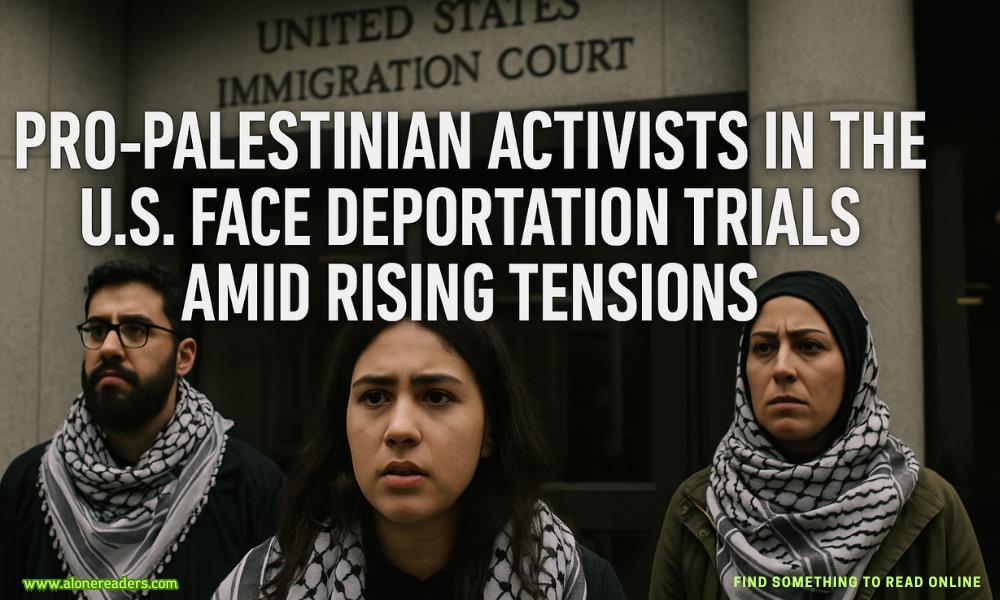
In recent months, a series of deportation trials targeting pro-Palestinian activists has stirred heated debates across the United States. At the heart of the controversy is the question of whether these legal proceedings are grounded in legitimate immigration concerns or if they reflect a broader crackdown on political dissent and activism. The trials have ignited outcry from human rights organizations, legal experts, and civil liberties advocates who argue that the U.S. government is using immigration enforcement as a tool to silence voices critical of American foreign policy and its longstanding support for Israel.
The situation has unfolded in a politically charged atmosphere shaped by ongoing conflict in Gaza and the West Bank, escalating tensions in U.S. universities, and deep polarization across American society. In many cases, the activists in question are international students, temporary visa holders, or permanent residents, not citizens. They have been active in organizing protests, engaging in social media advocacy, or participating in solidarity campaigns that call for a ceasefire, condemn Israeli military actions, or demand divestment from companies tied to the Israeli defense sector.
One such case involves a 26-year-old Palestinian-American graduate student at a prominent northeastern university who has been served a Notice to Appear before an immigration judge. The Department of Homeland Security claims she violated the terms of her visa by participating in an “unauthorized political rally” that allegedly led to property damage, though there is no evidence that she engaged in or incited any such behavior. Her supporters insist that her activism was peaceful and protected under the First Amendment, and view the charges as a pretext to expel her from the country due to her political stance.
Another high-profile case involves a Jordanian-born software engineer who has lived in the U.S. for more than a decade on a work visa. He is now facing removal proceedings following his online posts that criticized U.S. arms sales to Israel and called for a boycott of defense contractors. Federal authorities argue that some of his posts “may be interpreted as incitement,” although no criminal charges have been filed. Civil rights lawyers warn that this sets a dangerous precedent—one where expressing controversial political opinions becomes grounds for deportation.
The legal framework being used in many of these cases rests on the discretion afforded to immigration authorities. Under U.S. immigration law, non-citizens can be deported for a wide range of reasons, including minor visa infractions or conduct deemed inconsistent with public interest or national security. However, this broad latitude has drawn criticism, especially when enforcement appears to disproportionately affect individuals from politically sensitive backgrounds or marginalized communities.
Critics argue that the current actions mark a new chapter in the post-9/11 era of surveillance and repression. Back then, numerous Muslim immigrants were detained or deported based on weak or circumstantial links to terrorist activities. Now, with pro-Palestinian activism growing worldwide, some see history repeating itself—this time with student activists, artists, academics, and professionals as the targets.
Organizations like the American Civil Liberties Union (ACLU), Amnesty International, and the Center for Constitutional Rights have taken up several of these cases, arguing that political activism—no matter how unpopular—must not be conflated with threats to national security. Legal experts also point out that peaceful advocacy and public demonstrations fall squarely within the protections granted by the U.S. Constitution. They warn that using immigration proceedings to suppress dissent could lead to a chilling effect, especially among immigrant communities, who may self-censor for fear of retaliation.
On university campuses, the issue has become especially volatile. Following large-scale student-led demonstrations against the war in Gaza, some institutions have been accused of cooperating with federal agencies by reporting visa violations or disciplinary measures tied to activism. This has added fuel to the fire, with faculty members and student groups accusing universities of failing to uphold academic freedom and student rights. In some cases, disciplinary records are being used as evidence in deportation hearings, despite the fact that such infractions may not amount to legal misconduct.
Meanwhile, officials from the Biden administration maintain that immigration law is being applied uniformly and that no one is being targeted for their political beliefs. A spokesperson for U.S. Immigration and Customs Enforcement (ICE) said, “All enforcement actions are based on violations of immigration law. Claims of political persecution are not supported by the evidence in these cases.” Still, these assurances have done little to convince critics, many of whom point to the timing, scale, and focus of recent actions as indicative of a coordinated response to rising dissent.
International observers have also weighed in. Human Rights Watch and the United Nations Special Rapporteur on freedom of expression have expressed concern over what they describe as “selective enforcement” of immigration policies that threaten to suppress political speech. Some fear that these trends could embolden authoritarian regimes abroad, who may justify their own crackdowns by citing U.S. actions.
For affected individuals, the consequences are severe. Deportation not only uproots their lives but also stigmatizes them in ways that can have long-term social, psychological, and professional repercussions. Many report being placed in detention facilities under harsh conditions while awaiting hearings, sometimes for weeks or months. Some have been separated from families, lost jobs, or faced blacklisting in their fields. Others have been advised to leave the U.S. voluntarily in order to avoid more damaging outcomes—effectively silencing their activism and erasing their contributions from public discourse.
Despite the mounting pressure, pro-Palestinian groups in the U.S. have vowed not to back down. Many have doubled their efforts, organizing legal defense funds, protest campaigns, and awareness drives to shed light on what they see as an orchestrated attempt to quash a movement gaining momentum worldwide. They stress that their struggle is part of a broader battle for justice, human rights, and freedom of speech—not just for Palestinians, but for all people facing oppression and censorship.
Looking ahead, the deportation trials could set significant legal precedents. Courts will have to determine the extent to which immigration law can be used in cases where political speech is at the core. If judges side with the government, it could pave the way for even broader use of immigration enforcement as a disciplinary tool. Conversely, rulings in favor of the activists could reaffirm First Amendment protections and restrain the overreach of immigration authorities.
In the meantime, these cases remain flashpoints in a polarized America—one grappling with its own ideals of liberty and justice. Whether seen as a matter of national security or civil liberties, the trials of pro-Palestinian activists are testing the very foundation of American democracy, revealing the fine line between enforcement and suppression, between the rule of law and the power of dissent.



 Meaning and Origins of Easter: A Deep Dive into Its History and Symbolism
 A Complete Guide to Healthy and Delicious Easter Brunch Recipes
 Creative DIY Easter Decorations to Brighten Your Home
 Easter Traditions Around the World: Egg Hunts, Bonfires & Festive Feasts in 2025
 Reforming Uber Driver Ratings: The Need to Count Unrated Rides for Fairer Evaluations
 Best Smartphones of 2025 (So Far): Top Picks, AI Features, and Market Trends










