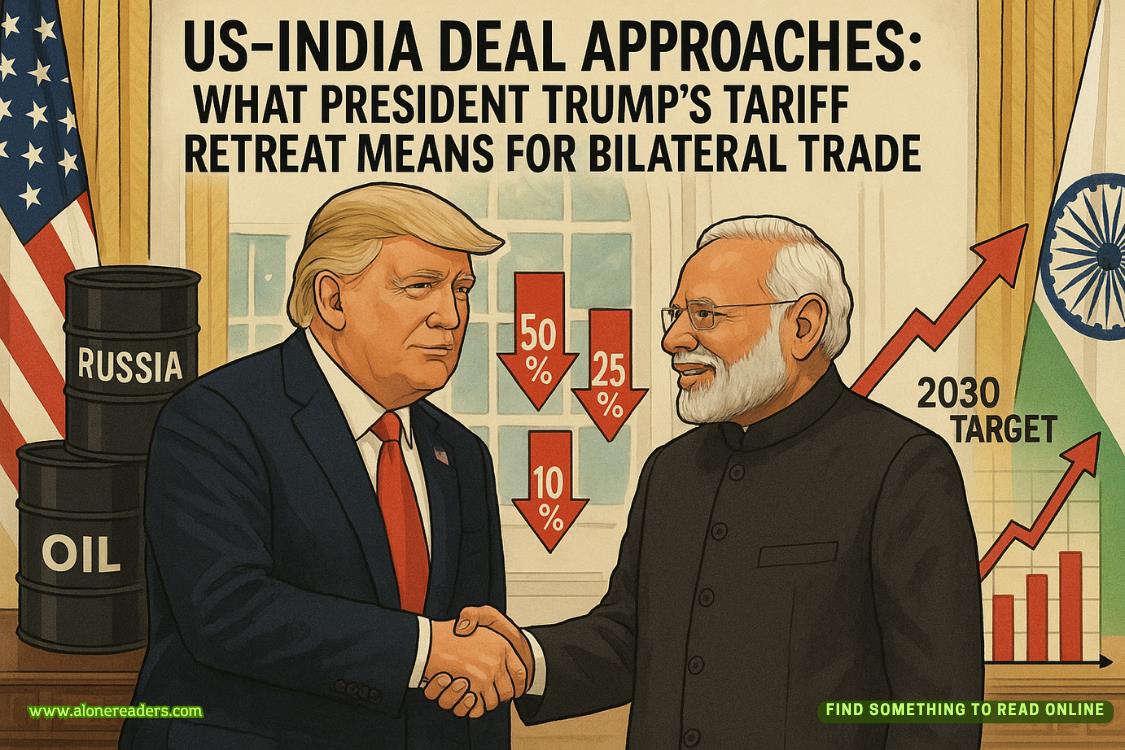
In a sudden shift of tone, Donald Trump has indicated that his administration is prepared to reduce tariffs on Indian imports as part of an impending trade agreement with India. This comes after months of escalating tensions, including the U.S.’s decision to impose tariffs of up to 50 per cent on Indian goods—primarily linked to India’s continued imports of Russian oil. With five rounds of negotiations already completed, the stakes are high: both nations are targeting an ambitious goal of doubling trade by 2030, expanding energy, manufacturing and services linkages. Yet despite the progress, several sensitive issues remain unresolved, notably U.S. demands for deeper access into India’s agricultural and automobile sectors. In this article we unpack exactly what the U.S.–India tariff saga looks like now, what the mechanics of the deal are likely to be, and what the implications will be for both countries if the deal closes.
Why tariffs escalated
From the outset of his current term, Trump has criticised India as a “tariff king” and warned that the United States would mirror any high levies India imposed. India’s trade-weighted average tariff is around 12 per cent, compared with the U.S. average of roughly 2.2 per cent. Previously, the Trump administration signalled its concern that India’s exports to the U.S. were protected and non-reciprocal.
What tipped the dispute into crisis was India’s import of Russian oil. The U.S. claimed India’s purchases financed Moscow in its war in Ukraine and used that as the justification for punitive tariffs. Trump’s position: India must curb those imports before tariff relief can be considered.
Tariff levels imposed
Initially the U.S. threatened “reciprocal tariffs” for India (roughly 26 per cent) and later escalated to a full scale 50 per cent duty on certain Indian exports as a penalty connected to the Russian oil issue. This made it one of the most severe measures applied to India by a major trading partner.
Rounds of talks and targets
Since March 2025, U.S. and Indian officials have concluded five negotiation rounds and are pressing toward a comprehensive bilateral-trade agreement. Key objectives include doubling trade volumes by 2030 (some reports cite a target of roughly US$500 billion) and broadening sectoral access for both sides.
Major leverage points
Tariffs linked to Russian oil purchases
Trump himself has publicly tied tariff relief to India’s reduction in Russian oil imports. He has stated that because India “very substantially” cut those imports, tariffs will “come down.” India, however, denies that any direct agreement was made to cease Russian oil purchases and insists its broader interests and energy-supply strategy must be preserved.
Tariff reduction schedule
– The U.S. is signalling willingness to reduce the punitive tariffs once India meets certain benchmarks.
– India is reportedly willing to cut its average tariff gap with the U.S. from nearly 13 per cent to under 4 per cent in exchange for greater U.S. market access.
– The deal may include a phased approach: first relief for the most-heavily-tariffed Indian export lines, with more structural reform as the agreement matures.
Energy and investment reciprocity
– A key U.S. aim is to boost American energy exports (gas, LNG, oil) to India, thereby improving the trade balance and locking in longer-term supply relationships.
– India will seek U.S. investment in manufacturing, defence, and technology sectors — aligning with its “Make in India” and industrial strategy.
Market-access concessions
– From the U.S.: deeper access to Indian agriculture (farm exports, dairy), automobiles, and high-tech services.
– From India: improved access for U.S. firms in services, manufacturing, stronger protections for U.S. IP, and cooperation in strategic sectors (semiconductors, biotech).
– India insists that any concessions must be phased and protect domestic priority sectors.
Energy-security caveat and Russian oil clause
– While India stops short of committing to zero Russian oil, the U.S. views a “very substantial reduction” as sufficient for relief.
– The treaty may include a non-explicit clause: India pledges to “diversify” its energy purchases and avoid sanction-risk Russian supply, thereby enabling tariff rollback.
Strategic and economic significance
– India is the U.S.’s largest export market in South Asia, and a partnership with India is a key pillar in America’s Indo-Pacific strategy.
– For India, a deal with the U.S. complements its shift toward diversifying supply chains, leveraging its large market for technology and manufacturing, and strengthening its global trade posture.
– A successful agreement could reshape global trade alliances and supply chains, as India would become a more integrated node in US-led networks.
Key remaining sticking points
– Agriculture and dairy: India is protective of these sectors; U.S. farmers expect access and may demand quicker liberalisation.
– Automobile tariffs: Indian import duties on vehicles are above 100 per cent; U.S. automakers will insist on relief or access.
– Energy and strategic autonomy: India does not wish to be seen as ceding its Russia or Middle-East energy ties; the U.S. wants a clear break from Russia.
– Domestic politics in both countries: U.S. exporters may oppose rapid liberalisation; Indian farmers and industry groups may resist opening up.
– Trust and timing: Having imposed steep tariffs, the U.S. must show credibility of relief; India must deliver on reforms without eroding domestic confidence.
Best-case scenario
Within the next few months, both countries sign a bilateral trade agreement. Tariffs on key Indian export lines began to be rolled back, U.S. energy exports to India ramp up, and both move toward the 2030 trade-doubling target. India makes selective market-access concessions but protects its strategic core sectors. The deal adds momentum to broader U.S.–India cooperation in defence, tech, and Indo-Pacific geopolitics.
Moderate outcome
A deal is signed but not deeply transformative. Tariff cuts are limited to a subset of goods, and heavy-protected sectors face slower liberalisation. Energy and investment deals proceed, but market access concessions are incremental. The 2030 target remains aspirational rather than guaranteed.
Worst-case / risk scenario
Negotiations stall. The U.S. refuses to deliver meaningful tariff relief, India resists deeper concessions, and the 50 per cent tariff regime lingers. Trade tensions persist, strategic cooperation stalls, and both sides begin looking for alternative partners—India turning further toward Russia/China, the U.S. recalibrating its India strategy.
– For Indian exporters: A successful deal means relief on U.S. duties, better access to one of the world’s largest consumer markets, and potential growth in sectors like textiles, gems, chemicals, pharmaceuticals.
– For U.S. firms: Access to India’s large market for energy, manufacturing, tech and services will open new growth corridors; also the trade balance may improve.
– For consumers: Lower tariffs could reduce costs for goods; improved energy trade could bolster supply stability in India; for U.S. consumers, deeper trade may mean more choice at lower cost.
– For investors: The deal could spur cross-border investment flows, especially in energy infrastructure, manufacturing and tech services; companies may reposition supply-chains knowing trade terms are more stable.
– For policymakers: The deal will set a precedent for U.S. trade negotiations with other large emerging economies; India’s handling of strategic autonomy will be watched globally.
The nearing trade agreement between the United States and India marks a potential pivot in a relationship that has oscillated between strategic partnership and tariff-driven confrontation. The fact that President Trump has publicly linked tariff relief to India’s energy behaviour signals a diplomatic breakthrough: the punitive 50 per cent tariffs may soon give way to a more cooperative framework. Yet the deal’s ultimate value will depend on whether both sides can deliver measurable relief and access without sacrificing their respective priorities.
For India, the challenge lies in preserving its strategic autonomy and industrial ambitions while embracing liberalisation. For the U.S., the test involves balancing domestic political pressures, energy-security goals and the strategic imperative of partnering with India. If successfully implemented, this deal could reshape the global trade map, deepen energy and tech cooperation, and lay the groundwork for significantly greater bilateral commercial exchange by 2030. But in trade diplomacy, as always, the devil lies in the details—and both capitals will need to navigate a complex web of economic, political and strategic interests to make this agreement truly transformative.



 How US Tariffs Have Reshaped Commodity Prices Around the World
 Sustainable Investing: Good for the Planet and Your Wallet
 How Crowdfunding Platforms Work: Fees, Campaign Vetting, and Investor Tools
 From Investment to Exit: Realistic Returns and Exit Strategies in Crowdfunding
 Risk Management in Crowdfunding Investments: Red Flags, Founder Vetting, and Smart Diversification
 Legal Frameworks of Crowdfunding: Reg CF, Reg A+, and Global Compliance Guide