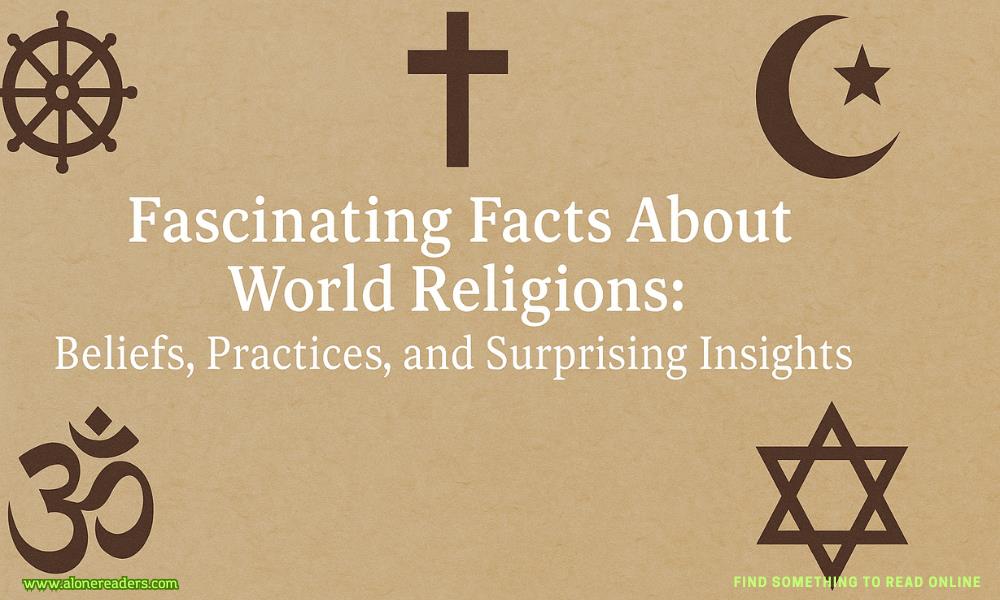
Religion has always played a central role in shaping human civilizations, cultures, and philosophies. From the earliest hunter-gatherer tribes who honored spirits in nature to the sprawling global religions of today, the diversity and depth of religious belief are astonishing. Each tradition, whether it developed in isolation or through centuries of contact and exchange, reflects humanity’s eternal quest for meaning, morality, and connection with something greater than oneself. What makes the study of religion especially fascinating is the wide array of beliefs, practices, and histories that offer both striking similarities and profound differences among cultures.
One surprising fact is that Hinduism, often cited as the world’s oldest religion still practiced today, has no single founder. It evolved over thousands of years and includes a vast tapestry of philosophies, rituals, and deities. Despite being associated with the Indian subcontinent, Hinduism’s influence has spread far beyond, with ancient temples found as far away as Indonesia and Cambodia. Unlike many Western religions, Hinduism embraces a polytheistic worldview, yet at its core is the concept of Brahman—a single, all-encompassing spiritual force that connects all things.
Buddhism, which emerged from Hindu traditions in the 6th century BCE, offers a stark contrast with its non-theistic approach. Founded by Siddhartha Gautama, known as the Buddha, it centers not on worship of gods but on achieving enlightenment through personal effort, ethical living, and mental discipline. One of the most intriguing aspects of Buddhism is its flexibility. It adapted to various cultures across Asia—becoming Zen in Japan, Vajrayana in Tibet, and Theravāda in Sri Lanka and Southeast Asia—while maintaining its core teachings on suffering, impermanence, and the path to liberation.
Christianity, the world’s largest religion with over 2.3 billion followers, began as a small Jewish sect in the 1st century CE. What’s remarkable is how quickly it spread across the Roman Empire and beyond, despite initial persecution. At the heart of Christianity is the belief in Jesus of Nazareth as the Messiah and Son of God, whose life and teachings emphasized love, forgiveness, and salvation. Over the centuries, Christianity evolved into numerous denominations—including Catholicism, Orthodoxy, and Protestantism—each with its own doctrines, rituals, and governance structures. The cross, once a Roman instrument of execution, has become one of the most recognized religious symbols globally, representing hope and redemption.
Islam, the second-largest religion, shares many roots with Christianity and Judaism. Founded in the 7th century CE in the Arabian Peninsula, it spread rapidly across continents. Muslims believe in the prophet Muhammad as the final messenger of God and regard the Quran as the ultimate divine revelation. One of the most unique aspects of Islam is its emphasis on community rituals, such as the five daily prayers, fasting during Ramadan, and pilgrimage to Mecca—an event that draws millions each year in one of the largest religious gatherings in the world. Despite misconceptions, Islam is not monolithic; it comprises various schools of thought, including Sunni and Shia branches, each with rich traditions and interpretations.
Judaism, one of the oldest monotheistic religions, traces its roots to the covenant between God and the patriarch Abraham. The Torah, its foundational text, has guided Jewish life for centuries, emphasizing ethics, justice, and community. What stands out about Judaism is its resilience; despite centuries of exile, persecution, and dispersion, Jewish communities have maintained a distinct identity and tradition. Festivals such as Passover and Hanukkah are not only religious observances but powerful acts of cultural memory and continuity.
Beyond the major world religions, there are many belief systems that are equally rich and complex. For example, the indigenous religions of Africa, the Americas, and Oceania often center on animism—the belief that spirits inhabit animals, plants, and natural phenomena. These traditions are deeply connected to the land and passed down through oral storytelling, music, and ritual. In Japan, Shintoism reveres kami—sacred spirits associated with nature and ancestors—without a rigid dogma or central scripture. In China, Confucianism, while often considered more a philosophy than a religion, has profoundly shaped social norms, governance, and ethical values across East Asia.
Another fascinating dimension is how religions have intersected with science and philosophy. Islamic scholars preserved and expanded upon ancient Greek knowledge during Europe’s Dark Ages, leading to advances in medicine, mathematics, and astronomy. The Buddhist practice of meditation, once confined to monastic life, is now widely adopted in secular mindfulness practices around the world, with research showing its benefits for mental health. Christianity was historically tied to the development of the university system in medieval Europe, where theology was once the "queen of the sciences."
Religious symbols, too, carry profound meanings that transcend time and place. The lotus flower in Buddhism symbolizes purity arising from the mud of suffering. The Star of David, once a simple geometric shape, has become a powerful emblem of Jewish identity. The crescent moon and star, although not originally Islamic, have come to symbolize Islamic civilization in many cultures. Even the Om symbol in Hinduism, when chanted, is said to embody the sound of the universe itself.
Interfaith connections and shared stories also abound. The story of a great flood appears in multiple traditions—from the Epic of Gilgamesh in Mesopotamia to the tale of Noah in Abrahamic faiths. Concepts of karma and rebirth appear not just in Hinduism and Buddhism but also in some indigenous spiritualities. Sacred places often overlap; for example, Jerusalem holds profound religious significance for Jews, Christians, and Muslims alike, making it one of the most contested and venerated cities in the world.
Religions are not static; they evolve. The rise of new religious movements in the modern era—such as the Baha’i Faith, which emphasizes unity and global peace, or Scientology, which incorporates elements of psychology and science fiction—reflects contemporary spiritual quests. Even within older traditions, reform movements and reinterpretations continually reshape practices and beliefs in response to changing cultural and ethical landscapes.
One cannot overlook the political and social influence of religion. It has been both a force for liberation and oppression, peace and conflict. The role of the Church in the abolition of slavery, the leadership of Buddhist monks in nonviolent resistance, and the advocacy of Muslim leaders for justice all highlight religion’s power for good. Conversely, religious intolerance and extremism have also led to tragic violence and persecution throughout history. Understanding this dual nature is essential to appreciating the complexity of faith in human affairs.
In the modern world, the rise of secularism and religious pluralism is reshaping how people relate to religion. Many identify as “spiritual but not religious,” blending practices from multiple traditions or seeking personal meaning outside institutional frameworks. Interfaith dialogue, meanwhile, is growing as communities recognize the need for coexistence and mutual respect in a globalized world. Technology has also transformed religious life—sermons are streamed online, scriptures are available in apps, and religious communities connect across borders more easily than ever.
Ultimately, the study of world religions reveals more than just theological doctrines or ritual practices. It uncovers the diverse ways in which humans seek to understand life, death, morality, and the universe. It highlights shared yearnings for compassion, justice, and transcendence. Whether one believes in a higher power, multiple deities, or no god at all, the story of religion is undeniably a story of humanity itself—filled with mystery, wonder, and the endless pursuit of meaning.



 Château de Vincennes: France’s Forgotten Royal Fortress and Medieval Stronghold
 Château de Carcassonne: Europe’s Greatest Medieval Citadel and Fortress
 Château de Chenonceau: The Castle Built by Remarkable Women
 Château de Chambord: France’s Magnificent Renaissance Castle and Architectural Wonder
 Tehri Dam: India's Tallest Dam and the Debate Behind It
 Bhakra Nangal Dam: India's Temple of Modern Development