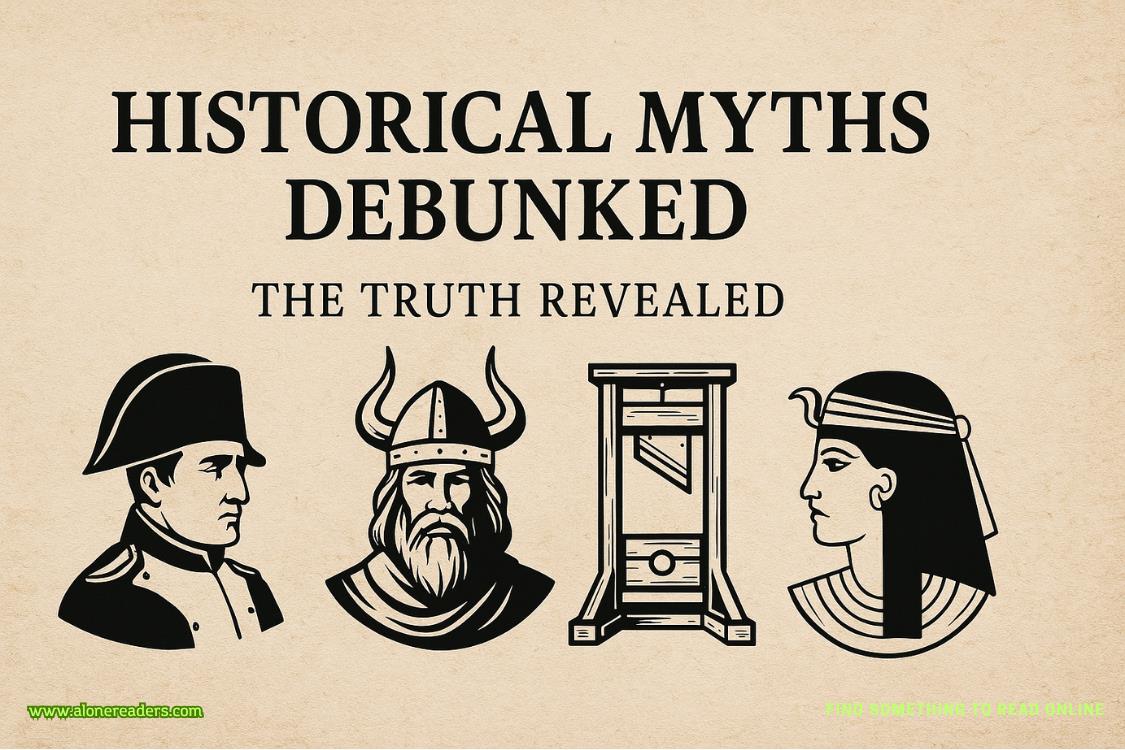
History is filled with stories that capture our imagination—but not all of them are true. Over centuries, misunderstandings, propaganda, and even deliberate inventions have shaped what we think we know about the past. In this article, we will uncover the truth behind some of the world’s most persistent historical myths, diving deep into what really happened and why these misconceptions endure.
Where the Myth Began
The belief that Napoleon Bonaparte was unusually short is perhaps one of the most enduring myths in history. However, this myth is a result of a mix-up between French and English measurements. At his death, Napoleon was recorded as being “5 feet 2 inches”—but in French feet, not the English imperial system.
The Real Measurement
In French feet, Napoleon’s height equates to about 5 feet 6.5 inches in modern measurements—slightly above average for Frenchmen of his era. British propaganda further exaggerated his supposed lack of stature to ridicule him and undermine his authority, giving rise to the phrase “Napoleon complex.” In reality, contemporary reports described him as a stocky, robust man.
Why the Myth Persists
This misconception fit nicely with British efforts to belittle a powerful enemy, and “short Napoleon” has since become cultural shorthand for overcompensation. The truth is, Napoleon was not short for his time, and the myth reveals more about the power of propaganda than the man himself.
The Imaginary Warrior
Images of Vikings with horned helmets storming into battle are ubiquitous in modern media and popular culture. But there is no archaeological evidence to support this idea.
Origins of the Horned Helmet Myth
The myth began in the 19th century, during a wave of Romantic nationalism in Scandinavia. Costume designer Carl Emil Doepler created horned helmets for Wagner’s “Der Ring des Nibelungen” opera in 1876, and this look became fixed in the popular imagination. No Viking helmet ever discovered has had horns; actual Viking helmets were practical and designed for protection.
Viking Reality
Vikings were pragmatic seafarers, merchants, and warriors. Their real helmets, made of iron and leather, had nose guards but no horns, which would have been a dangerous liability in combat.
What We Were Taught
Many learned that Columbus set out to prove the world was round, defying a flat-earth medieval consensus. However, educated people in Columbus’s day already knew the Earth was a sphere. Ancient Greeks had calculated the planet’s circumference as early as the 3rd century BCE.
What Columbus Actually Did
Columbus’s “revolutionary” claim was that Asia could be reached quickly by sailing west. The true controversy was about the size of the Earth, not its shape—Columbus severely underestimated the distance, which is why his voyages ended in the Caribbean rather than Asia.
Why the Myth Spread
Washington Irving’s 1828 biography of Columbus popularized the flat-earth story. It stuck because it fits a narrative of progress—ignorance conquered by bold vision—but the real debate was much more technical.
The Famous Phrase
Marie Antoinette is often remembered for her supposed indifference to the starving French masses, summed up by the phrase, “Let them eat cake.” But there is no evidence she ever uttered these words.
Tracing the Origins
The phrase “Qu’ils mangent de la brioche” appears in Jean-Jacques Rousseau’s Confessions, written when Marie Antoinette was only nine years old. There is no contemporary record of her saying anything similar.
A Convenient Scapegoat
The phrase was likely attributed to Marie Antoinette as revolutionary propaganda to paint her as callous and out of touch. In reality, she was a foreign queen and an easy target for political enemies. Her real life, while privileged, was more nuanced.
Myth of Stagnation
The term “Dark Ages” evokes an era of ignorance and backwardness between the fall of Rome and the Renaissance. However, modern historians have debunked this simplistic view.
Intellectual and Cultural Growth
While Europe faced significant challenges, the so-called “Dark Ages” saw the foundation of universities, advancements in technology (like the heavy plow and windmill), architectural achievements (such as Gothic cathedrals), and preservation of classical knowledge by monastic scholars.
The True Source of the Term
The idea of a backward Middle Ages was a Renaissance invention, used to elevate their own era. It was reinforced in later centuries by Enlightenment thinkers who wanted to emphasize progress over superstition.
What Really Happened in Salem
The Salem witch trials of 1692-1693 in Massachusetts are infamous for accusations of witchcraft and mass hysteria. But despite popular imagery, those convicted of witchcraft in Salem were not burned at the stake.
Execution by Hanging
Nineteen people were executed, all by hanging, not burning. The image of witches being burned alive in America comes from European witch trials, particularly in Germany and Switzerland. Only one man, Giles Corey, was pressed to death by heavy stones after refusing to enter a plea.
Origins of the Burning Myth
Popular culture, including books, movies, and Halloween traditions, have muddled together European and American witch trials, but the historical record is clear about the method of execution in Salem.
A Persistent Misconception
It’s a common claim that the Great Wall of China is the only man-made object visible from space. In reality, astronauts confirm that the wall is not visible to the naked eye from the Moon, and is barely discernible even from low Earth orbit without aid.
The Facts from Astronauts
NASA astronauts have repeatedly clarified that while some cities or highways may be visible from space under certain conditions, the Great Wall’s materials and narrow width make it almost impossible to spot without magnification. Urban legends and textbooks perpetuated this idea long after it was debunked by those who have actually been in orbit.
The Emperor’s Reputation
Roman Emperor Nero is remembered as a madman who played the fiddle while Rome burned in 64 CE, showing callous indifference to the suffering of his people. But this story is not supported by historical fact.
What Actually Happened
For one, the fiddle (violin) did not exist in ancient Rome. Contemporary accounts say Nero was at his villa in Antium when the fire began and returned to organize relief efforts. Ancient writers hostile to Nero, such as Suetonius and Tacitus, reported that he sang about the destruction of Troy while watching Rome burn, but these were likely rumors or embellishments by his political enemies.
How the Myth Took Hold
Nero’s unpopularity and the later political climate made it easy for successors and historians to scapegoat him for the disaster, cementing the “fiddling” myth in public consciousness.
The Truth About the First President’s Teeth
George Washington’s dental problems are well documented, but the claim that he wore wooden dentures is a myth.
What Were His Dentures Made Of?
Washington’s dentures were constructed from a variety of materials, including ivory (from hippopotamus, walrus, and elephant), gold, lead, and human teeth purchased from donors. Over time, staining and wear may have made the dentures look wooden, but wood was never used.
Why the Myth Developed
The story of wooden teeth likely arose from the appearance of his dental prosthetics and a desire to humanize a revered figure with relatable struggles.
Cleopatra’s True Origins
Cleopatra VII, the last active ruler of the Ptolemaic Kingdom of Egypt, is often thought of as an “Egyptian queen.” In fact, she was Macedonian Greek by descent.
The Ptolemaic Dynasty
The Ptolemies were descendants of one of Alexander the Great’s generals, who took control of Egypt after Alexander’s death. For almost three centuries, they ruled as a Greek-speaking elite, largely maintaining their Greek heritage and customs. Cleopatra was the first of her line to learn the Egyptian language, and she embraced aspects of Egyptian culture, but her lineage was not native Egyptian.
How the Myth Endures
Cleopatra’s identification with Egypt was both genuine and a political necessity. Over centuries, art and literature cemented her image as the quintessential “Egyptian queen,” but her ancestry tells a more complex story.
Many historical myths begin with a misunderstanding, a deliberate distortion, or simply a story that sounds too good to check. They persist because they are memorable and serve particular cultural or political needs. By examining the evidence and questioning accepted wisdom, we gain a more accurate and nuanced understanding of the past. The truth is often more fascinating—and more human—than the myth.



 Château de Vincennes: France’s Forgotten Royal Fortress and Medieval Stronghold
 Château de Carcassonne: Europe’s Greatest Medieval Citadel and Fortress
 Château de Chenonceau: The Castle Built by Remarkable Women
 Château de Chambord: France’s Magnificent Renaissance Castle and Architectural Wonder
 Tehri Dam: India's Tallest Dam and the Debate Behind It
 Bhakra Nangal Dam: India's Temple of Modern Development