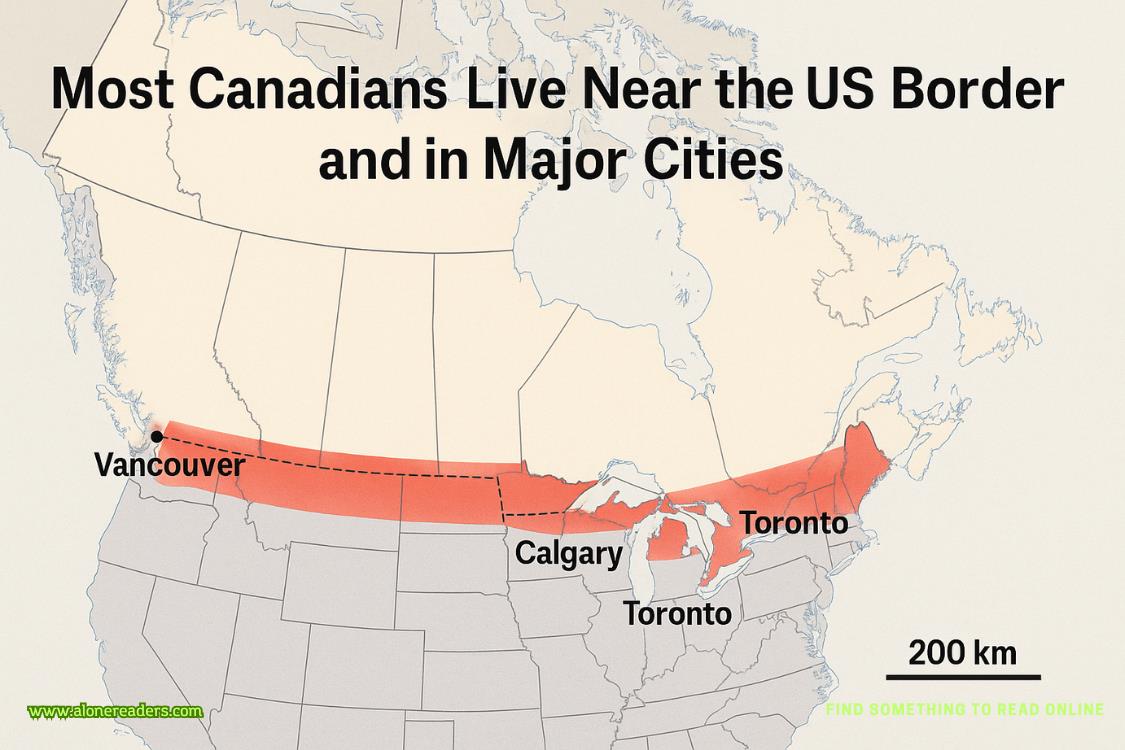
Canada is known for its vast and breathtaking landscapes, stretching from the Pacific coast in the west to the Atlantic Ocean in the east, and reaching deep into the Arctic north. Yet, despite its enormous size—the second largest country in the world by total area—Canada’s population distribution is remarkably concentrated. The majority of Canadians, in fact, live within a narrow band, just 200 kilometers from the United States border, and most reside in the country’s major urban centers, such as Toronto, Montreal, Vancouver, and Calgary. This unique demographic pattern is not merely a quirk of geography; it’s shaped by a combination of historical, economic, climatic, and social factors.
The phenomenon of population concentration near the US border is rooted in Canada’s geography and history. The southern edge of Canada contains the country’s most hospitable climates, fertile land, and access to major waterways, which made it the natural choice for early settlements. The St. Lawrence River, the Great Lakes, and the broad valleys of southern Ontario and Quebec offered opportunities for agriculture, trade, and transportation. Early French and British colonists established settlements in these regions, and over time, these grew into the modern urban centers we know today. Even as the nation expanded westward, the Prairie Provinces saw their largest cities—Winnipeg, Regina, Calgary, and Edmonton—established along lines of transportation and trade that remained close to the border.
Climatic conditions play a huge role in shaping where people live in Canada. North of the 49th parallel, conditions become increasingly harsh, with long, cold winters, short summers, and challenging terrain. Much of northern Canada consists of boreal forest, tundra, and even polar ice, making it difficult to build infrastructure or sustain large populations. As a result, the far north remains sparsely populated, inhabited primarily by Indigenous peoples and a few scattered communities engaged in mining, oil extraction, or government services. In contrast, the southern regions near the border enjoy milder climates, longer growing seasons, and easier transportation connections.
The proximity to the United States is another significant factor. The US-Canada border is not only the world’s longest undefended border, but also the world’s busiest, with billions of dollars in trade crossing every year. Major Canadian cities close to the border, such as Toronto, Montreal, and Vancouver, have leveraged their location to develop thriving economic ties with the US. These connections drive employment, business opportunities, and cultural exchange, making these cities attractive destinations for newcomers and long-time residents alike.
Toronto, Canada’s largest city, is a case study in urban growth and diversity. Located on the northwestern shore of Lake Ontario, just over 100 kilometers from the US border, Toronto is home to more than six million people in its metropolitan area. Its growth has been fueled by its status as an economic powerhouse, cultural center, and hub for immigration. More than half of Toronto’s population was born outside of Canada, making it one of the most multicultural cities in the world. The city’s appeal lies not only in its vibrant job market, but also in its diverse neighborhoods, world-class education, and quality of life.
Montreal, located in the province of Quebec, is another major urban center with a rich history. Positioned on an island in the St. Lawrence River, Montreal is just a short drive from the US border and has long served as a gateway between North America and Europe. The city is known for its French heritage, cultural festivals, universities, and culinary scene. It has maintained a strong manufacturing and technology sector, attracting talent from across Canada and beyond.
Vancouver, nestled between the Pacific Ocean and the Coast Mountains, stands out as a west coast metropolis. Its proximity to the US border and the port of Vancouver have made it a major player in trade with Asia and the US. Vancouver’s natural beauty, mild climate, and diverse economy make it one of Canada’s most desirable places to live, despite its high cost of housing.
Calgary, located in the province of Alberta, illustrates how resource-driven economies can also spur urban growth. While a bit farther from the US border than Toronto or Montreal, Calgary’s development accelerated in the late 20th century due to the oil and gas industry. The city’s population has boomed, and today it is recognized for its modern skyline, vibrant downtown, and proximity to the Rocky Mountains.
Canada’s other large cities, such as Ottawa, Edmonton, Winnipeg, and Quebec City, also fit into this pattern of southern concentration. Each is located in a region that is comparatively easier to develop and maintain than the northern expanse. Rural and northern communities do exist, but they account for only a small fraction of the country’s population.
Urbanization in Canada has been a steady trend for decades. According to recent statistics, over 80% of Canadians live in urban areas, and a significant portion are concentrated in the so-called “Windsor-Quebec Corridor,” which stretches from Windsor, Ontario in the west, through Toronto and Ottawa, to Montreal and Quebec City in the east. This corridor is the economic heartland of Canada, home to key industries, government institutions, and a network of highways and railroads.
The concentration of population in southern urban centers poses both opportunities and challenges. On the one hand, it allows for efficient delivery of public services, strong job markets, and dynamic cultural life. On the other hand, it can lead to urban sprawl, traffic congestion, rising housing costs, and strains on infrastructure. The rural and northern regions, meanwhile, sometimes struggle to maintain their populations and economic vitality, facing challenges such as youth migration to cities, limited services, and reliance on resource extraction.
Immigration also plays a significant role in reinforcing these population patterns. Most newcomers to Canada choose to settle in major cities, attracted by job prospects, social networks, and cultural communities. Programs aimed at encouraging settlement in smaller towns and northern regions have had limited success, as the pull of urban life remains strong.
Canada’s unique population distribution is not likely to change dramatically in the near future. The combination of climate, geography, economics, and history has created a pattern that is deeply embedded in the fabric of Canadian society. Governments at various levels continue to invest in urban infrastructure and to seek ways to support rural and northern communities, but the underlying drivers of settlement remain powerful.
In summary, while Canada’s landmass is massive, the vast majority of its people live close to the southern border, clustered in a handful of thriving urban centers. This pattern is the result of centuries of historical development, economic necessity, climatic reality, and the lure of opportunity. Whether walking the bustling streets of Toronto or Montreal, gazing at the mountains from Vancouver, or attending the Calgary Stampede, most Canadians experience a way of life shaped by proximity to the border and the dynamic energy of city living.



 Château de Vincennes: France’s Forgotten Royal Fortress and Medieval Stronghold
 Château de Carcassonne: Europe’s Greatest Medieval Citadel and Fortress
 Château de Chenonceau: The Castle Built by Remarkable Women
 Château de Chambord: France’s Magnificent Renaissance Castle and Architectural Wonder
 Tehri Dam: India's Tallest Dam and the Debate Behind It
 Bhakra Nangal Dam: India's Temple of Modern Development