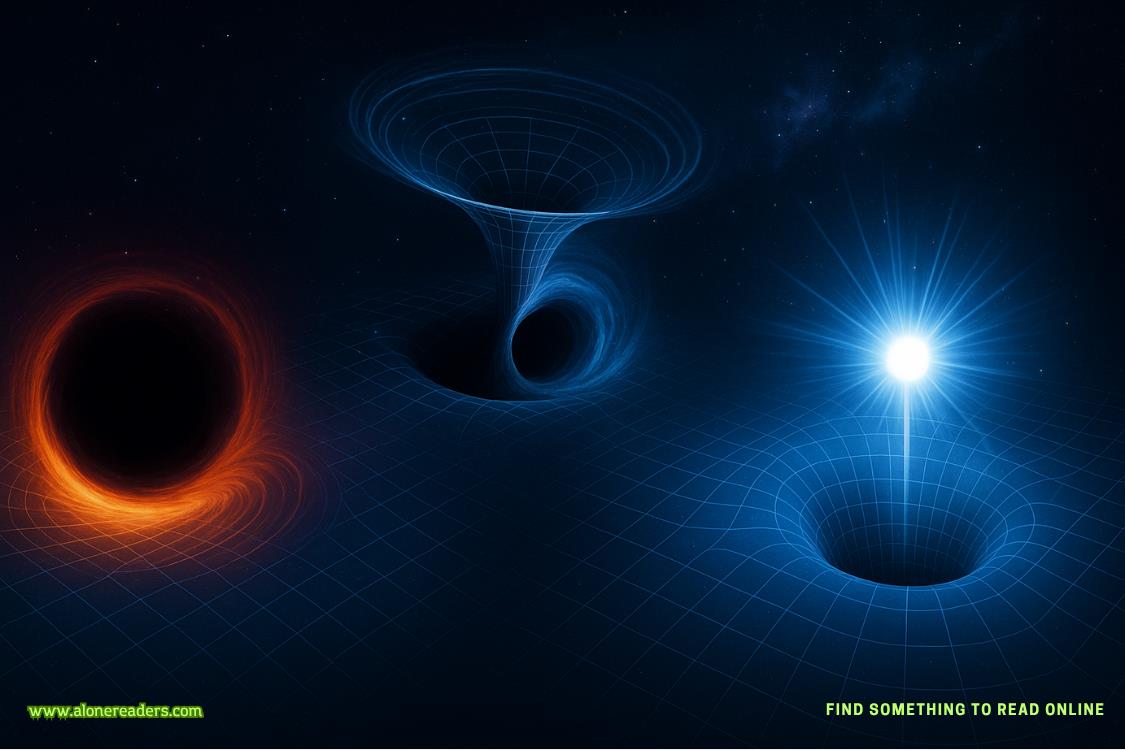
When it comes to the grand mysteries of the universe, few objects capture the imagination quite like black holes, white holes, and wormholes. These enigmatic phenomena are not just staples of science fiction but are deeply rooted in the real mathematics and theories that describe the fabric of our universe. Each has its own unique characteristics, behaviors, and theoretical underpinnings. While black holes have a solid foundation in observational astrophysics, white holes and wormholes remain largely theoretical, pushing the limits of what we understand about space, time, and gravity.
Let’s begin with black holes, which are perhaps the best known of the three. A black hole forms when a massive star collapses under its own gravity at the end of its life cycle, compressing its matter into an incredibly small point known as a singularity. The gravitational pull in this region becomes so intense that nothing, not even light, can escape once it crosses the boundary known as the event horizon. This is what gives black holes their name—they are literally invisible, detected only by the effect their gravity has on surrounding matter. Black holes come in several types: stellar-mass black holes, intermediate black holes, supermassive black holes, and possibly even primordial black holes formed in the earliest moments of the universe. The existence of supermassive black holes at the centers of most galaxies, including our own Milky Way, has been confirmed by the observation of stars orbiting around invisible, massive objects and, most recently, by the Event Horizon Telescope’s imaging of the shadow of a black hole in the galaxy M87.
Black holes are described by Einstein’s general theory of relativity as distortions or curvatures in the fabric of space-time. The more mass that is concentrated in a small region, the stronger the curvature, eventually becoming so extreme that it pinches off from the rest of the universe. When an object or even light gets too close to a black hole—closer than the event horizon—it will inexorably be drawn inward, unable to escape. The singularity at the center is a point of infinite density where our current physical theories break down. However, from the perspective of an outside observer, time appears to slow down for anything approaching the event horizon, never quite reaching it, due to the phenomenon known as time dilation.
On the opposite end of the spectrum, at least theoretically, we find white holes. A white hole can be thought of as the reverse of a black hole. Instead of allowing nothing to escape, it allows nothing to enter; instead of pulling in matter, it expels it. The idea of a white hole arises from the same equations of general relativity that predict black holes. If a black hole is a region from which nothing can escape, a white hole is a region into which nothing can enter but from which matter and energy can theoretically emerge. In this sense, white holes are time-reversed black holes. Unlike black holes, there is no observational evidence for the existence of white holes. They are considered mathematical solutions rather than physical objects, at least so far.
One of the reasons white holes are so intriguing is because of their connection to the concept of wormholes. In theoretical physics, a wormhole—also called an Einstein-Rosen bridge—is a tunnel-like structure that could connect two separate points in space and time. Wormholes are solutions to the equations of general relativity that involve connecting a black hole and a white hole, forming a shortcut or “bridge” between distant regions of the universe. In this scenario, the black hole serves as the entrance and the white hole as the exit. If wormholes exist, they could theoretically allow for instantaneous travel between distant parts of the cosmos or even facilitate time travel.
The idea of wormholes goes back to the work of Albert Einstein and his colleague Nathan Rosen, who first described the Einstein-Rosen bridge in 1935. However, most physicists believe that any naturally occurring wormhole would be extremely unstable. Even if a wormhole could exist, it would likely collapse before anything could pass through it, unless it was kept open by some form of exotic matter with negative energy density—an idea that remains speculative and without experimental support.
Despite the challenges and mysteries, each of these phenomena offers insight into how space and time behave under extreme conditions. Black holes have gone from mathematical oddities to observable entities, thanks to advances in telescope technology and indirect evidence such as the detection of gravitational waves. These ripples in space-time, observed when two black holes collide, provide direct proof of their existence and the violent dynamics of their mergers. The study of black holes also underpins many modern theories about the fate of stars, the evolution of galaxies, and the nature of the early universe.
In contrast, white holes remain a largely theoretical construct. Some physicists have speculated that the Big Bang itself could have been a kind of white hole, a point where matter and energy burst forth into our universe. Others have tried to link white holes to the so-called information paradox of black holes—the question of whether information that falls into a black hole is lost forever, violating the principles of quantum mechanics. If a black hole eventually transforms into a white hole, some theorists suggest, it might expel all the information it once consumed. However, this remains in the realm of speculation, and there is no empirical evidence to support these ideas.
Wormholes, meanwhile, have become a popular subject in science fiction for good reason: they represent a loophole in the cosmic speed limit set by the speed of light. In stories, wormholes are used for interstellar travel, shortcuts across the universe, and even time machines. The concept is tantalizing but fraught with problems. Most solutions to the equations that describe wormholes require the existence of exotic matter, and all are highly unstable under the influence of real-world forces. Theoretical work continues, and physicists use these ideas to probe the limits of our understanding of space, time, and the unification of general relativity with quantum mechanics.
One area where black holes, white holes, and wormholes intersect is in the discussion of space-time singularities and the structure of the universe on the smallest and largest scales. Singularity, the heart of a black hole, is where gravity crushes matter to an infinitely small point, and the laws of physics as we know them cease to function. Some theoretical models suggest that singularities might be gateways to other regions of space-time, or that they might be resolved by a theory of quantum gravity, which remains one of the biggest unsolved problems in physics.
Despite the absence of experimental evidence for white holes and traversable wormholes, their study helps drive theoretical physics forward. By exploring these concepts, scientists hope to answer fundamental questions about the nature of the universe, the fate of information, and whether shortcuts through space and time are truly possible.
The differences between black holes, white holes, and wormholes are rooted in their theoretical foundations, their roles in the universe, and our ability to observe or infer their presence. Black holes are the collapsed remnants of massive stars with immense gravitational pull, observable through their effects on nearby matter and space-time. White holes are the time-reversed counterparts to black holes, hypothetical objects that spew matter and cannot be entered from the outside. Wormholes are bridges or shortcuts between distant points in space-time, requiring exotic conditions to exist and representing one of the most tantalizing ideas in both physics and science fiction.
As our tools and understanding of the cosmos improve, the hope is that one day we may find evidence of phenomena even stranger than black holes, perhaps even glimpses of white holes or the first signs of a real wormhole. Until then, these objects remain at the cutting edge of our exploration of space, time, and the profound mysteries that define our universe.



 Château de Vincennes: France’s Forgotten Royal Fortress and Medieval Stronghold
 Château de Carcassonne: Europe’s Greatest Medieval Citadel and Fortress
 Château de Chenonceau: The Castle Built by Remarkable Women
 Château de Chambord: France’s Magnificent Renaissance Castle and Architectural Wonder
 Tehri Dam: India's Tallest Dam and the Debate Behind It
 Bhakra Nangal Dam: India's Temple of Modern Development










