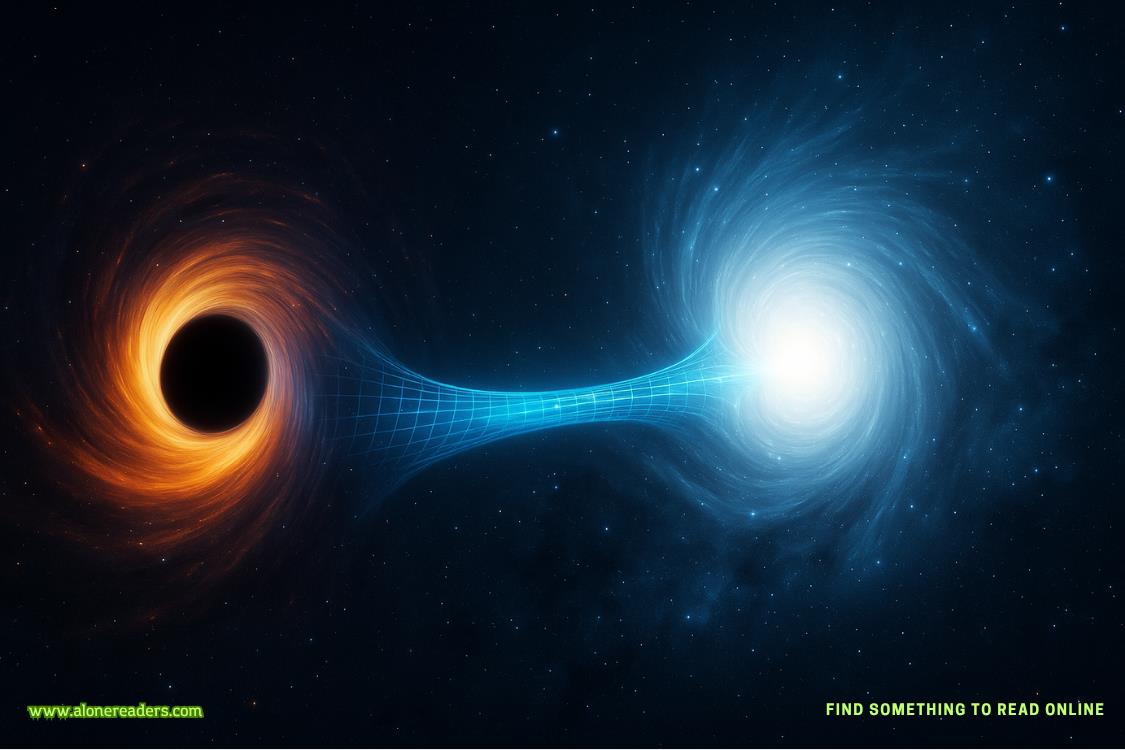
In the realm of astrophysics, few concepts inspire as much awe and speculation as black holes, white holes, and wormholes. These celestial phenomena push the boundaries of our understanding of the universe, blending hard science with profound mystery. The question of whether black holes and white holes could be connected by wormholes is a topic that continues to captivate scientists and enthusiasts alike. To explore this idea, it’s essential to dive into the nature of these cosmic objects, the mathematics that describe them, and the theoretical physics that underpin their possible interconnections.
A black hole is a region in space where gravity is so intense that nothing, not even light, can escape its grasp. This immense gravity is caused by the collapse of massive stars, compressing matter into a singularity—a point of infinite density—surrounded by an event horizon, which marks the boundary beyond which escape is impossible. Black holes are now well established in astronomy; evidence for their existence comes from observing the motion of stars near invisible masses, gravitational waves from colliding black holes, and the famous image of a black hole’s shadow captured by the Event Horizon Telescope.
White holes, on the other hand, are theoretical constructs predicted by the same equations that give rise to black holes in general relativity. In simplest terms, a white hole can be described as the time-reverse of a black hole. Whereas black holes consume all matter and light that pass their event horizon, white holes are thought to expel matter and light, allowing nothing to enter from the outside. However, no white holes have ever been observed in the universe, and their existence remains speculative. Some physicists argue that if white holes do exist, they could only do so for extremely brief periods or under very specific cosmic conditions.
Wormholes, also called Einstein-Rosen bridges, are another fascinating prediction of general relativity. In 1935, Albert Einstein and Nathan Rosen formulated the idea that space-time could be folded so that two distant regions of the universe are directly connected via a shortcut—a tunnel, so to speak—known as a wormhole. Mathematically, the simplest model of a wormhole arises by extending the solution for a black hole. This solution suggests that the event horizon of a black hole could, under certain conditions, connect to another region of space-time, which, in theory, might act as a white hole. In the classic Einstein-Rosen bridge scenario, the black hole serves as one mouth of the tunnel and the white hole as the other.
The question, then, is whether such connections actually exist in our universe or are merely mathematical curiosities. General relativity allows for the existence of wormholes in its equations, but the physical reality is more complicated. For a wormhole to remain open and traversable (allowing matter or information to pass through), it requires what is known as “exotic matter” with negative energy density. No such material has yet been discovered, and all known forms of matter and energy in the universe have positive energy density, which causes wormholes to collapse almost instantly after they form. Nevertheless, the mathematical link between black holes, white holes, and wormholes remains an intriguing area of research.
Some speculative models suggest that when a black hole forms, the matter collapsing into it might be “spit out” somewhere else in the universe (or perhaps in a different universe entirely) through a white hole, connected by a wormhole. This scenario is sometimes referred to as a “black hole-white hole pair.” However, this model faces significant theoretical challenges. Firstly, the extreme conditions inside black holes—such as the infinite density of the singularity—imply that classical general relativity breaks down, and quantum effects must be considered. The yet-to-be-discovered theory of quantum gravity is needed to fully understand what happens inside a black hole and whether a wormhole could actually connect to a white hole.
Moreover, even if such a wormhole could form, there is strong evidence that it would be incredibly unstable. Theorists have shown that any matter attempting to travel through the wormhole would likely cause it to pinch off or collapse before anything could get through. Additionally, white holes, as predicted by classical relativity, would radiate away energy extremely quickly and would not be stable objects in the universe.
Despite these difficulties, the idea of black holes, white holes, and wormholes being connected has inspired countless scientific papers and even science fiction stories. Some recent theories, like those proposed in quantum gravity research, speculate that the process of black hole evaporation via Hawking radiation might be related to white holes in some way, or that information swallowed by a black hole could eventually be released through a white hole-like mechanism, preserving the fundamental laws of physics such as information conservation. These ideas are still highly theoretical and far from being experimentally verified.
The concept of “ER=EPR,” proposed by physicists Juan Maldacena and Leonard Susskind, suggests a possible connection between wormholes (Einstein-Rosen bridges) and quantum entanglement (Einstein-Podolsky-Rosen pairs). According to this conjecture, quantum entangled particles might be connected by tiny, microscopic wormholes in space-time. While this does not directly link astronomical black holes and white holes via large, traversable wormholes, it hints at a profound relationship between space-time geometry and quantum information, potentially offering clues to the deep structure of reality.
Another area of exploration involves loop quantum gravity and other attempts to quantize space-time itself. Some models suggest that black hole singularities may be resolved or avoided altogether by quantum gravitational effects, possibly resulting in a “bounce” rather than a collapse to a point of infinite density. In these speculative scenarios, a black hole could potentially evolve into a white hole over immense timescales, or information lost inside a black hole could eventually escape via a white hole phase. These ideas, while mathematically interesting, remain untested and are at the very edge of modern theoretical physics.
Observationally, there is no evidence for wormholes or white holes in our universe to date. Astronomers continue to search for unusual cosmic events or objects that might indicate the presence of such exotic phenomena, but so far, all observed black holes behave as the standard model predicts: they swallow matter and emit nothing but, eventually, weak Hawking radiation. The lack of observed white holes does not rule them out entirely, but it makes their existence unlikely in the form envisioned by classical general relativity.
The connection between black holes, white holes, and wormholes remains one of the most exciting frontiers in astrophysics and theoretical physics. It raises profound questions about the nature of space, time, and information in the universe. Are these cosmic gateways simply mathematical possibilities, or could they play a role in the grand tapestry of the cosmos? Future advances in quantum gravity, astronomical observation, and perhaps even the discovery of exotic forms of matter might one day provide answers.
In conclusion, while black holes, white holes, and wormholes are deeply interconnected in the mathematics of general relativity, there is currently no empirical evidence that they are physically connected in the universe as cosmic gateways. Theories continue to evolve, and the quest to understand these mysterious objects pushes the boundaries of science. For now, the idea that black holes and white holes could be connected by wormholes remains a fascinating hypothesis—one that speaks to both the limits and the potential of human knowledge.



 Château de Vincennes: France’s Forgotten Royal Fortress and Medieval Stronghold
 Château de Carcassonne: Europe’s Greatest Medieval Citadel and Fortress
 Château de Chenonceau: The Castle Built by Remarkable Women
 Château de Chambord: France’s Magnificent Renaissance Castle and Architectural Wonder
 Tehri Dam: India's Tallest Dam and the Debate Behind It
 Bhakra Nangal Dam: India's Temple of Modern Development