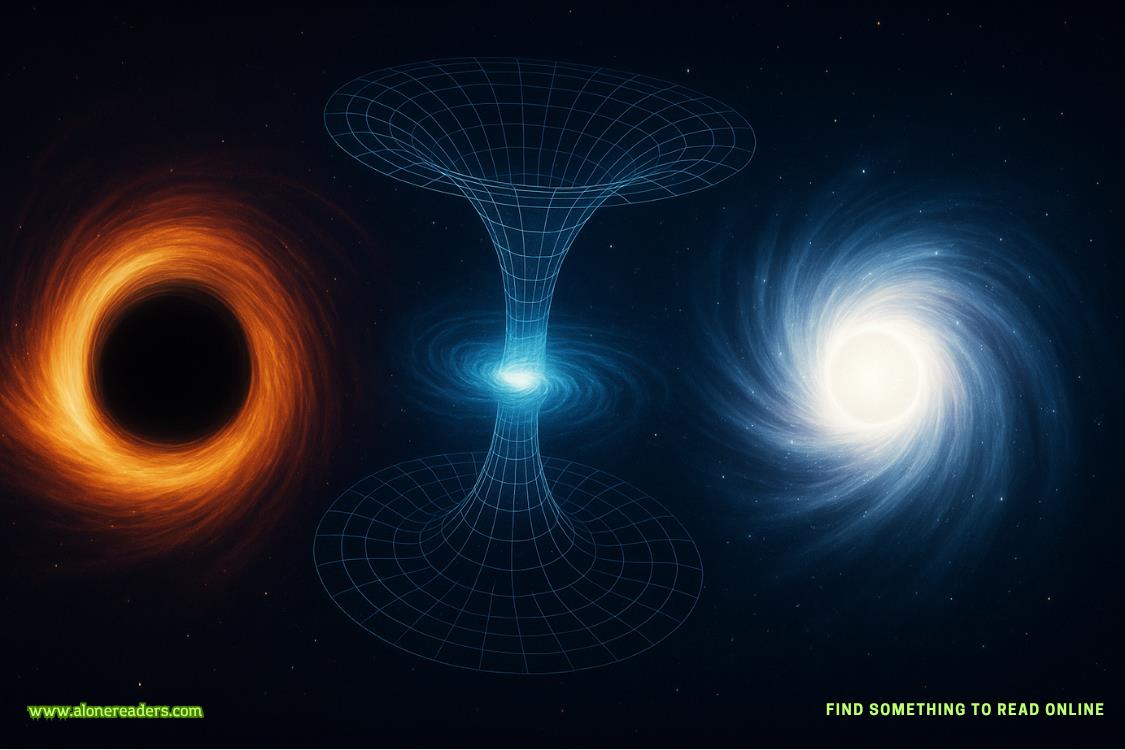
The universe is filled with phenomena that challenge human understanding and fuel both scientific research and the imagination of storytellers. Among the most fascinating cosmic mysteries are black holes, white holes, and wormholes. These objects occupy a special place not only in astrophysics but also in science fiction, bridging the gap between the known, the theorized, and the utterly speculative.
Black holes are perhaps the best-known of the three. Their existence is firmly grounded in the predictions of Einstein’s general theory of relativity and supported by growing observational evidence. A black hole forms when a massive star exhausts its nuclear fuel and collapses under its own gravity, compressing its mass into an extremely small, dense point called a singularity. The boundary surrounding this singularity is known as the event horizon—a region beyond which nothing, not even light, can escape. The first direct image of a black hole’s event horizon, captured by the Event Horizon Telescope in 2019, provided a historic glimpse into these enigmatic objects, reinforcing their real presence in the cosmos.
The science behind black holes is rooted in gravity’s ability to warp spacetime. According to general relativity, massive objects curve the fabric of spacetime, and black holes are regions where this curvature becomes so extreme that it creates a well from which escape is impossible. Matter and energy drawn into a black hole are lost to the outside universe, though the laws of physics suggest that information about what fell in may never truly disappear—a puzzle known as the black hole information paradox. Black holes are also key engines of cosmic drama, found at the centers of galaxies as supermassive black holes and occasionally merging to create ripples in spacetime detected as gravitational waves.
While black holes are widely accepted by scientists, white holes exist more in the realm of theory than observed reality. In essence, a white hole is the mathematical time-reverse of a black hole. While a black hole allows matter and energy to enter but not leave, a white hole would theoretically allow matter and energy to exit but never enter. The idea of white holes emerges naturally from certain solutions to Einstein’s field equations, particularly in the context of the maximally extended Schwarzschild solution, which is a theoretical model combining a black hole and a white hole at opposite ends of a wormhole. However, unlike black holes, no observational evidence supports the existence of white holes. They remain speculative, with questions about their stability and how they could form in nature.
Wormholes add another layer of complexity—and excitement—to the conversation. A wormhole is a hypothetical tunnel-like structure that connects two distant regions of spacetime. First proposed by Albert Einstein and Nathan Rosen in 1935, these so-called Einstein-Rosen bridges are solutions to the equations of general relativity. Theoretically, a wormhole could allow for instant travel between widely separated points in space, or even between different universes. This tantalizing concept has captured the imagination of science fiction writers for decades, appearing in stories as a means of interstellar travel or even time travel.
Despite their appeal, wormholes remain purely theoretical. The mathematics of general relativity permit such structures, but their stability and traversability are questionable. To prevent a wormhole from collapsing, it would require a form of matter with negative energy density, known as “exotic matter.” While quantum theory hints at the possible existence of negative energy under certain conditions (such as the Casimir effect), no known material possesses the properties needed to stabilize a traversable wormhole. As a result, wormholes are a fertile ground for theoretical exploration but have no observational evidence to support their existence.
The interconnectivity of black holes, white holes, and wormholes is a subject of both serious scientific study and speculative fiction. In certain mathematical models, a black hole could be connected to a white hole by a wormhole, forming a bridge between different points in space or time. Such a structure is called a maximally extended solution in general relativity, and is sometimes referred to as a Schwarzschild wormhole. In these models, matter falling into a black hole could, in theory, emerge from a white hole in another universe or a distant region of our own. However, these constructs are unstable—any perturbation is thought to cause the wormhole to collapse or pinch off before anything could travel through it. Thus, while the mathematics allows for the possibility, the universe may not cooperate in practice.
Beyond the technical details, these objects have taken on a life of their own in science fiction and popular culture. Black holes often appear as portals to other dimensions or as engines of cosmic destruction, while wormholes are depicted as shortcuts for space travel, enabling ships to traverse light-years in seconds. White holes, being less familiar, are rarely featured but sometimes appear as mysterious cosmic fountains or exits for matter swallowed by black holes. While these depictions are highly imaginative, they often stretch or ignore the hard realities of physics for the sake of storytelling.
Yet the allure of these concepts lies in their grounding in real science. Black holes, once considered mathematical oddities, are now routinely observed through their interactions with nearby matter, gravitational waves, and even direct imaging. The continued study of black holes is at the forefront of modern astrophysics, offering potential clues to the unification of quantum mechanics and gravity. Wormholes and white holes, while still theoretical, challenge our understanding of spacetime and encourage the search for a deeper, more complete theory of the universe.
Some researchers speculate that quantum gravity—the as-yet-unknown theory that merges general relativity with quantum mechanics—might permit new forms of these exotic objects. For example, the notion that black holes could be gateways to other universes, or that information could be preserved via quantum entanglement across the event horizon, are active topics of debate. Similarly, advances in our understanding of dark energy and the quantum structure of spacetime could shed light on whether wormholes are possible, or forever confined to the world of speculation.
In summary, the science behind black holes is firmly rooted in observation and theory, while white holes and wormholes remain mostly within the domain of mathematical possibilities and imaginative speculation. Their interconnectedness is fascinating, offering a canvas on which physicists and storytellers alike paint visions of cosmic adventure and mystery. As technology advances and our ability to probe the universe deepens, some of these mysteries may one day be solved, revealing truths that are stranger—and perhaps more wondrous—than any fiction. Until then, black holes, white holes, and wormholes remain among the most captivating enigmas in all of science, inspiring curiosity and fueling the ongoing human quest to understand the cosmos.



 Château de Vincennes: France’s Forgotten Royal Fortress and Medieval Stronghold
 Château de Carcassonne: Europe’s Greatest Medieval Citadel and Fortress
 Château de Chenonceau: The Castle Built by Remarkable Women
 Château de Chambord: France’s Magnificent Renaissance Castle and Architectural Wonder
 Tehri Dam: India's Tallest Dam and the Debate Behind It
 Bhakra Nangal Dam: India's Temple of Modern Development