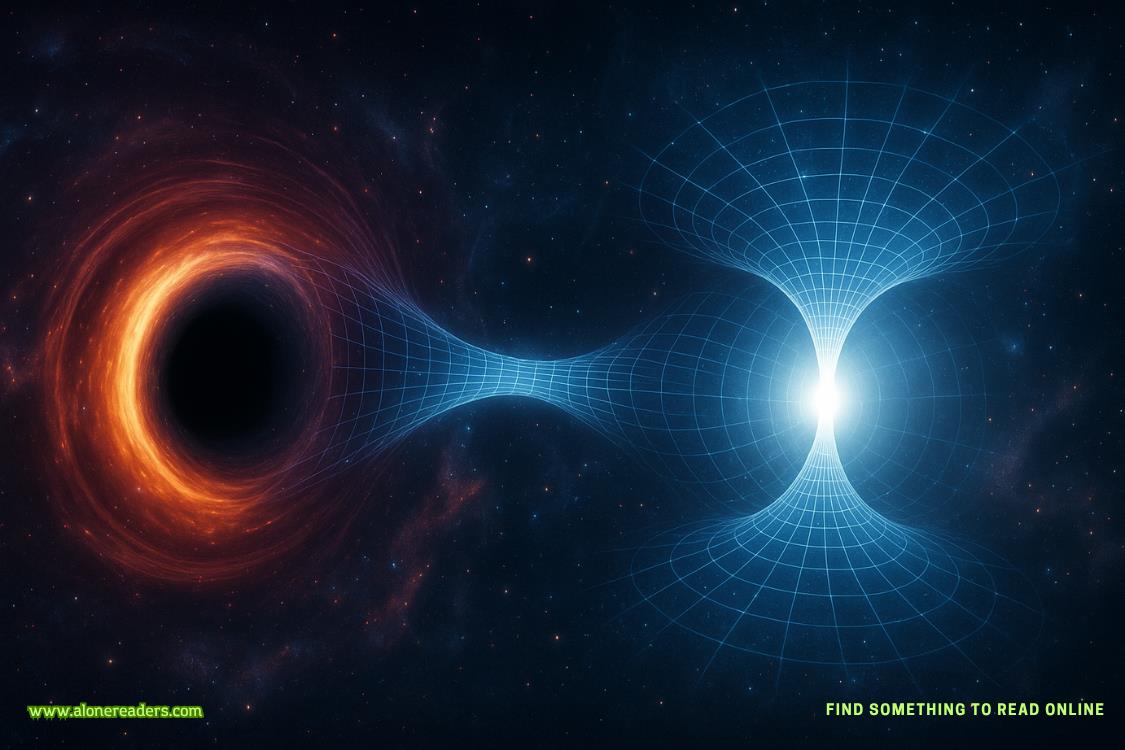
The universe is filled with extraordinary mysteries that challenge our understanding of space, time, and the very nature of reality. Among the most captivating concepts in modern astrophysics are black holes, white holes, and the elusive wormhole—objects that seem almost fictional, yet are rooted in the complex mathematics of general relativity and theoretical physics. One of the most intriguing questions asked by both scientists and sci-fi fans alike is whether wormholes could actually connect black holes and white holes, creating a tunnel through spacetime. To answer this, let’s dive into what these objects really are, how they might interact, and what the current science says—explained as simply as possible.
To begin, it’s essential to understand what black holes and white holes are. Black holes are regions in space where gravity is so strong that nothing, not even light, can escape their pull. They form when massive stars collapse at the end of their life cycles, squeezing matter into an infinitely dense point called a singularity, surrounded by an event horizon—the boundary beyond which escape is impossible. Any matter or energy that crosses this horizon is lost to the outside universe, making black holes appear as “cosmic traps.”
In contrast, a white hole is the theoretical opposite of a black hole. While black holes pull matter in, a white hole is thought to spit matter out, allowing nothing to enter from the outside. White holes have never been observed in nature, and remain purely hypothetical. Their existence arises naturally in some solutions to Einstein’s equations, suggesting that for every black hole, there could be a corresponding white hole in reverse. While black holes absorb everything, white holes could theoretically eject everything, making them like cosmic fountains as opposed to cosmic sinks.
Wormholes, also known as Einstein-Rosen bridges, are hypothetical passages through spacetime that could connect two distant points in the universe, or even two different universes altogether. In the mathematical language of general relativity, a wormhole is a “shortcut” that bends space and time, allowing something to travel vast distances instantly. The concept was first introduced in 1935 by Albert Einstein and Nathan Rosen, who realized that certain solutions to the equations of general relativity described a tunnel-like structure connecting a black hole and a white hole. These tunnels, in theory, could link different parts of spacetime, making the impossible journey between far-off places almost instantaneous.
But how exactly could a wormhole connect a black hole and a white hole? The simplest model comes from the Einstein-Rosen bridge solution itself. In this mathematical construct, a wormhole forms a tunnel with one end anchored in a black hole and the other end anchored in a white hole. If an object were to fall into the black hole, it would travel through the wormhole and emerge from the white hole elsewhere in space or time. This model, however, is purely theoretical. In the real universe, black holes are expected to collapse into singularities, while white holes are not believed to exist. Moreover, the original Einstein-Rosen bridge is unstable; it would pinch shut before anything could actually travel through it, according to further studies.
Despite these obstacles, the idea that wormholes might connect black holes and white holes continues to fascinate physicists. Theoretical work has shown that stable wormholes might be possible if they are held open by “exotic matter,” a hypothetical substance with negative energy density. This negative energy would counteract the immense gravitational pull that would otherwise cause the wormhole to collapse. Unfortunately, no such exotic matter has ever been observed, and it remains a speculative concept. Still, it is a key ingredient in keeping the wormhole open and traversable, at least according to the math.
Let’s look deeper at what theoretical physics says about these connections. In 1962, physicists John A. Wheeler and Robert W. Fuller analyzed the Einstein-Rosen bridge and showed it is not traversable by humans or matter; it closes off too quickly for anything to pass through. Later, in the 1980s and 1990s, Kip Thorne and Michael Morris explored traversable wormholes, introducing the idea that negative energy could stabilize a wormhole long enough for travel. These theoretical wormholes might function like cosmic subway tunnels, allowing for rapid transit between distant parts of the universe—or even between universes. Some proposals suggest the mouth of a wormhole could be located inside a black hole, with the other end opening out of a white hole elsewhere. If this were possible, it would fundamentally change our understanding of causality and the structure of the universe.
However, real-life physics throws up serious roadblocks. First, there is the problem of singularities. The core of a black hole is thought to be a singularity—a point where gravity is infinitely strong, and the laws of physics as we know them break down. Any object falling into a black hole would be destroyed long before it could reach or pass through a wormhole, assuming the wormhole even exists. Second, there is the issue of white holes themselves. While they are valid mathematical solutions, there is no evidence they occur naturally. Some scientists suggest that white holes could be a phase in the life cycle of a black hole, or that they might occur in a different universe altogether, but this remains speculative.
Another major consideration is the second law of thermodynamics. Black holes have entropy and can absorb matter, but a white hole, which ejects matter, seems to violate this law. This leads many scientists to view white holes more as mathematical curiosities than physically plausible objects. If wormholes require white holes to exist, then the entire concept becomes much less likely in our universe, at least with our current understanding of physics.
That said, wormholes remain an area of active research. Advances in quantum physics, especially in the field known as quantum gravity, may one day provide a mechanism for wormholes to exist or become traversable. For instance, ideas from string theory and the holographic principle suggest that the fabric of spacetime might be much more flexible than Einstein imagined, with quantum effects potentially allowing for stable wormholes. Some theories even suggest that entangled particles (those in quantum entanglement) are connected by tiny wormholes at the quantum level, hinting at a deep connection between wormholes and the fundamental structure of reality.
Even if wormholes connecting black holes and white holes do not exist in our universe, the concepts continue to inspire science fiction, as well as deeper theoretical work. Movies like “Interstellar” have popularized the idea of traveling through wormholes to reach distant galaxies, and countless books and TV shows imagine universes connected by cosmic tunnels. These stories, while imaginative, are grounded in the real science of general relativity, even if they stretch the known laws of physics for dramatic effect.
Ultimately, the question of whether wormholes could link black holes and white holes remains open. The mathematics says it is possible under certain highly idealized conditions, but nature has not yet revealed such wonders to our telescopes or detectors. If one day we discover evidence of a wormhole, or even glimpse a white hole, it would revolutionize not only our understanding of the universe, but also our sense of what is physically possible. Until then, the idea stands as one of the greatest mysteries at the intersection of science and imagination, reminding us how much there still is to learn about the cosmos. The study of these exotic objects continues to push the boundaries of physics, opening new avenues for exploring the ultimate nature of reality.



 Château de Vincennes: France’s Forgotten Royal Fortress and Medieval Stronghold
 Château de Carcassonne: Europe’s Greatest Medieval Citadel and Fortress
 Château de Chenonceau: The Castle Built by Remarkable Women
 Château de Chambord: France’s Magnificent Renaissance Castle and Architectural Wonder
 Tehri Dam: India's Tallest Dam and the Debate Behind It
 Bhakra Nangal Dam: India's Temple of Modern Development










