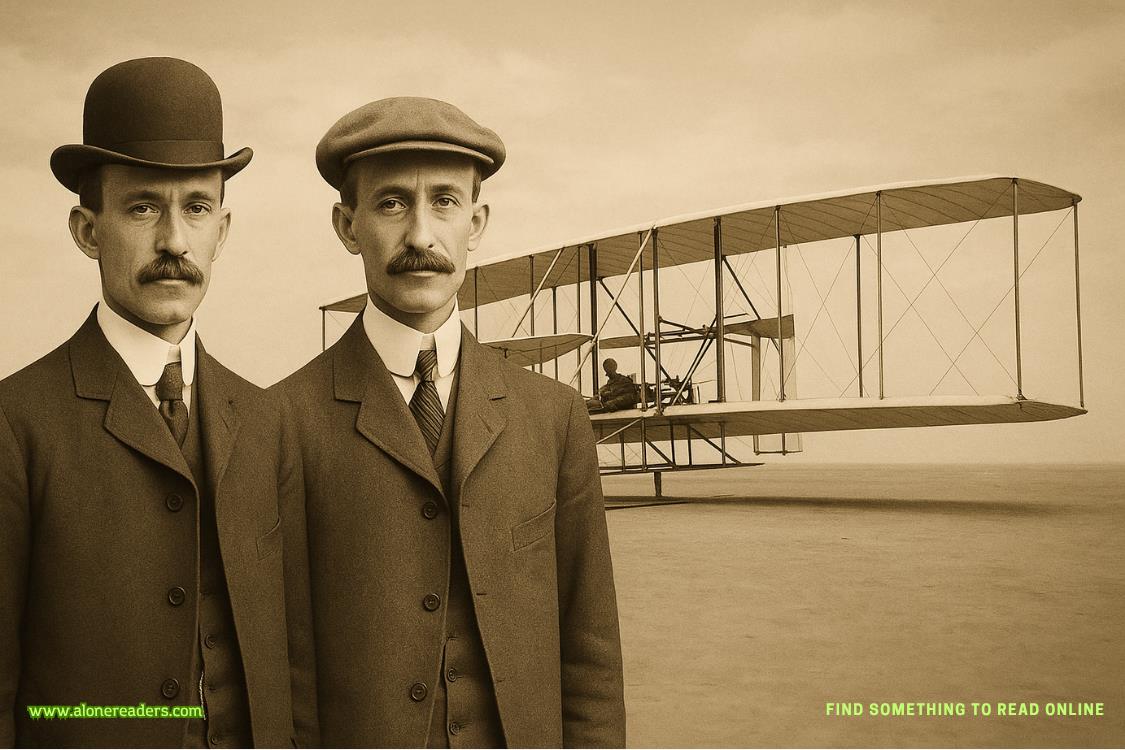
When we speak of the birth of modern aviation, the names Wilbur and Orville Wright stand as monumental figures who not only dreamed of flight but meticulously engineered the world’s first powered, controlled, and sustained heavier-than-air human flight. Unlike the mythologized, simplistic version of their story, the Wright brothers’ journey was marked by scientific rigor, iterative design, and an obsessive commitment to understanding the subtleties of flight dynamics. Their methodical approach and innovative solutions set the foundation for the aerospace age, influencing generations of engineers, pilots, and inventors.
Wilbur and Orville’s Childhood
Born in the late 19th century—Wilbur in 1867 and Orville in 1871—in Dayton, Ohio, the Wright brothers were raised in an environment that fostered curiosity, creativity, and intellectual exploration. Their father, Milton Wright, was a bishop who filled their home with books and encouraged independent thought, while their mechanically inclined mother, Susan, provided hands-on skills.
Formative Experiences with Mechanics
The brothers’ early fascination with mechanics was apparent in their teenage years, where they designed kites, created toys, and even launched a printing business with a press of their own invention. This hands-on experience would later become critical in their aviation experiments.
The Otto Lilienthal Catalyst
A pivotal moment came in 1896 when German aviation pioneer Otto Lilienthal died in a glider crash. Lilienthal’s dedication to understanding lift and his scientific publications captured Wilbur’s imagination, convincing both brothers that the problem of flight was not insurmountable—it simply required the right approach.
Challenging Existing Theories
Unlike many would-be inventors of the era, the Wright brothers did not chase glory with haphazard trial and error. Instead, they systematically questioned the accuracy of existing aerodynamic data, including the widely accepted tables of lift and drag coefficients published by Lilienthal and Samuel Langley. Wilbur, in particular, delved into physics texts and corresponded with the Smithsonian Institution, gradually piecing together a coherent scientific strategy.
Building the Wind Tunnel
Dissatisfied with the available data, the brothers constructed their own wind tunnel in 1901—one of the first in America. By testing over 200 different wing shapes, they gathered reliable figures for lift and drag, leading to their breakthrough understanding of the “airfoil” and the discovery that curved surfaces generated significantly more lift than flat ones. This wind tunnel work was foundational, separating them from less rigorous contemporaries.
The 1899-1902 Glider Experiments
The Wrights began practical experiments with gliders in 1899. Their earliest models incorporated a critical innovation—wing-warping—which enabled them to control roll and maintain balance in flight. At Kitty Hawk, North Carolina, chosen for its steady winds and isolation, the brothers repeatedly tested, adjusted, and refined their glider designs.
Breakthrough in Control: The Three-Axis System
While others had achieved brief, uncontrolled flights, the Wright brothers pioneered the three-axis control system:
This approach enabled not just flight, but truly controlled flight, allowing pilots to navigate, turn, and recover from instability—problems that had doomed previous attempts.
Iterative Improvement
Their experiments were far from a single eureka moment; each season brought failures, injuries, and new insights. For instance, after several accidents in 1901, the brothers recalculated lift tables and rebuilt their gliders. This willingness to learn from failure and embrace data-driven change was unique among their peers.
Building the Wright Flyer
Armed with their hard-earned data, the Wrights set out to build a powered aircraft. They constructed a 12-horsepower engine with the help of mechanic Charlie Taylor—a testament to their belief that custom solutions, not off-the-shelf parts, were required for success.
Innovative Propeller Design
Instead of using traditional marine-style propellers, the Wrights treated the propeller as a rotating wing, applying aerodynamic principles to maximize efficiency. Their hand-carved, twisted propellers converted over 80% of engine power into thrust—a level not achieved by others until decades later.
The Historic Flights
On December 17, 1903, Orville took the controls for the first sustained, controlled, powered flight, traveling 120 feet in 12 seconds. Wilbur’s turn later that day resulted in a 59-second, 852-foot flight—the true birth of modern aviation. Notably, these flights were witnessed by a small group, and the brothers’ low-key approach meant their achievement was initially met with skepticism by the broader scientific community.
The 1904-1905 Flyers
The Wrights returned to Dayton and built improved versions of their Flyer, gradually increasing range and control. By 1905, their Flyer III could make figure-eight turns and stay aloft for 39 minutes—a practical, reliable aircraft.
Overcoming Skepticism
Despite their achievements, the Wrights faced years of doubt from both the public and experts. Their secretiveness, born of fears over patent theft, fueled skepticism. It was only in 1908, during public demonstrations in France and the United States, that the world finally accepted the Wrights as the true pioneers of powered flight.
Patent Battles and Business Ventures
The brothers secured key patents, particularly for the three-axis control system, and entered into complex business negotiations with the U.S. Army and European governments. Their company, the Wright Company, became a leading manufacturer of aircraft, though it would eventually be surpassed by more modern designs.
The Scientific Mindset
More than their invention, the Wrights’ greatest contribution was their scientific methodology. By blending engineering skill, empirical data collection, and iterative refinement, they provided a model for innovation that influenced fields far beyond aviation.
Advancements in Aircraft Design
Their work on airfoils, control surfaces, and propeller dynamics remains foundational in aerospace engineering curricula to this day. The three-axis control system, especially, is a universal feature of all modern airplanes, helicopters, and even spacecraft.
Inspiring Future Generations
The Wright brothers became symbols of human ingenuity. Their story inspired countless engineers, inventors, and dreamers, serving as a testament to what relentless curiosity and disciplined experimentation can achieve.
Personal Legacies
Wilbur died in 1912 at just 45, his health worn down by years of travel and legal battles. Orville lived until 1948, witnessing the dawn of the jet age and reflecting with satisfaction on how their vision had changed the world. Neither brother married or had children, devoting their lives entirely to their work.
The Wright brothers’ story is far more than a tale of two bicycle makers who “got lucky.” It is a chronicle of methodical inquiry, bold risk-taking, and the kind of tenacious curiosity that transforms the impossible into the inevitable. Wilbur and Orville Wright not only invented the airplane—they forged the principles, mindset, and legacy that continue to drive the evolution of flight. Their journey from small-town Ohio to the sands of Kitty Hawk, and ultimately to the annals of history, remains a powerful lesson in how true pioneers think, work, and ultimately soar.



 The Hundred Days Offensive: How the Allies Defeated Germany in World War I
 The Second Battle of the Marne: The Turning Point of World War I in 1918
 The Spring Offensive of 1918: Germany's Final Gamble to Win World War I
 The Treaty of Brest-Litovsk: How Russia Left World War I
 The Russian Revolution and World War I: How War Brought Down the Tsar
 The Zimmermann Telegram Explained: Germany's Secret Offer to Mexico in World War I