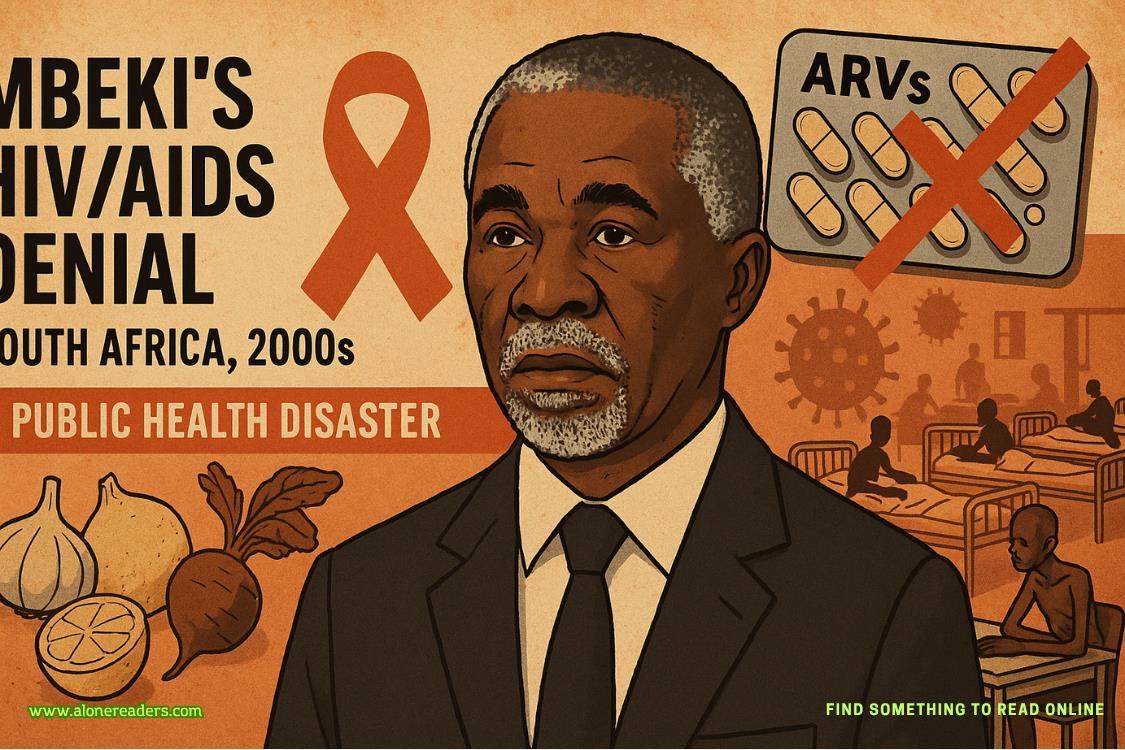
In the late 1990s and early 2000s, South Africa was facing one of the world’s worst HIV/AIDS epidemics. With an estimated five million people living with HIV by the year 2000, the country stood at a crossroads. It was in this context that Thabo Mbeki, the President of South Africa from 1999 to 2008, made a series of decisions and public statements that would later be recognized as a catastrophic error—one that cost the lives of hundreds of thousands and left a deep scar on the country’s social and political fabric.
Thabo Mbeki’s presidency began with promise and optimism. Having played a key role in South Africa’s transition to democracy, he was seen as an intellectual and a technocrat. But his approach to the HIV/AIDS epidemic revealed a tragic flaw: a deep skepticism of Western medical orthodoxy and an inclination toward conspiracy theories about the origins and treatment of AIDS. At the dawn of the new millennium, when global scientific consensus held that HIV was the cause of AIDS and that antiretroviral drugs (ARVs) could save lives, Mbeki publicly questioned these conclusions.
The seeds of denialism had been sown in the early 1990s, when a small but vocal group of so-called “AIDS dissidents” began to argue that HIV did not cause AIDS. Some of these voices, such as Peter Duesberg, gained a following among a minority of scientists but were overwhelmingly rejected by the broader scientific community. Inexplicably, Mbeki became enamored with these fringe views, in part due to suspicions about Western pharmaceutical companies and a colonial legacy of exploitation in Africa.
In 2000, at the International AIDS Conference in Durban, Mbeki stunned the world by defending his stance. He argued that poverty, malnutrition, and other factors played a more significant role in the AIDS crisis than HIV itself. The South African government under his leadership began to question the efficacy and safety of antiretroviral drugs, warning that they were toxic and potentially more dangerous than the disease they purported to treat. Instead of embracing proven treatment protocols, the government promoted “alternative” remedies, including vitamins, herbal supplements, and even garlic, beetroot, and lemon, as proposed by Manto Tshabalala-Msimang, Mbeki’s Minister of Health.
This denialist policy had devastating consequences. South Africa, home to the largest HIV-positive population in the world, became a battleground not only against the virus but against misinformation. The government’s resistance to providing ARVs through the public health system led to a catastrophic delay in rolling out life-saving drugs. By the time the policy began to shift in the mid-2000s—thanks in large part to legal battles, international pressure, and the tireless advocacy of organizations like the Treatment Action Campaign (TAC)—irreparable damage had already been done.
Scientific research later quantified the human cost of Mbeki’s denialism. A widely cited study by researchers at Harvard University estimated that more than 330,000 premature deaths could have been prevented between 2000 and 2005 if the government had provided timely access to ARV treatment. Tens of thousands of children were born with HIV during this period because pregnant women were denied medication that could have prevented mother-to-child transmission.
The stories behind these statistics are harrowing. Families were torn apart as parents died of AIDS-related illnesses, leaving behind orphaned children. Hospitals overflowed with patients who might have survived had they received appropriate treatment. The stigma surrounding HIV/AIDS deepened, as public discourse became mired in confusion and misinformation. Some doctors were threatened with disciplinary action for prescribing ARVs outside of official policy, while activists faced state harassment.
The global community watched in horror as South Africa, a country with the resources and medical infrastructure to lead the continent’s fight against AIDS, stumbled due to policy based on ideology rather than science. The United Nations, World Health Organization, and numerous scientists condemned the South African government’s stance, but official policy remained unchanged for years. Civil society, led by the Treatment Action Campaign and courageous individuals living with HIV, ultimately forced the government to relent. In 2003, following a Constitutional Court order, the South African government finally began to provide ARVs in the public health sector.
But even as access to treatment improved, the consequences of the lost years lingered. An entire generation suffered needlessly, while South Africa’s reputation for progressive social policy was tarnished. Mbeki, once celebrated as a modernizer, became associated in the public imagination with a profound policy failure. In later years, he defended his stance by arguing that he had been misunderstood or misrepresented, but the record is clear: his administration’s policies were rooted in denial of established science and a disregard for the lived realities of millions of South Africans.
The roots of Mbeki’s denialism were complex, involving a mix of skepticism toward Western medicine, fear of exploitation, and a desire to assert African agency in the face of perceived foreign interference. However, this stance had the tragic effect of undermining public trust in legitimate medicine and cost the lives of people who should have been saved. The story of Mbeki’s HIV/AIDS denialism is not only a cautionary tale about the dangers of political interference in science, but also a reminder of the immense responsibility that comes with leadership.
Today, South Africa has one of the largest HIV treatment programs in the world, a testament to the resilience of its people and the advocacy of its civil society. But the scars of the denialist era are still visible—in the lives lost, the children orphaned, and the ongoing stigma that surrounds HIV/AIDS in the country. The lesson of the 2000s is stark: when politics trumps science, the cost is measured in human lives. Mbeki’s era serves as a grim warning for leaders everywhere about the peril of ignoring evidence in the face of a public health crisis.
South Africa’s struggle with HIV/AIDS continues, but with access to ARVs and better public health education, the outlook is brighter. Yet the country’s history reminds us that the battle against disease is never only about medicine—it is also about truth, leadership, and the courage to act on behalf of those who cannot speak for themselves.



 Top 10 Highest-Paid Professions in the United States (2025): Salaries, Roles, and Career Paths
 Top 10 Largest U.S. Companies by Revenue in 2025 (Fortune 500 Analysis)
 Top 10 Highest-Earning Global Tech Companies in 2025: Revenue, Strategy, and Market Power
 Top 10 Highest-Earning Mobile Apps in 2025: Revenue, Monetization, and Market Dominance
 ZombieAgent: Inside the Zero-Click AI Attack That Turns ChatGPT Agents into Persistent Data-Leaking Zombies
 China’s Urban Air Is a Hidden Plastic Reservoir: Inside the Microplastic Clouds Over Megacities