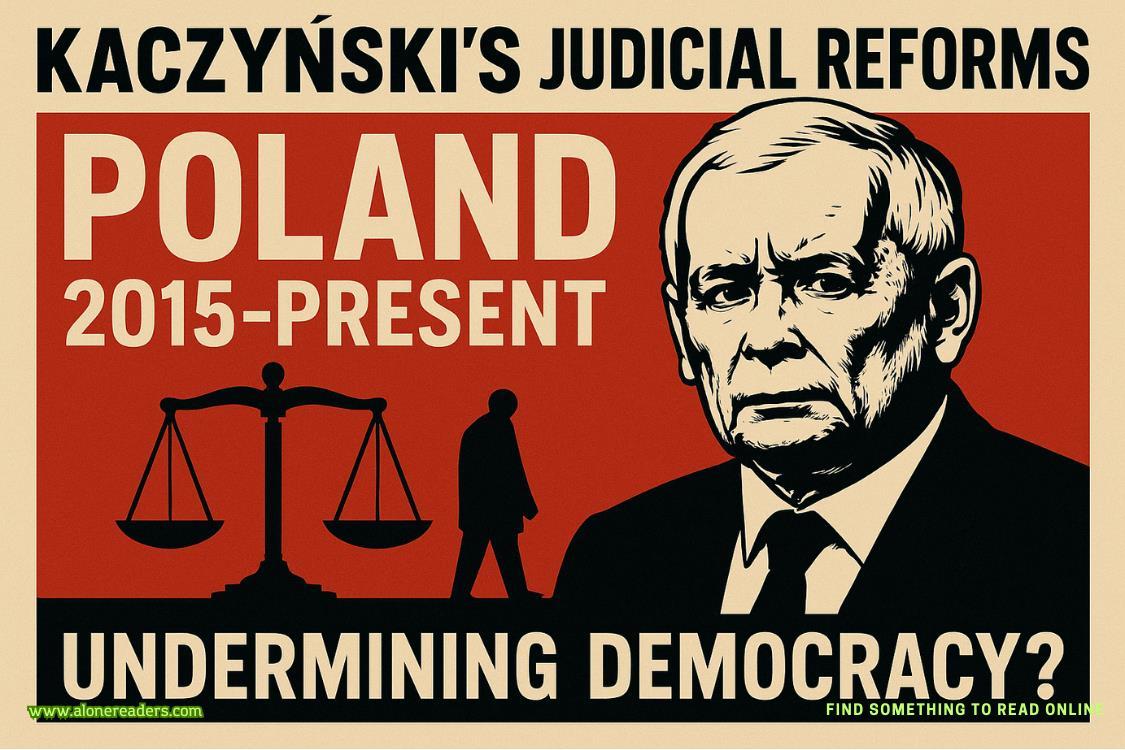
Since 2015, Poland has been undergoing one of the most contentious political transformations in its post-communist history. Under the leadership of Jarosław Kaczyński, the de facto head of the ruling Law and Justice party (PiS), the Polish government has embarked on sweeping judicial reforms. Proponents argue that these changes were necessary to purge the judiciary of corruption and inefficiency, remnants of the communist era. Critics, however, contend that these reforms represent an assault on judicial independence, undermine democratic safeguards, and place Poland on a collision course with the European Union over the rule of law. The question remains whether these reforms are an exercise in overdue modernization or a calculated strategy to consolidate political power.
The first significant step came with changes to the Constitutional Tribunal in late 2015. PiS altered the appointment process for judges, enabling the government to install loyalists and limit the court’s ability to challenge legislation. This move set the tone for subsequent reforms. Soon after, the government introduced measures lowering the retirement age of Supreme Court judges, forcing out nearly 40% of them. While presented as a way to refresh the judiciary, critics saw it as an attempt to remove experienced, often independent-minded judges and replace them with politically aligned figures.
The reforms extended to the National Council of the Judiciary (KRS), the body responsible for appointing judges. Traditionally, the KRS operated with a degree of autonomy, but PiS shifted the power to appoint its members from the judiciary to the parliament, where the ruling party holds a majority. This change effectively gave the government direct influence over judicial appointments, raising alarms about the erosion of checks and balances.
Another major point of controversy was the creation of a Disciplinary Chamber within the Supreme Court. This chamber was given wide powers to sanction judges for actions deemed “political” or contrary to state interests. In practice, it has been accused of targeting judges who criticize the reforms or rule against government positions. The European Court of Justice has ruled that the chamber lacks independence and violates EU law, but the Polish government has been slow to dismantle it, signaling its determination to maintain control over the judiciary.
The political justification for these reforms has been framed around combating inefficiency, corruption, and “post-communist influence” in the judiciary. PiS argues that the courts have long been an unaccountable elite resistant to reform, and that changes are necessary to make them more responsive to the will of the people. However, opponents—both domestic and international—counter that the reforms are less about improving justice and more about creating a judiciary that cannot effectively check government power.
The European Union has responded with unprecedented measures, including triggering Article 7 proceedings, which could strip Poland of voting rights in the EU Council. The dispute has strained Poland’s relationship with Brussels, with the EU insisting that judicial independence is a non-negotiable principle of membership. Financial penalties have also been imposed, and there are ongoing threats to withhold EU funding if Poland continues on its current trajectory. This has placed Warsaw in a difficult position, balancing domestic political gains against the economic and diplomatic costs of EU confrontation.
Public opinion in Poland is deeply divided. Supporters of PiS often view the reforms as a necessary step to break the power of entrenched judicial elites and align the judiciary with the democratic mandate of elected officials. Many rural and conservative voters believe that the judiciary has long been disconnected from ordinary citizens, and trust PiS to deliver change. Urban, liberal, and pro-European Poles, on the other hand, see the reforms as a dismantling of democratic safeguards and a slide toward authoritarianism. This polarization reflects deeper cultural and political divides in Polish society.
The long-term consequences of these reforms are still unfolding. International watchdogs like Freedom House and the World Justice Project have noted declines in Poland’s scores for judicial independence and democratic governance. Domestically, the reforms may have created an environment where judges feel pressured to align with government expectations, potentially undermining public trust in impartial justice. The chilling effect on judicial decision-making could extend far beyond the tenure of the current government, embedding political influence deep into the legal system.
Kaczyński himself holds no formal government office, yet his influence over policy and personnel is unmatched. This has raised questions about accountability, as key decisions about the judiciary appear to be driven more by party strategy than transparent public debate. The centralization of power in the hands of a few party leaders has fueled concerns that Poland’s democratic institutions are being reshaped in ways that may be difficult to reverse.
From a geopolitical perspective, Poland’s trajectory has implications for the wider European Union. The EU is already grappling with challenges to liberal democracy from other member states such as Hungary. A persistent standoff with Warsaw over the rule of law could embolden other governments to push against EU norms, weakening the bloc’s cohesion. At the same time, Poland’s strategic position in Eastern Europe—especially amid tensions with Russia—makes the EU reluctant to escalate the conflict to the point of a full political rupture.
Ultimately, whether Kaczyński’s judicial reforms represent a legitimate effort to modernize Poland’s courts or a deliberate move toward illiberal democracy depends on one’s interpretation of both intent and outcome. What is undeniable is that these reforms have fundamentally altered the balance of power in Poland, drawing clear battle lines between national sovereignty advocates and defenders of supranational democratic standards. As the political struggle continues, Poland stands as a critical test case for the resilience of democratic institutions in the face of populist governance.
The years since 2015 have demonstrated that democracy can be weakened not only by abrupt coups or blatant authoritarian takeovers, but also through incremental legal and institutional changes presented as reforms. In Poland’s case, the consolidation of power over the judiciary under PiS has shown how a determined political movement can reshape a nation’s constitutional order within the framework of formal legality. Whether this path can be reversed—or even whether a future government will have the political will to attempt it—remains one of the central questions for Poland’s democratic future.

October 25, 2023

January 02, 2025



 Top 10 Highest-Paid Professions in the United States (2025): Salaries, Roles, and Career Paths
 Top 10 Largest U.S. Companies by Revenue in 2025 (Fortune 500 Analysis)
 Top 10 Highest-Earning Global Tech Companies in 2025: Revenue, Strategy, and Market Power
 Top 10 Highest-Earning Mobile Apps in 2025: Revenue, Monetization, and Market Dominance
 ZombieAgent: Inside the Zero-Click AI Attack That Turns ChatGPT Agents into Persistent Data-Leaking Zombies
 China’s Urban Air Is a Hidden Plastic Reservoir: Inside the Microplastic Clouds Over Megacities
 The Abu Ghraib Scandal, Iraq, 2004: A Human Rights Disaster That Shook the World
 The Disbanding of the CNRP, Cambodia, 2017: Hun Sen's Clampdown on Democracy and the Reshaping of Cambodian Politics
 The Firing of James Comey, United States, 2017: Trump's Controversial Decision Amid FBI Investigation
 The Rwandan Refugee Crisis, Central Africa, 1994: Aftermath of Genocide and the Humanitarian Catastrophe
 The Most Important Turning Points of the Battle of Hastings (1066)
 Why William Won the Battle of Hastings and Harold Lost: Strategy, Leadership and Fate in 1066
 How King Harold II Died: Facts, Myths, and Historical Debate
 The Battle of Hastings: A Complete Timeline of the Fighting
 High-End Talent Category A Work Permit China 2026: Complete Eligibility, Benefits, Application Process, and Expert Guide
 Cultural Activities Visa Japan 2026 Guide: Complete Eligibility, Requirements, Application Process, and Expert Tips