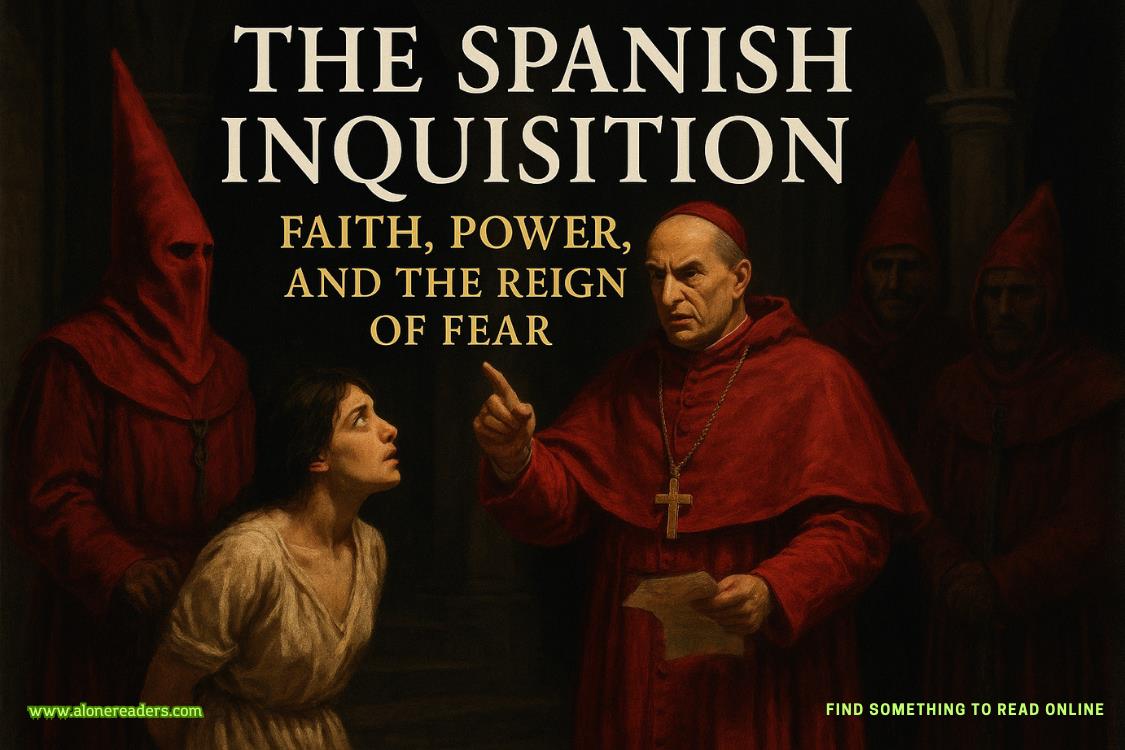
The Spanish Inquisition remains one of history’s most infamous examples of religion entwined with political power, creating a climate of deep fear and suspicion. Established in 1478 by Catholic Monarchs Ferdinand II of Aragon and Isabella I of Castile, its official purpose was to maintain Catholic orthodoxy in their kingdoms. In reality, it became a powerful instrument of political control, designed to enforce religious unity and suppress dissent. The timing of its creation was crucial: Spain had just emerged from centuries of conflict with Muslim rulers during the Reconquista, and the monarchs sought to solidify their rule by ensuring a homogenous religious identity under Catholicism.
Initially, its focus fell heavily on conversos—Jews who had converted to Christianity but were suspected of secretly practicing Judaism. Later, it targeted Moriscos (Muslims who converted to Christianity) and Protestants, as well as anyone accused of blasphemy, witchcraft, or heretical ideas. The Inquisition operated under the principle that faith must be pure and unquestioned, and deviation from orthodoxy was not just a sin but a threat to the entire social order. This meant that accusations—often motivated by personal grudges, jealousy, or political rivalries—could lead to interrogations, imprisonment, and even execution.
The Inquisition’s methods were infamous for their secrecy and severity. Trials were conducted behind closed doors, and the accused were often unaware of the full charges against them. Testimonies from anonymous witnesses carried great weight, and the accused had little opportunity to defend themselves effectively. Torture was authorized as a means of extracting confessions, justified by the belief that saving a soul from heresy outweighed the suffering of the body. These confessions, whether truthful or forced, often sealed a person’s fate.
Public punishments were both judicial and symbolic. The most feared was the auto-da-fé, a public act of penance where sentences were read and punishments carried out, sometimes culminating in execution by burning at the stake. Such spectacles served as both religious rituals and political theater, reminding the population of the dire consequences of straying from the faith. These events reinforced a culture of fear that permeated daily life, discouraging open discussion of religious ideas and fostering an environment where suspicion could destroy reputations and lives.
The Inquisition was not solely a tool of religion—it was also a mechanism of statecraft. By aligning the Catholic Church with the crown’s political objectives, Ferdinand and Isabella used it to consolidate their authority, weaken opposition, and eliminate potential threats. The wealth seized from convicted heretics also enriched the state, making the Inquisition a financially beneficial enterprise. Over time, the institution’s reach extended into censorship, controlling which books could be published or read, thereby limiting the spread of ideas that might challenge official doctrine or political stability.
The psychological impact of the Inquisition was profound. Generations of Spaniards grew up under the shadow of potential denunciation. Friendships, family bonds, and business partnerships could be shattered by a single accusation. In such a climate, conformity became a survival strategy, and genuine religious devotion was often tangled with fear of persecution. This pervasive anxiety stifled intellectual curiosity and slowed Spain’s engagement with the broader currents of the Renaissance and the Enlightenment.
Despite its notorious reputation, the Inquisition was not omnipotent, and its influence varied across regions and over time. Some areas experienced more intense scrutiny, while others were more loosely monitored. Over the centuries, criticism of its methods and excesses grew, both within Spain and abroad. Enlightenment thinkers condemned its suppression of free thought, and political shifts in Europe gradually eroded the Church’s absolute authority. By the early 19th century, the institution was increasingly seen as incompatible with modern governance and human rights.
The Spanish Inquisition was officially abolished in 1834, bringing an end to more than three centuries of religious policing. Its legacy, however, has endured in historical memory as a cautionary tale about the dangers of absolute authority, the fusion of religion and politics, and the corrosive effects of fear on a society. It is remembered not only for its brutal methods but also for the way it shaped Spain’s cultural, political, and intellectual trajectory for generations.
Today, historians continue to study the Inquisition not only to understand its role in Spanish history but also to draw lessons about intolerance, the abuse of power, and the resilience of human belief. The Spanish Inquisition was born in an age of deep religious conviction, but its methods reveal the peril of pursuing unity through oppression. In the tension between faith and fear, the Inquisition chose fear as its instrument, leaving behind a legacy that remains both a subject of fascination and a stark warning to future generations.



 The Hundred Days Offensive: How the Allies Defeated Germany in World War I
 The Second Battle of the Marne: The Turning Point of World War I in 1918
 The Spring Offensive of 1918: Germany's Final Gamble to Win World War I
 The Treaty of Brest-Litovsk: How Russia Left World War I
 The Russian Revolution and World War I: How War Brought Down the Tsar
 The Zimmermann Telegram Explained: Germany's Secret Offer to Mexico in World War I










