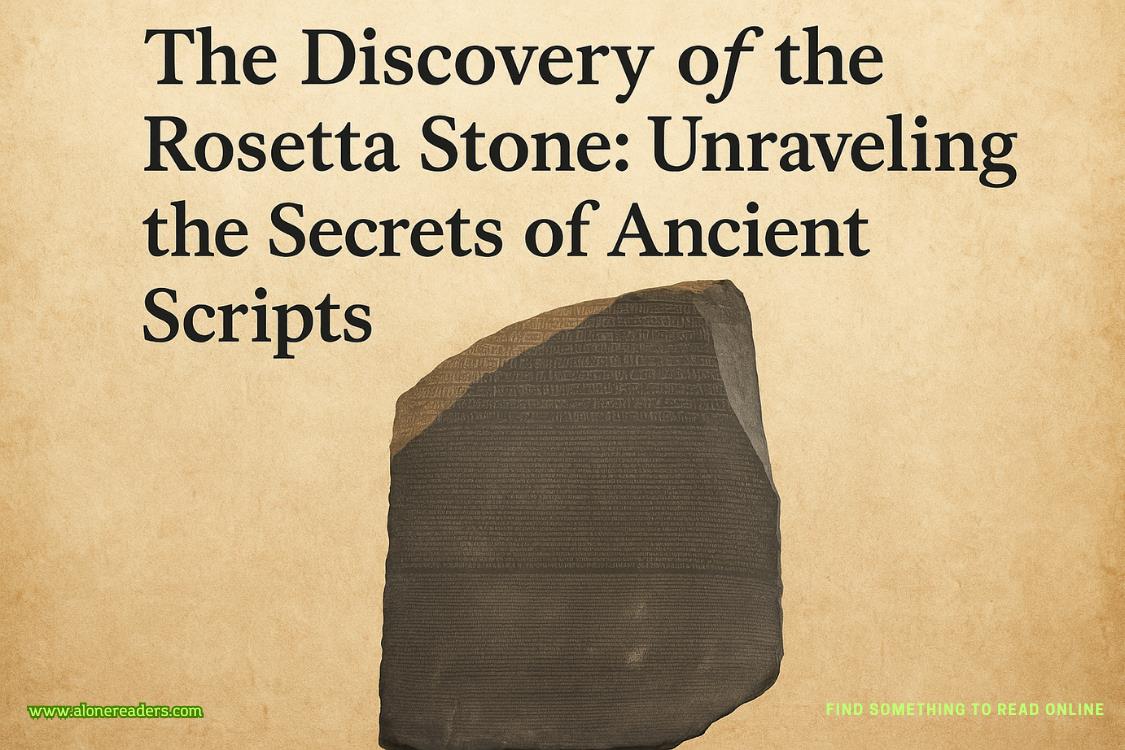
The discovery of the Rosetta Stone in 1799 was not just an archaeological find; it was a pivotal moment that bridged centuries of lost knowledge and resurrected the voices of ancient Egypt. The stone, a seemingly ordinary slab of granodiorite, became the key to deciphering Egyptian hieroglyphs, a writing system that had been a mystery to scholars for over a millennium. It was unearthed by French soldiers during Napoleon Bonaparte’s campaign in Egypt, near the town of Rosetta (modern-day Rashid) in the Nile Delta. This accidental discovery would go on to reshape the study of Egyptology and unlock an entire civilization’s written record.
The stone itself is inscribed with a decree issued in 196 BCE during the reign of King Ptolemy V. What made it extraordinary was that the decree was written in three distinct scripts: Egyptian hieroglyphs, Demotic script, and Ancient Greek. Greek, being well understood by scholars of the time, provided a crucial translation key for the other two scripts. The arrangement of these texts allowed linguists to compare each version side-by-side, offering a rare linguistic bridge between the ancient and modern worlds. This trilingual nature made the Rosetta Stone unlike any other artifact, functioning almost like a bilingual dictionary for ancient scripts.
When the British defeated the French in Egypt in 1801, the Rosetta Stone was seized and taken to London, where it has remained in the British Museum ever since. Its relocation intensified scholarly interest across Europe, sparking a race among linguists to unlock the hieroglyphic code. Early attempts at decipherment met with limited success, as researchers struggled to understand the complex combination of ideograms, phonetic symbols, and determinatives that composed the hieroglyphic system. Many assumed that hieroglyphs were purely symbolic, an art form rather than a functional written language, an assumption that slowed progress for years.
A breakthrough came when scholars began to suspect that hieroglyphs included phonetic elements, especially for foreign names. The English polymath Thomas Young was among the first to identify that certain hieroglyphic symbols spelled out the name of King Ptolemy. His work was significant, yet it was the French scholar Jean-François Champollion who ultimately unlocked the full system. Building on Young’s observations and drawing from his deep knowledge of Coptic, the liturgical language of Egyptian Christians and a direct descendant of ancient Egyptian, Champollion realized that hieroglyphs represented a mixture of sounds and ideas.
In 1822, Champollion announced his decipherment of the hieroglyphic script, revealing that it was not purely pictorial but a complex writing system with phonetic signs, ideograms, and determinatives. This breakthrough allowed historians to read temple inscriptions, tomb writings, and papyrus documents for the first time in nearly 1,500 years. His work opened the door to translating vast amounts of ancient Egyptian literature, from royal decrees to religious texts, shedding light on political history, religious beliefs, cultural practices, and everyday life in the Nile Valley.
The implications of deciphering the Rosetta Stone extended far beyond Egyptology. It demonstrated the importance of comparative linguistics and interdisciplinary study in historical research. The stone provided not just a translation tool but also a cultural bridge between civilizations, illustrating how knowledge can be preserved, lost, and rediscovered. The methodical analysis applied by Young and Champollion set new standards for decipherment of other ancient scripts, influencing later breakthroughs with cuneiform and Mayan hieroglyphs.
The Rosetta Stone’s story also raises questions about cultural heritage and the ownership of historical artifacts. While it remains a centerpiece of the British Museum’s collection, Egypt has repeatedly requested its return, citing its deep national and cultural significance. The ongoing debate reflects larger conversations about the repatriation of artifacts acquired during colonial eras, as well as the responsibilities of museums to the cultures they represent.
Today, the Rosetta Stone continues to fascinate both scholars and the public. Replicas and casts are displayed in museums worldwide, and digital imaging has made its inscriptions accessible to researchers everywhere. Modern technology allows for high-resolution scans and detailed linguistic databases that preserve its content indefinitely, ensuring that the lessons of its discovery remain accessible for future generations. For Egyptologists, the stone is more than an artifact—it is a symbol of intellectual persistence, cross-cultural curiosity, and the transformative power of language.
The discovery of the Rosetta Stone and the subsequent decipherment of hieroglyphs is a testament to human ingenuity and the enduring drive to understand the past. Without it, the voices of pharaohs, priests, and common Egyptians might have remained silent forever, locked behind symbols no one could read. Instead, the stone became the key that opened an ancient civilization to the modern world, turning mystery into knowledge and cementing its place as one of the most important archaeological finds in history.



 The Hundred Days Offensive: How the Allies Defeated Germany in World War I
 The Second Battle of the Marne: The Turning Point of World War I in 1918
 The Spring Offensive of 1918: Germany's Final Gamble to Win World War I
 The Treaty of Brest-Litovsk: How Russia Left World War I
 The Russian Revolution and World War I: How War Brought Down the Tsar
 The Zimmermann Telegram Explained: Germany's Secret Offer to Mexico in World War I










