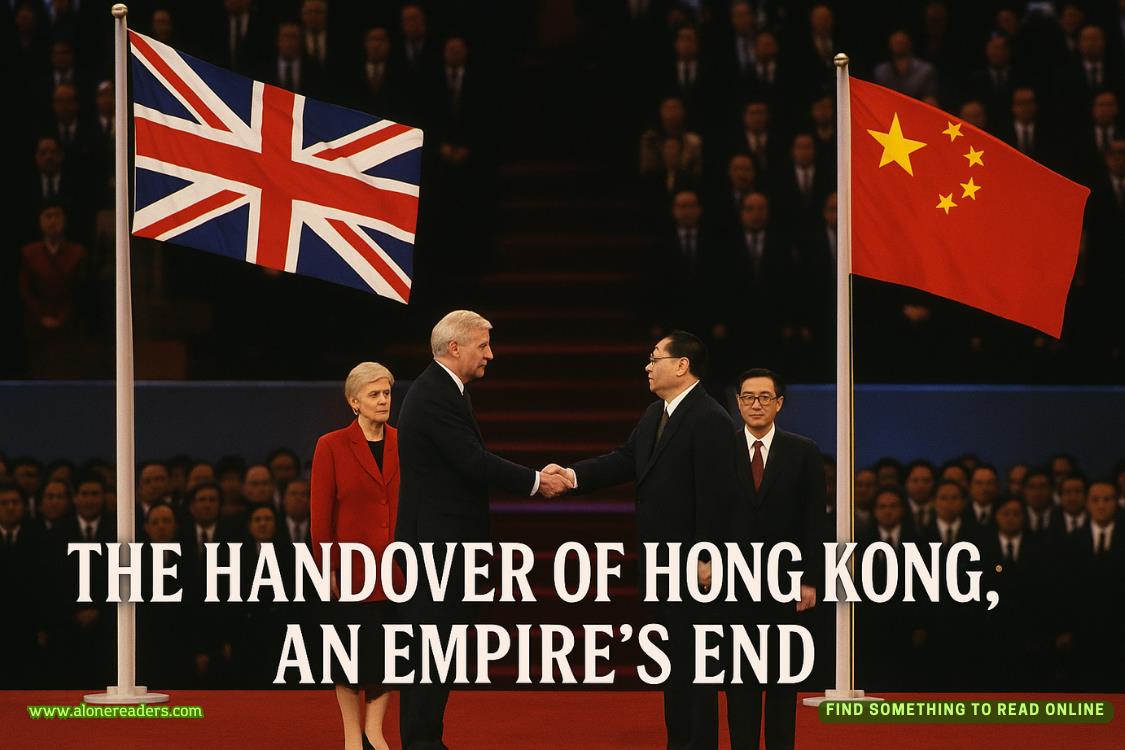
The handover of Hong Kong in 1997 was more than a ceremonial passing of sovereignty from the United Kingdom to the People’s Republic of China; it was the symbolic conclusion of one of the longest-running colonial enterprises in world history. As the Union Jack was lowered and the Chinese flag rose over Victoria Harbour at midnight on July 1, 1997, the world witnessed not just a diplomatic ritual, but a powerful image of an empire’s twilight. For Britain, Hong Kong had been its last great imperial possession in Asia, a jewel of commerce and culture that embodied both the ambition and contradictions of colonial rule. For China, the handover represented the end of a “century of humiliation” and the restoration of national dignity. For Hong Kong’s people, it was the start of a complex new era defined by uncertainty, identity struggles, and an evolving relationship with Beijing.
The roots of this historic moment trace back to the nineteenth century, when Britain, expanding its global empire, used its naval and commercial power to force China into concessions after the Opium Wars. The Treaty of Nanking in 1842 ceded Hong Kong Island to Britain in perpetuity, followed by the Convention of Peking in 1860, which added Kowloon. The final expansion came in 1898 with the 99-year lease of the New Territories, the hinterland that made Hong Kong strategically viable. Although Britain invested heavily in turning Hong Kong into a financial hub and major port, its rule was marked by an unequal system where local Chinese residents had little political voice. By the late twentieth century, Hong Kong had become a paradox: a thriving, capitalist city with democratic aspirations, governed under colonial authority without full representation.
The expiry of the New Territories lease in 1997 forced the issue of Hong Kong’s future. Without the New Territories, Hong Kong was economically and strategically unsustainable. Negotiations between Britain and China began in the late 1970s and culminated in the Sino-British Joint Declaration of 1984. This agreement established the principle of “one country, two systems,” under which Hong Kong would return to Chinese sovereignty but retain its capitalist system, independent judiciary, and way of life for fifty years beyond 1997. The Joint Declaration promised that Hong Kong would enjoy a “high degree of autonomy,” ensuring that freedoms absent in mainland China would be preserved until at least 2047. Yet beneath the diplomatic language, there were deep anxieties about whether these promises would hold true.
The transition itself was meticulously choreographed. On the night of June 30, 1997, Prince Charles represented the British Crown, while Prime Minister Tony Blair and Governor Chris Patten attended the handover ceremony. Patten, often called the “last imperial governor,” had attempted to introduce democratic reforms in Hong Kong in the early 1990s, which caused tensions with Beijing. His departure was seen by many as an emotional end to British rule. The ceremony at the Hong Kong Convention and Exhibition Centre was marked by a mix of pomp and solemnity, with Chinese President Jiang Zemin and Premier Li Peng leading the delegation from Beijing. The lowering of the British flag and raising of the Chinese flag, accompanied by a dramatic midnight rainstorm, became etched in global memory. For many, it was the perfect metaphor: the fading of imperial power under stormy skies, giving way to an uncertain dawn.
For Britain, the handover was both a humiliation and a relief. Humiliation, because it underscored the limits of imperial ambition and the inability to secure perpetual control over such a vital territory. Relief, because it removed the burden of administering a colony increasingly restless for representation, and it allowed Britain to redefine its role as a modern global power less reliant on colonial possessions. The British narrative after 1997 focused on the pride in having developed Hong Kong into one of the world’s great financial centers, while avoiding confrontation with China that could have jeopardized the city’s stability. Yet for many Britons, the handover remained tinged with regret, a recognition that their empire’s final curtain call was played not in victory, but in retreat.
For China, the return of Hong Kong was a triumph of diplomacy and symbolism. It showcased the Communist Party’s ability to reclaim lost territories without war, contrasting with the violent turmoil that had characterized much of the twentieth century. Chinese leaders presented the event as a reversal of the injustices imposed during the era of Western imperialism, a period when China had been forced into unequal treaties and territorial concessions. Hong Kong’s return was portrayed as the start of national rejuvenation, a stepping stone toward China’s reemergence as a global power. Yet the challenge for Beijing was profound: how to integrate a city steeped in free-market economics, common law traditions, and civic freedoms into a one-party state without sparking instability.
For Hong Kong’s people, the moment was far more complex. Many residents were deeply anxious about the future, fearing erosion of freedoms under Chinese rule. In the years leading up to 1997, a wave of emigration took place, with families relocating to Canada, Australia, and the United States, often as a form of insurance policy against political uncertainty. Yet others remained hopeful that the “one country, two systems” framework would allow Hong Kong to thrive, benefiting from closer integration with the booming Chinese economy while retaining its global character. The early years after the handover seemed to confirm this optimism: Hong Kong continued to flourish as a financial hub, its legal system remained intact, and its freedoms largely preserved. But beneath the surface, tensions simmered between local aspirations and Beijing’s authority.
The legacy of the handover cannot be fully understood without considering the deeper question of empire itself. Hong Kong was Britain’s last great possession in Asia, and its transfer symbolized the end of a world order built on colonial dominance. Unlike other decolonization moments, where independence movements brought self-rule, Hong Kong’s destiny was decided by negotiations between two states, with limited input from its own people. This highlighted the contradictions of both colonialism and global diplomacy: Hong Kong was developed into a modern, prosperous city by imperial powers, yet denied a full voice in shaping its own political future. The handover revealed both the adaptability and the fragility of the British Empire’s legacy.
In hindsight, the 1997 handover marked a turning point not only for Hong Kong, but for global geopolitics. It signaled the decline of Western colonialism and the rise of China as a force that could reshape international order. The questions it raised about sovereignty, identity, and democracy continue to resonate today, particularly as Hong Kong has faced political upheavals in the decades since. The promise of “one country, two systems” remains under strain, with debates over freedoms, governance, and autonomy intensifying in ways that the negotiators of the 1980s could scarcely have imagined. Yet in the collective memory of the world, that rain-soaked night in 1997 remains indelible: the end of empire, the reclaiming of sovereignty, and the uncertain beginning of a new era.
Ultimately, the handover of Hong Kong in 1997 was not just a transfer of territory but the culmination of centuries of history, empire, and struggle. It represented Britain’s reluctant farewell to its imperial past, China’s assertion of renewed national pride, and Hong Kong’s step into an ambiguous future. As history continues to unfold, the legacy of that midnight moment endures as a reminder of the shifting tides of power, the complexities of identity, and the enduring impact of empire’s end.



 Top 10 Highest-Paid Professions in the United States (2025): Salaries, Roles, and Career Paths
 Top 10 Largest U.S. Companies by Revenue in 2025 (Fortune 500 Analysis)
 Top 10 Highest-Earning Global Tech Companies in 2025: Revenue, Strategy, and Market Power
 Top 10 Highest-Earning Mobile Apps in 2025: Revenue, Monetization, and Market Dominance
 ZombieAgent: Inside the Zero-Click AI Attack That Turns ChatGPT Agents into Persistent Data-Leaking Zombies
 China’s Urban Air Is a Hidden Plastic Reservoir: Inside the Microplastic Clouds Over Megacities