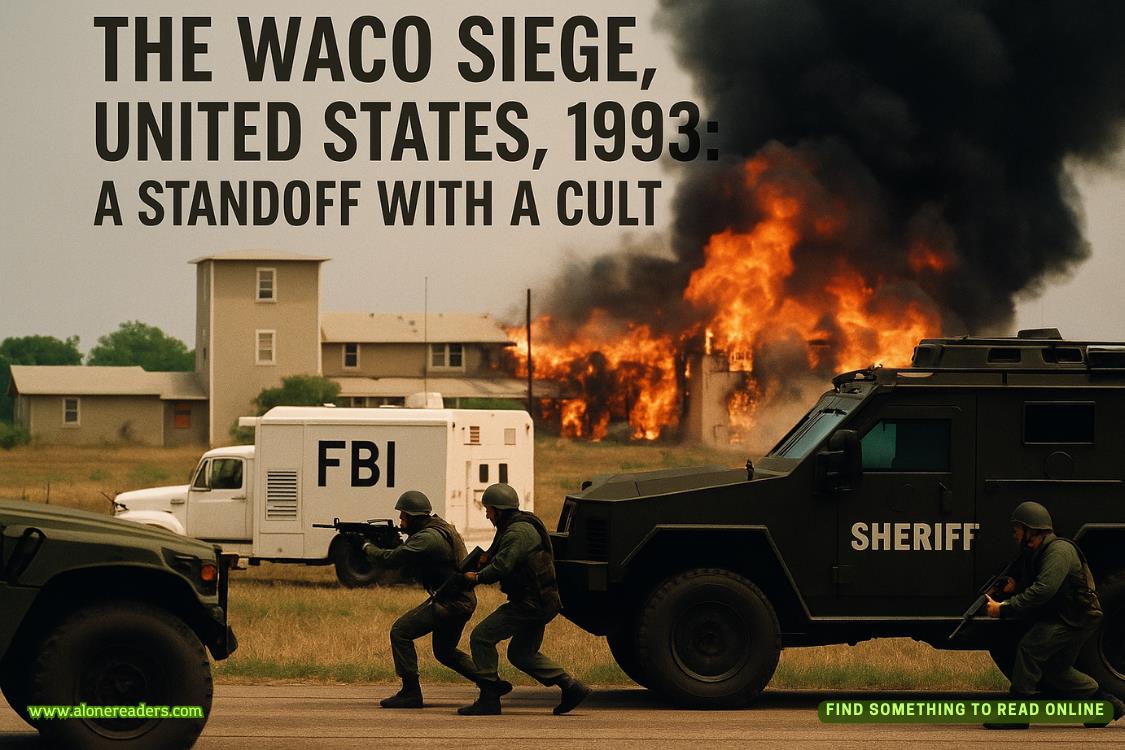
The Waco Siege of 1993 remains one of the most infamous and controversial episodes in modern American history. It was a 51-day standoff between federal authorities and the Branch Davidians, a religious sect led by David Koresh, near Waco, Texas. The confrontation captured the attention of the nation, dividing public opinion and sparking debates about government overreach, religious freedom, and law enforcement accountability. Its outcome, which resulted in the deaths of more than 80 Branch Davidians, including women and children, left a deep scar on the American consciousness and continues to influence discussions around policing and government power.
The origins of the Waco Siege can be traced to the beliefs of the Branch Davidians, a splinter group of the Seventh-day Adventist Church. Under David Koresh, born Vernon Wayne Howell, the group developed into a highly insular community devoted to apocalyptic teachings. Koresh proclaimed himself as the final prophet, interpreting biblical texts to assert his authority and predict the imminent end of the world. His leadership style combined religious fervor with absolute control, as he dictated not only the spiritual but also the personal lives of his followers. Reports of child abuse, forced marriages, and stockpiling of weapons at their Mount Carmel compound brought the group to the attention of law enforcement.
By the early 1990s, federal agencies such as the Bureau of Alcohol, Tobacco, and Firearms (ATF) began investigating the Branch Davidians for alleged weapons violations. The group was suspected of modifying semi-automatic rifles into illegal automatic weapons and amassing a large arsenal. On February 28, 1993, the ATF attempted to execute a search and arrest warrant against Koresh and his followers. However, the raid quickly went awry. The Branch Davidians had been tipped off about the impending action, leading to a deadly exchange of gunfire. Four ATF agents were killed, and several others wounded, while an unknown number of Davidians also died. What was meant to be a swift operation spiraled into a protracted siege.
The failed raid brought in the Federal Bureau of Investigation (FBI), which took control of the standoff. Negotiations with Koresh and his inner circle began immediately. During the 51 days, the FBI employed a mix of negotiation tactics and psychological pressure, ranging from direct communication with Koresh to the use of loudspeakers blasting music, floodlights to deprive the occupants of sleep, and cutting off power and water supplies to the compound. At times, Koresh appeared willing to surrender but repeatedly stalled, claiming that he was awaiting divine instructions before taking action. The prolonged stalemate frustrated both the negotiators and tactical teams.
Public attention intensified as the standoff dragged on. Media outlets broadcasted live coverage of the compound, with analysts, politicians, and ordinary citizens weighing in on the situation. Critics accused federal agents of mishandling the operation, while others argued that Koresh and his followers bore full responsibility for their defiance. Religious leaders warned that heavy-handed tactics against a faith-based community, however unorthodox, risked violating constitutional rights. Meanwhile, those who had left the compound during the standoff provided disturbing accounts of life inside, describing Koresh’s authoritarian rule, forced polygamy, and indoctrination.
The standoff reached its tragic climax on April 19, 1993, when the FBI launched a final assault to force the Davidians out. Armored vehicles began to punch holes in the compound walls, inserting tear gas to flush the occupants out. However, instead of surrendering, a fire erupted within the compound. The flames spread rapidly, consuming the entire structure. In less than an hour, the Mount Carmel Center was reduced to ashes. The fire claimed the lives of 76 Branch Davidians, including David Koresh, many of whom were children. Only a handful of survivors emerged from the inferno. Whether the fire was deliberately set by the Davidians as an act of defiance or inadvertently caused by the FBI’s assault remains a subject of intense debate and conspiracy theories.
The aftermath of the Waco Siege was marked by public outcry, congressional investigations, and years of legal battles. Survivors were prosecuted on various charges, including weapons offenses, though few were convicted of direct responsibility for the deaths of federal agents. The government faced widespread criticism for its handling of the operation. Independent reports and congressional hearings examined the decisions made by both the ATF and FBI, highlighting failures in intelligence, planning, and negotiation strategies. The tragedy fueled deep mistrust of federal authority, especially among anti-government and militia movements across the United States.
The Waco Siege also had long-term implications beyond the immediate tragedy. It became a rallying point for extremist groups who saw the event as evidence of federal tyranny. Timothy McVeigh, the perpetrator of the 1995 Oklahoma City bombing, cited the siege as one of his primary motivations. The image of the burning compound became a powerful symbol of government oppression in the eyes of anti-establishment activists, influencing the growth of radical ideologies in the years that followed.
For scholars and policymakers, Waco remains a cautionary tale of how religious zealotry and government force can collide with catastrophic results. It underscores the complexity of dealing with insular, high-control groups where deep faith and absolute loyalty to a leader may override rational negotiation. It also highlights the dangers of escalating confrontations through militarized tactics without fully appreciating the psychological and theological dynamics at play within such communities.
The human cost of the Waco Siege is impossible to ignore. Beyond the statistics, the lives lost included families who had committed themselves to a belief system they thought would offer salvation. Many of the children who perished never had the chance to choose their path. For law enforcement officers and federal agents, the deaths of their colleagues left a legacy of sacrifice and questions about whether different approaches might have saved lives. For the nation, Waco became a painful reminder of the balance that must be struck between enforcing the law and respecting religious liberties, even when those beliefs fall outside mainstream norms.
Three decades later, the Waco Siege continues to evoke strong emotions and inspire both scholarly analysis and popular media portrayals. Documentaries, films, and books have sought to examine the personalities, decisions, and ideologies that led to the confrontation. Each retelling sparks renewed debate over accountability and the broader lessons of the tragedy. Some portray the Davidians as victims of government aggression, while others emphasize the dangers of unchecked cult leadership. The reality is complex, lying somewhere between these interpretations.
In the final analysis, the Waco Siege was not only a violent standoff but also a cultural moment that reshaped American perceptions of power, faith, and resistance. It revealed the vulnerabilities of law enforcement when facing unconventional adversaries, and it exposed how fragile the trust between citizens and their government can become in times of crisis. The charred ruins of the Mount Carmel compound remain a symbol of a tragedy that might have been prevented but will never be forgotten. It stands as a haunting testament to the consequences of fear, misunderstanding, and the collision of two uncompromising forces on American soil.



 Top 10 Highest-Paid Professions in the United States (2025): Salaries, Roles, and Career Paths
 Top 10 Largest U.S. Companies by Revenue in 2025 (Fortune 500 Analysis)
 Top 10 Highest-Earning Global Tech Companies in 2025: Revenue, Strategy, and Market Power
 Top 10 Highest-Earning Mobile Apps in 2025: Revenue, Monetization, and Market Dominance
 ZombieAgent: Inside the Zero-Click AI Attack That Turns ChatGPT Agents into Persistent Data-Leaking Zombies
 China’s Urban Air Is a Hidden Plastic Reservoir: Inside the Microplastic Clouds Over Megacities










