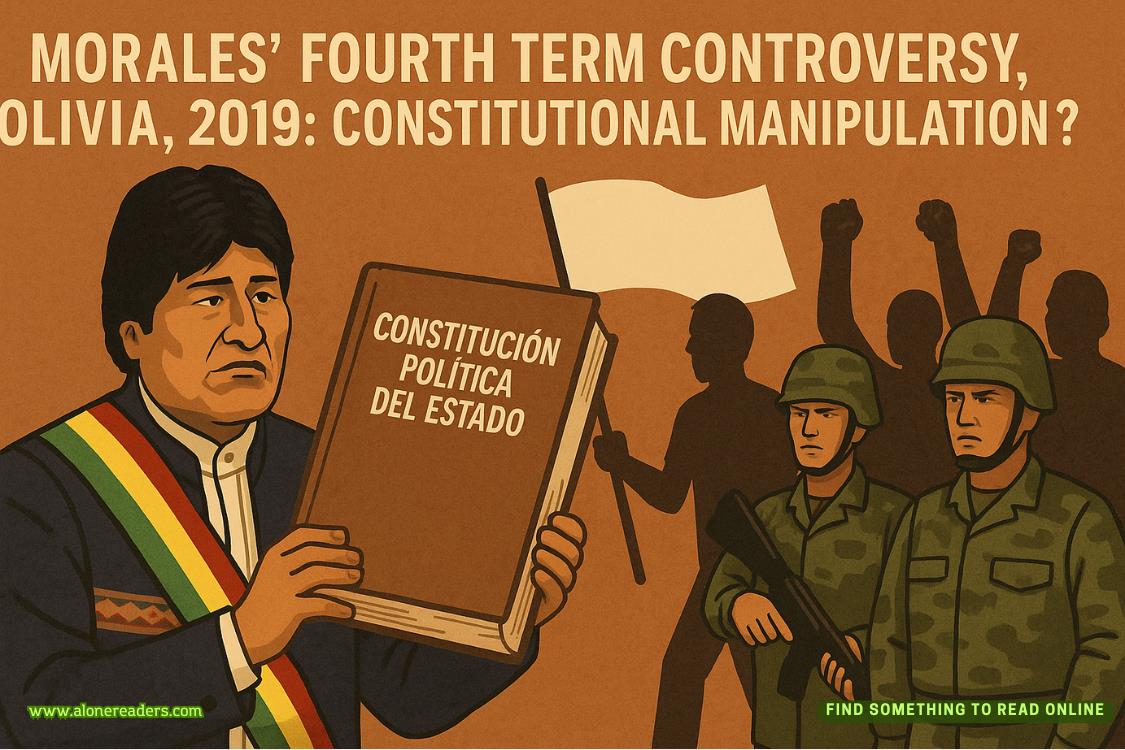
The Bolivian political crisis of 2019 remains one of the most significant constitutional controversies in Latin America’s modern history. At its heart was the contentious attempt by Evo Morales, Bolivia’s first Indigenous president and a long-time leader of the Movimiento al Socialismo (MAS) party, to secure a fourth consecutive term in office. While Morales had earned widespread acclaim during his earlier years for reducing poverty, empowering Indigenous communities, and overseeing one of the most stable economic periods in Bolivia’s history, his decision to run again in 2019 triggered a national debate over constitutional limits, democracy, and the legitimacy of electoral institutions. For many observers, the question was not just whether Morales could continue leading Bolivia but whether the rules of democracy itself were being bent in his favor.
The controversy originated from the 2009 Bolivian Constitution, drafted and approved under Morales’ administration, which explicitly limited presidents to two consecutive terms. However, Morales and his party sought reinterpretation of these provisions to extend his political longevity. By 2016, the government called a national referendum to ask voters whether term limits should be abolished, effectively allowing Morales to run indefinitely if supported by the electorate. The results of the referendum were narrow but clear: 51 percent of Bolivians rejected the proposal, signaling public fatigue with prolonged incumbency. For most democracies, this rejection would have been the end of the story, but Morales and MAS pursued another path that ignited accusations of constitutional manipulation.
The Bolivian Constitutional Court, largely viewed as sympathetic to Morales, ruled in 2017 that term limits violated human rights because they restricted political participation. This decision allowed Morales to stand again as a candidate, despite the referendum outcome. To critics, this legal reasoning appeared contrived, a political maneuver cloaked in judicial language. It not only overturned the democratic verdict of 2016 but also undermined trust in Bolivia’s institutions. For Morales’ supporters, however, the decision was a way to preserve his leadership during a period of economic stability and social progress. They argued that voters should have the ultimate say in who leads them, regardless of term limits.
The presidential elections of October 2019 became the defining moment of the crisis. Early results showed a close race between Morales and his main challenger, Carlos Mesa, a former president with strong support among middle-class and urban voters. According to Bolivian electoral law, a candidate could win outright in the first round if they secured more than 50 percent of the vote or at least 40 percent with a 10-point margin over the runner-up. Initial counts indicated Morales had a slim lead but not enough to avoid a runoff. However, midway through the vote count, the electoral tribunal abruptly stopped releasing updates. When results resumed nearly 24 hours later, Morales’ margin had mysteriously widened, giving him just enough of a lead to claim victory in the first round.
This abrupt pause and sudden shift fueled suspicions of electoral fraud. Opposition groups, international observers, and ordinary citizens took to the streets, accusing the Morales administration of manipulating the results to maintain power. The Organization of American States (OAS) conducted an audit of the election and concluded there were “serious irregularities” in the vote count. While Morales rejected these findings, insisting the election was legitimate, the perception of manipulation had already eroded his credibility. Protests escalated into violent clashes, paralyzing cities and polarizing Bolivian society along political and ethnic lines.
As tensions intensified, Morales’ political survival came into question. The police forces mutinied in several regions, refusing to repress protests, while the military eventually suggested Morales should resign for the sake of stability. On November 10, 2019, Morales announced his resignation and fled to Mexico, later receiving asylum in Argentina. His departure marked a dramatic fall for a leader who had once symbolized a new era of Indigenous empowerment and leftist governance in Latin America. To supporters, Morales’ ousting amounted to a coup orchestrated by elites and external actors, particularly given the military’s role in pressuring him to step down. To opponents, it was the restoration of democratic norms after years of institutional erosion and constitutional manipulation.
The aftermath of Morales’ resignation plunged Bolivia into further uncertainty. Jeanine Áñez, a relatively unknown senator, declared herself interim president, a move criticized by MAS as illegitimate but later endorsed by many international governments. Her administration oversaw a turbulent transitional period marked by violence, protests, and accusations of political persecution. Bolivia was deeply divided: one side lamented the fall of its Indigenous leader through what they considered an anti-democratic coup, while the other celebrated the end of what they saw as creeping authoritarianism.
The controversy over Morales’ fourth term raises profound questions about the balance between popular sovereignty and constitutional limits in democracies. Should voters be allowed to decide without restriction, even if it means reelecting the same leader indefinitely? Or should constitutions enforce term limits to prevent concentration of power, even if a leader remains popular? Morales’ case exemplifies the risks of blurring these lines. By pushing beyond the constitutional boundaries he once championed, Morales damaged the democratic legitimacy that had bolstered his earlier successes. His achievements in reducing inequality and elevating Indigenous voices became overshadowed by accusations of manipulation and authoritarian ambition.
Bolivia’s 2019 crisis also illustrates the fragility of democratic institutions in polarized societies. The judiciary’s credibility was weakened by perceptions of bias, the electoral authority lost trust due to opaque practices, and the military’s intervention reignited painful memories of coups in Latin America. International actors, including the OAS and foreign governments, played influential roles, but their involvement also fueled debates about sovereignty and external interference. Ultimately, the crisis was not just about Morales but about the health of Bolivia’s democracy.
In the years since 2019, Morales has remained an influential figure in Bolivian politics, while his party, MAS, returned to power in the 2020 elections with Luis Arce as president. This outcome demonstrates that while Morales himself was controversial, the broader political project of MAS retained significant popular support. Nevertheless, the events of 2019 continue to shape Bolivia’s political landscape, serving as a reminder of how constitutional manipulation and contested elections can destabilize even relatively stable democracies.
The Morales fourth term controversy remains a cautionary tale about the dangers of overstaying in power, even for leaders who once brought transformative change. Constitutional limits, electoral integrity, and the separation of powers are not mere technicalities but the bedrock of democratic legitimacy. When those principles are bent to suit the ambitions of a single leader or party, the cost is often institutional trust, social stability, and international credibility. For Bolivia in 2019, that cost was immense, and the scars of the crisis continue to shape its politics today.



 Top 10 Highest-Paid Professions in the United States (2025): Salaries, Roles, and Career Paths
 Top 10 Largest U.S. Companies by Revenue in 2025 (Fortune 500 Analysis)
 Top 10 Highest-Earning Global Tech Companies in 2025: Revenue, Strategy, and Market Power
 Top 10 Highest-Earning Mobile Apps in 2025: Revenue, Monetization, and Market Dominance
 ZombieAgent: Inside the Zero-Click AI Attack That Turns ChatGPT Agents into Persistent Data-Leaking Zombies
 China’s Urban Air Is a Hidden Plastic Reservoir: Inside the Microplastic Clouds Over Megacities










