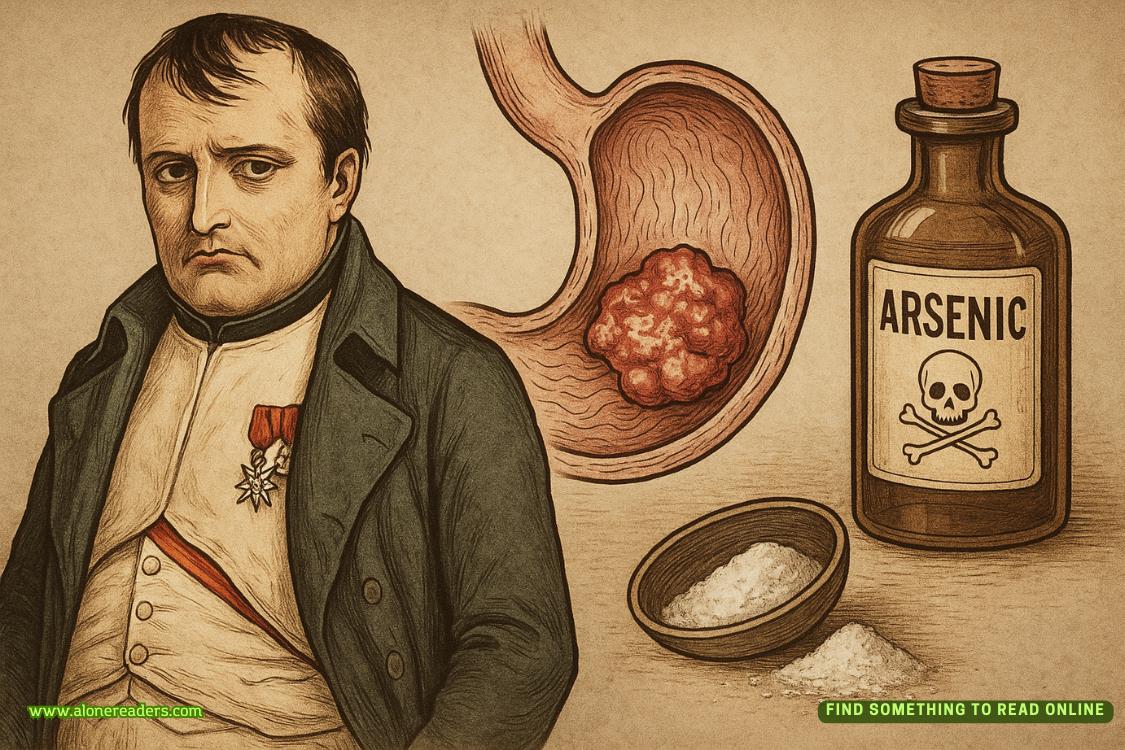
Few figures in history have inspired as much fascination and debate as Napoleon Bonaparte. The French emperor, military genius, and political mastermind reshaped Europe in the early nineteenth century, only to meet a lonely end in exile on the remote island of Saint Helena in 1821. His death at the age of fifty-one sparked immediate speculation. Was it a natural end, the result of stomach cancer that had plagued his family? Or was it something far more sinister—an assassination by slow poisoning, carried out with arsenic by his captors or even his political enemies? Nearly two centuries later, historians, scientists, and conspiracy theorists continue to examine the strange circumstances of Napoleon’s final days.
When Napoleon surrendered to the British in 1815 after his defeat at Waterloo, he was sent into exile on Saint Helena, a volcanic island in the South Atlantic Ocean. Cut off from France and the wider world, he lived under constant surveillance in Longwood House, a damp and gloomy residence that many believed contributed to his declining health. Contemporary accounts describe Napoleon suffering from persistent stomach pain, nausea, weakness, and swelling—symptoms that culminated in his death on May 5, 1821. His attending doctors, led by François Carlo Antommarchi, performed an autopsy that concluded the cause of death was stomach cancer. Indeed, his father, Carlo Buonaparte, had died of gastric cancer at the relatively young age of thirty-eight, suggesting a hereditary predisposition. To many, this seemed to be the natural explanation.
But the autopsy report was only the beginning of the mystery. While it cited a large stomach ulcer that had developed into cancer, discrepancies in descriptions of the findings and disagreements among the doctors fueled doubt. Some of Napoleon’s close associates noted his rapid hair loss, unusual weight fluctuations, and edema—symptoms not always consistent with stomach cancer. Others recalled that he himself had long feared stomach ailments, yet his decline seemed more complicated than a single disease. Over time, rumors grew that perhaps his captors, eager to ensure he would never return to power, had quietly poisoned him.
The arsenic theory gained traction in the mid-twentieth century when researchers tested strands of Napoleon’s preserved hair. Beginning in the 1960s, studies using neutron activation analysis revealed unusually high levels of arsenic in his hair samples. Arsenic, a potent poison, was widely available in the nineteenth century, used in pesticides, cosmetics, and even wallpapers. Chronic exposure could produce symptoms resembling gastrointestinal disease, while also explaining Napoleon’s drawn-out suffering. Advocates of the poisoning theory argued that the British, or possibly French royalists, had reason to eliminate him permanently and discreetly. Slow poisoning with arsenic would have allowed his captors to avoid suspicion, cloaking his demise in apparent natural illness.
However, arsenic poisoning is not an easy verdict. Later studies complicated the matter by showing that high arsenic levels were present in the hair of many people from that era. The element was so common in nineteenth-century environments that chronic exposure was almost unavoidable. Paints, inks, medicines, and even clothing dyes often contained arsenic. As a result, it is difficult to determine whether the levels in Napoleon’s hair were exceptional or merely typical of his time. Furthermore, chronic arsenic poisoning tends to leave distinct marks on the body, such as lesions on nails and skin, which the autopsy report did not clearly record. Critics of the poisoning theory argue that Napoleon’s symptoms and autopsy findings align more closely with stomach cancer than with deliberate poisoning.
Adding complexity, some historians have pointed to environmental explanations. Longwood House was known to be poorly ventilated and damp, with wallpaper reportedly laced with green pigments containing arsenic compounds. In such a setting, arsenic could have been released gradually into the air, inadvertently contributing to his illness without any need for deliberate murder. This environmental factor bridges the two theories: Napoleon could have been poisoned, but not intentionally—his surroundings themselves may have been toxic.
The debate intensified in 2001 when a team of French and Swiss scientists re-examined Napoleon’s hair using more advanced technology. They confirmed the presence of arsenic but concluded that the concentrations were consistent across his life, suggesting long-term, low-level exposure rather than a sudden poisoning in his final years. In other words, he likely lived with elevated arsenic levels for decades, well before his exile on Saint Helena. The team argued that this finding weakened the case for intentional poisoning, leaving stomach cancer as the more likely cause of death.
Yet the question refuses to die. The appeal of a dramatic murder is hard to resist. Napoleon was not merely a deposed ruler; he was a symbol, loved and hated in equal measure, capable of inspiring revolutions and unrest even from exile. For his enemies, the idea of him returning to Europe was terrifying. For his supporters, the notion that he was poisoned fits neatly with the narrative of a heroic leader betrayed and silenced. In both cases, the mystery enhances his legend, transforming his death into a riddle that mirrors the turbulent complexity of his life.
Ultimately, the strange end of Napoleon may remain forever unresolved. The autopsy suggests stomach cancer, supported by his family history and by modern re-analysis of his symptoms. The arsenic levels in his hair point to chronic exposure, but not conclusively to murder. His surroundings may have contributed to his decline, but whether by design or accident remains uncertain. What is clear is that his death has become part of the mythology surrounding him, a final chapter that embodies the drama, intrigue, and controversy that marked his entire career.
More than two hundred years later, Napoleon’s death is still debated not only by historians but by scientists, physicians, and enthusiasts across the world. His case illustrates the difficulty of pinning down the truth in history, where evidence is fragmentary and interpretation is colored by politics, myth, and human imagination. Was it arsenic? Was it cancer? Or was it a combination of both, an unfortunate convergence of hereditary illness and environmental hazards? We may never know with absolute certainty. What we do know is that Napoleon’s end, like his life, refuses to be simple or ordinary. In the great sweep of history, even his death continues to command attention, sparking arguments and studies as though the emperor himself were still a force to be reckoned with.
In that sense, Napoleon achieved in death what he pursued in life: to remain unforgettable, controversial, and larger than life. Whether victim of disease or of poison, his strange end ensures that the world will always look back with curiosity, suspicion, and fascination, keeping his name alive in the annals of both history and mystery.



 The Hundred Days Offensive: How the Allies Defeated Germany in World War I
 The Second Battle of the Marne: The Turning Point of World War I in 1918
 The Spring Offensive of 1918: Germany's Final Gamble to Win World War I
 The Treaty of Brest-Litovsk: How Russia Left World War I
 The Russian Revolution and World War I: How War Brought Down the Tsar
 The Zimmermann Telegram Explained: Germany's Secret Offer to Mexico in World War I