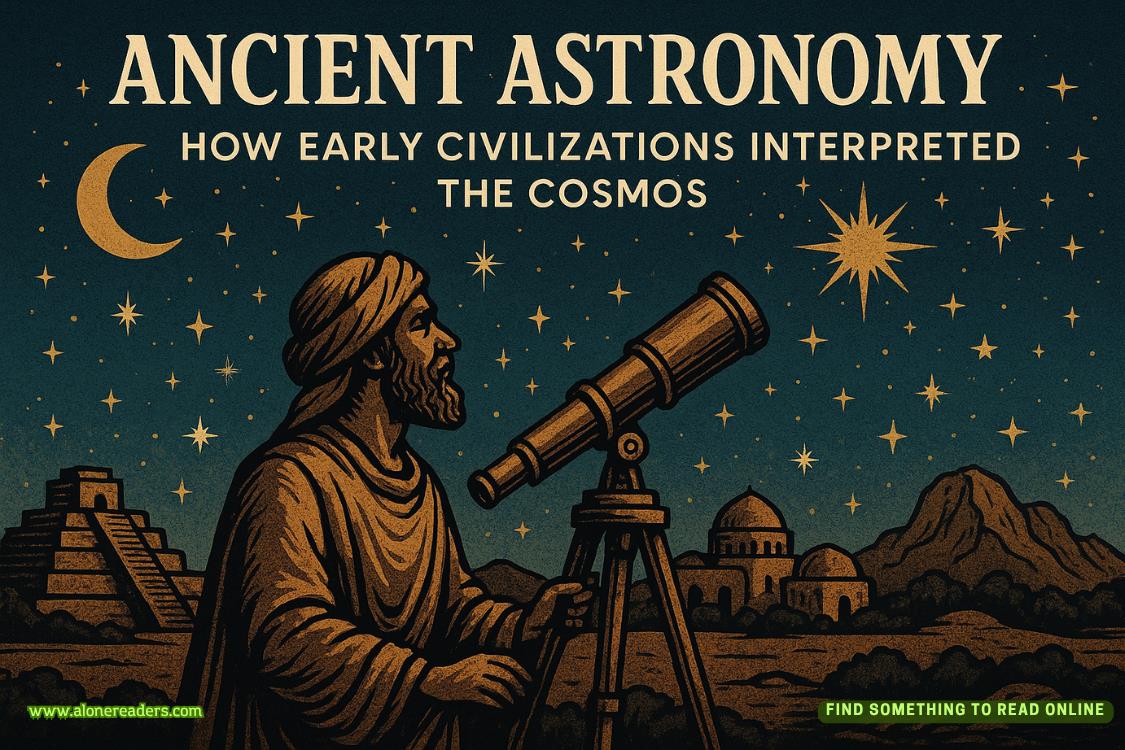
From the earliest moments of human curiosity, the night sky served as both mystery and guide. Long before telescopes or scientific instruments, ancient civilizations looked upward and saw in the stars stories, gods, and the blueprint of existence itself. Astronomy, one of humanity’s oldest sciences, emerged from these primal acts of observation. What began as mythic interpretation gradually evolved into mathematical precision, influencing calendars, navigation, religion, and architecture across continents.
In ancient Mesopotamia, the cradle of recorded civilization, astronomy was inseparable from divinity. Babylonian priests meticulously observed planetary motions and celestial omens, believing the heavens reflected the will of the gods. Clay tablets from as early as 1700 BCE show detailed records of lunar eclipses and planetary movements, forming the basis for predictive astronomy. The Babylonians recognized repeating cycles, such as the Saros cycle, which allowed them to forecast eclipses with remarkable accuracy. Their sexagesimal (base-60) number system, still echoed in our 60-minute hours, was crucial in measuring time and angles, revealing a sophisticated understanding of celestial geometry.
In ancient Egypt, the heavens were equally sacred. The Egyptians connected celestial events with the divine order of Ma’at, symbolizing balance and harmony. The heliacal rising of Sirius (Sopdet) heralded the annual flooding of the Nile, a life-sustaining event that determined the agricultural calendar. The precision of this observation was so vital that the Egyptian civil calendar became one of the first solar-based systems in human history. The alignment of monumental structures, such as the Great Pyramids of Giza and the temples of Karnak and Abu Simbel, suggests intentional astronomical design. These constructions aligned with solstices and stellar risings, turning sacred spaces into cosmic observatories. To the Egyptians, the pharaoh was a divine intermediary between earth and sky, and their monuments were built as stairways to the stars.
Further east, Chinese astronomers were among the most disciplined record keepers in history. As early as 2000 BCE, they systematically recorded comets, novae, sunspots, and eclipses. Their approach was both empirical and bureaucratic, reflecting the Confucian value of order. Astronomers served the imperial court, where accurate celestial predictions were considered signs of political legitimacy. The Chinese developed instruments such as the gnomon, armillary sphere, and water clocks to measure time and track heavenly movements. Their star catalogs contained hundreds of named stars, and they divided the sky into asterisms—patterns distinct from Western constellations. Chinese astronomy emphasized continuity; over centuries, it preserved precise observational data that would later influence Islamic and European astronomy alike.
In the Indian subcontinent, the study of the cosmos was deeply intertwined with philosophy and spirituality. The ancient Vedic texts, particularly the Rigveda and later astronomical treatises like the Surya Siddhanta, combined mythic imagery with geometric analysis. Indian astronomers calculated the length of the solar year, the phases of the moon, and planetary positions with remarkable precision. Aryabhata, writing in the 5th century CE, proposed that the Earth rotated on its axis—a concept centuries ahead of European thought. His trigonometric methods influenced both Islamic and Renaissance scholars. In India, astronomy (Jyotisha) was also essential to astrology, determining auspicious times for rituals, marriages, and political events. The cosmic order, or Rta, was perceived as both mathematical and divine—a harmony that linked human existence to celestial rhythm.
Across the Mediterranean, Greek philosophers transformed celestial observation into a discipline of reason. Thales, Anaximander, and Pythagoras sought natural explanations for cosmic order, rejecting purely mythological views. By the 4th century BCE, Plato and Aristotle introduced the concept of crystalline spheres—perfect circular orbits surrounding the Earth. Eudoxus of Cnidus devised a geometric model to explain planetary motion, while Hipparchus, one of the greatest astronomers of antiquity, cataloged over 850 stars and discovered the precession of the equinoxes. Then came Claudius Ptolemy, whose Almagest systematized centuries of Greek and Babylonian knowledge into a geocentric model that would dominate astronomical thought for more than a millennium. His detailed mathematical models allowed accurate predictions of planetary positions, despite being based on the flawed assumption that Earth was the center of the universe. Greek astronomy bridged observation with theory, shaping scientific methodology itself.
Meanwhile, in the Americas, civilizations like the Maya, Aztec, and Inca developed astronomy with astonishing precision—entirely independent of the Old World. The Maya tracked Venus with obsessive accuracy, associating its cycles with warfare and ritual timing. The Dresden Codex, one of the few surviving Mayan manuscripts, contains sophisticated tables of planetary cycles, lunar phases, and eclipse predictions. Their architectural achievements, such as the observatory at Chichén Itzá and the alignment of pyramids with equinoxes, reflect a profound integration of astronomy and cosmology. For the Maya, the cosmos was not distant or abstract—it was alive, cyclical, and intertwined with the fate of humanity. Similarly, the Inca in South America aligned their temples and roads with solstitial points and used horizon markers to track the sun’s progress across the year. Their understanding of the heavens guided agriculture, festivals, and governance, blending observation with spirituality in every aspect of life.
The Islamic Golden Age brought together the scattered threads of ancient astronomy into a new synthesis of precision and innovation. Scholars in Baghdad, Damascus, and Córdoba translated Greek, Persian, and Indian texts, preserving and expanding upon them. Observatories like the one in Maragha (Persia) and later in Samarkand (Uzbekistan) were equipped with instruments capable of measuring celestial angles to minute accuracy. Figures such as Al-Battani, Al-Sufi, and Al-Zarqali refined the parameters of planetary motion, while Ibn al-Shatir developed models that foreshadowed Copernicus. The Islamic scholars also improved upon Ptolemy’s work, introducing trigonometry as a mathematical tool for astronomy. Their meticulous star catalogs and tables—such as the Zij al-Sultani of Ulugh Beg—became vital references for later European astronomers.
In Europe, the revival of ancient astronomical knowledge during the Renaissance ignited a revolution. Copernicus, inspired by both Greek rationalism and Islamic refinement, proposed a heliocentric model that placed the Sun at the center of the cosmos. This radical shift was not merely scientific—it was philosophical, challenging humanity’s self-perception. Galileo’s telescopic discoveries of Jupiter’s moons, the phases of Venus, and the mountains of the Moon shattered the Ptolemaic illusion of perfect celestial spheres. Kepler’s laws of planetary motion and Newton’s theory of universal gravitation completed the transformation of astronomy from divine interpretation to empirical science. Yet even in this age of reason, the legacy of ancient civilizations endured. Their myths, alignments, and star maps formed the foundation upon which modern astronomy was built.
The shared legacy of ancient astronomy reveals more than an intellectual pursuit; it reflects a universal human desire to find meaning in the cosmos. Whether through the ziggurats of Mesopotamia, the pyramids of Egypt, the observatories of the Maya, or the manuscripts of Baghdad, every culture reached upward, seeking connection between heaven and earth. The stars inspired religion, guided explorers, and structured time itself. Though modern astronomy now peers billions of light-years into the universe, it remains driven by the same wonder that once led a Babylonian priest, an Egyptian architect, or a Mayan astronomer to gaze skyward and ask: what lies beyond?
Ancient astronomy was not merely the study of stars; it was the poetry of observation—the bridge between human imagination and the infinite. Its legacy endures in every modern observatory and every scientific theory that dares to map the unknown heavens. Humanity’s first science began with awe, and in many ways, that awe still defines us.





 The Hundred Days Offensive: How the Allies Defeated Germany in World War I
 The Second Battle of the Marne: The Turning Point of World War I in 1918
 The Spring Offensive of 1918: Germany's Final Gamble to Win World War I
 The Treaty of Brest-Litovsk: How Russia Left World War I
 The Russian Revolution and World War I: How War Brought Down the Tsar
 The Zimmermann Telegram Explained: Germany's Secret Offer to Mexico in World War I








