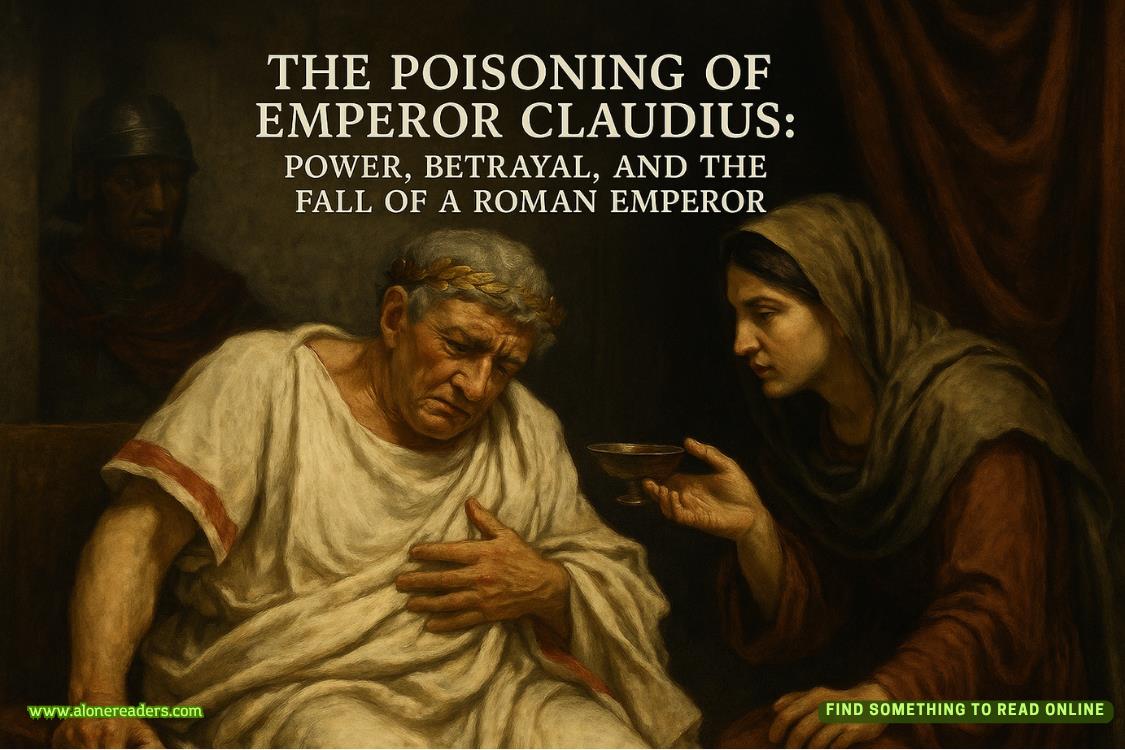
The death of Emperor Claudius in AD 54 remains one of ancient Rome’s most debated mysteries. A man who had survived palace intrigues, conspiracies, and political manipulation finally met his end not in battle or rebellion, but through what many believe was a calculated poisoning orchestrated from within his own household. The story of Claudius’s final hours is not just a tale of murder—it is a reflection of Rome’s volatile imperial politics, the ambition of those around him, and the ruthless machinery of dynastic power in the early empire.
Claudius was not an emperor born of charisma or acclaim. When he ascended the throne in AD 41 after the assassination of Caligula, few in the Roman elite believed he would last. Physically frail and afflicted with speech and motor issues, Claudius had been dismissed for most of his life as a harmless scholar—a man unfit for rule. Yet his intelligence, administrative talent, and deep understanding of law and governance soon transformed him into one of Rome’s most capable rulers. Under his reign, the empire expanded into Britain, its legal systems were refined, and public works flourished. But his success came at the cost of constant intrigue from senators, freedmen, and his own family members, all eager to influence or replace him.
The narrative of Claudius’s death is inseparable from one central figure: Agrippina the Younger, his fourth wife and the mother of Nero. Agrippina was no ordinary empress; she was ambitious, intelligent, and politically ruthless. As a descendant of Augustus and sister of Caligula, her imperial bloodline gave her both legitimacy and leverage. She married Claudius in AD 49, a union that scandalized Rome due to their uncle-niece relationship but was legalized by a special senatorial decree. Through her marriage, Agrippina consolidated her power, positioned her son Nero as Claudius’s heir, and systematically eliminated rivals—including Claudius’s own son Britannicus, who stood next in line for the throne.
According to the ancient sources—Tacitus, Suetonius, and Cassius Dio—the poisoning of Claudius was the final act in Agrippina’s strategy to secure Nero’s succession. The details vary among the historians, but the core elements remain consistent: Claudius was served a dish laced with poison, possibly mushrooms, his favorite delicacy. The poisoner, they allege, was Locusta, a notorious professional poisoner often employed by the imperial family. The poison was likely administered at a banquet in the imperial palace, under Agrippina’s supervision. When Claudius began to show signs of distress—vomiting, paralysis, and loss of speech—his physician Xenophon was said to have “assisted” his death by inserting a poisoned feather into his throat, ostensibly to help him vomit but in fact ensuring he would not recover.
The choice of mushrooms was both symbolic and practical. They were a delicacy Claudius adored, making them an ideal vehicle for a subtle and deadly toxin. Ancient commentators even referred to mushrooms as “the food of the gods” in dark jest after his death. Whether the poison was administered in the first course or during a later dish is uncertain, but Claudius’s death was not immediate. Tacitus describes a long night of agony, during which Agrippina maintained the façade of concern, while secretly preparing for the political transition. By dawn, Claudius was dead—and Agrippina announced that he had peacefully passed away of natural causes.
The immediate aftermath of Claudius’s death exposes the efficiency and calculation behind the act. Agrippina moved swiftly to ensure Nero’s accession before any questions could arise. The guards and senators were informed that Claudius had named Nero as his successor, and the young man was presented to the Praetorian Guard, who hailed him as emperor. Claudius’s body was still warm when Nero was escorted to the Senate, where his rule was confirmed without resistance. Britannicus, Claudius’s biological son, was too young to oppose the succession and would himself die under suspicious circumstances a few years later—many suspecting Nero’s hand, continuing his mother’s legacy of ruthless elimination.
While Tacitus and Suetonius both assert Agrippina’s guilt, modern historians are more cautious. The lack of concrete forensic evidence and the sensational tone of the ancient accounts—written decades after the event—suggest political bias. Both Tacitus and Suetonius wrote under later emperors who wished to depict the Julio-Claudian dynasty as morally corrupt, a cautionary tale against imperial excess. Still, Agrippina’s motives were strong, her influence real, and the sequence of events too convenient to ignore. Claudius had begun to show signs of favoring Britannicus and regretting his marriage to Agrippina. Tacitus even claims Claudius once declared that “he deserved to be doomed if he did not punish his wives.” Such remarks could have convinced Agrippina that her position—and her son’s future—were at risk.
The political consequences of Claudius’s death were immense. Nero’s ascension at the age of sixteen marked a new era, one that began under Agrippina’s regency but soon spiraled into tyranny and bloodshed. Claudius’s posthumous deification by the Senate—common for emperors—was likely a political maneuver to legitimize Nero’s rule. Ironically, Nero would later mock the divine honors granted to his stepfather, famously referring to mushrooms as “the food that made my father a god.” The line encapsulates the cold cynicism that came to define the early Roman imperial court, where murder could masquerade as divine providence.
Claudius’s poisoning also exposed the fragility of Rome’s imperial system. Despite his achievements as a ruler—building aqueducts, annexing provinces, reforming the bureaucracy—his fate was determined not by his policies or armies, but by domestic intrigue. The imperial palace had become a battlefield of subtle assassinations and whispered conspiracies, where power was sustained by manipulation and proximity to the emperor’s table. Poison was not just a weapon; it was a political instrument, used with precision and plausible deniability. Claudius himself had risen to power after the violent death of Caligula, yet he failed to prevent a similar fate from befalling him.
Over time, Claudius’s image evolved. While the ancient writers mocked his physical frailty and portrayed him as a puppet of women and freedmen, later assessments have been more sympathetic. Archaeological and administrative evidence reveals a ruler of competence and foresight. His reforms in law and governance laid the groundwork for the stability of the Roman Empire for decades. Yet his tragic end serves as a reminder that even wisdom and diligence could not safeguard an emperor from the treachery of those closest to him.
The poisoning of Emperor Claudius stands as one of history’s most emblematic political murders—an act blending personal ambition, dynastic strategy, and cold-blooded calculation. Whether Agrippina truly orchestrated the deed or whether Claudius succumbed to illness, the legend endures because it captures the essence of imperial Rome: a civilization of grandeur and intellect built upon a foundation of intrigue, betrayal, and ruthless pursuit of power. In Claudius’s death, we glimpse not only the fall of a man but the cost of empire itself—a cost measured not in wars or conquests, but in the silent poison of those who ruled behind the throne.



 The Hundred Days Offensive: How the Allies Defeated Germany in World War I
 The Second Battle of the Marne: The Turning Point of World War I in 1918
 The Spring Offensive of 1918: Germany's Final Gamble to Win World War I
 The Treaty of Brest-Litovsk: How Russia Left World War I
 The Russian Revolution and World War I: How War Brought Down the Tsar
 The Zimmermann Telegram Explained: Germany's Secret Offer to Mexico in World War I










