Mary Stuart, better known as Mary, Queen of Scots, remains one of history’s most tragic and complex monarchs—a woman of royal birth whose life was shaped by ambition, religion, betrayal, and an unrelenting struggle for power. Her story is not merely that of a queen who met a grim end; it is a tale woven into the very fabric of sixteenth-century European politics, where dynastic legitimacy, religion, and gender collided in one of the most turbulent eras of British history. The fate of Mary, Queen of Scots, was sealed not only by her own decisions but also by the shifting tides of power that swept across England, Scotland, and France.
Mary was born in December 1542 at Linlithgow Palace, the only surviving legitimate child of King James V of Scotland. Within days of her birth, her father died, leaving her an infant queen in a country dominated by rival nobles and religious factions. Scotland, at the time, was torn between Catholic loyalties and the growing influence of Protestant reformers. To secure her safety and strengthen the Catholic cause, the Scottish regents sent Mary to France at the age of five, where she was raised in luxury at the French court. Her beauty, intelligence, and royal charm captivated all who met her. In 1558, she married the French dauphin, Francis, uniting the crowns of France and Scotland under a Catholic alliance that alarmed Protestant England.
When Francis ascended to the French throne as Francis II, Mary became Queen Consort of France. However, her fortune changed abruptly when Francis died in 1560, leaving her widowed at just eighteen. With her mother-in-law, Catherine de’ Medici, assuming control of France, Mary returned to Scotland in 1561—a nation she had not seen since childhood. Her return was both hopeful and perilous. The Scotland she came home to was no longer the Catholic stronghold of her infancy; it was a land transformed by Protestant reform, led by men like John Knox who viewed Mary’s Catholicism as a threat. Yet Mary attempted a careful balance—tolerating Protestantism while maintaining her personal Catholic faith. Her charm and grace initially won support, but politics and religion would soon erode that fragile goodwill.
Mary’s next great mistake came through her marriages. In 1565, she wed her cousin Henry Stuart, Lord Darnley, in what was intended as a political alliance to strengthen her claim to the English throne. Darnley, however, proved vain, arrogant, and reckless. Their union deteriorated quickly, especially after the birth of their son, James, in 1566—the future James VI of Scotland and James I of England. Darnley grew jealous of Mary’s close friendship with her Italian secretary, David Rizzio. In a shocking act of brutality, Darnley and a group of Protestant nobles murdered Rizzio in front of the pregnant queen, forever staining Darnley’s reputation and their marriage. The relationship never recovered. Less than a year later, Darnley was found dead under mysterious circumstances after an explosion at Kirk o’ Field in Edinburgh. Though the cause of his death was officially declared murder, many suspected that Mary and her close ally, James Hepburn, Earl of Bothwell, were involved.
Whether guilty or not, Mary’s swift marriage to Bothwell—only months after Darnley’s death—cemented the scandal. Bothwell had been accused of orchestrating Darnley’s murder, and when Mary married him, public opinion turned sharply against her. The Scottish nobles rebelled, capturing Mary and forcing her to abdicate in favor of her infant son. Bothwell fled into exile, and Mary was imprisoned in Loch Leven Castle. In 1568, she managed a daring escape, raising a small army to reclaim her throne. But her forces were defeated at the Battle of Langside, and Mary fled across the border into England, seeking refuge from her cousin, Queen Elizabeth I—a decision that would seal her tragic fate.
Elizabeth I faced a dangerous dilemma. Mary was not only her cousin but also a legitimate Catholic claimant to the English throne. Many English Catholics viewed Elizabeth, a Protestant, as illegitimate, and Mary as the rightful queen. Though Elizabeth initially claimed she would protect Mary, she soon realized that her cousin’s presence in England was a political time bomb. Instead of granting her freedom, Elizabeth ordered her imprisonment. What began as protective custody stretched into nearly nineteen years of confinement in various castles across England, including Sheffield and Fotheringhay. Mary remained dignified and politically shrewd during these years, writing letters, plotting her release, and maintaining her belief that she would one day rule again.
However, her long imprisonment bred desperation. Various plots were hatched by Catholic sympathizers to free her and overthrow Elizabeth. The most infamous was the Babington Plot of 1586, in which conspirators sought to assassinate Elizabeth and place Mary on the English throne. While there is debate about the extent of Mary’s involvement, her coded correspondence—intercepted and deciphered by Elizabeth’s spymaster Sir Francis Walsingham—seemed to implicate her. This was the evidence Elizabeth’s government needed. After two decades of hesitation, Elizabeth reluctantly authorized Mary’s trial for treason. The verdict was inevitable.
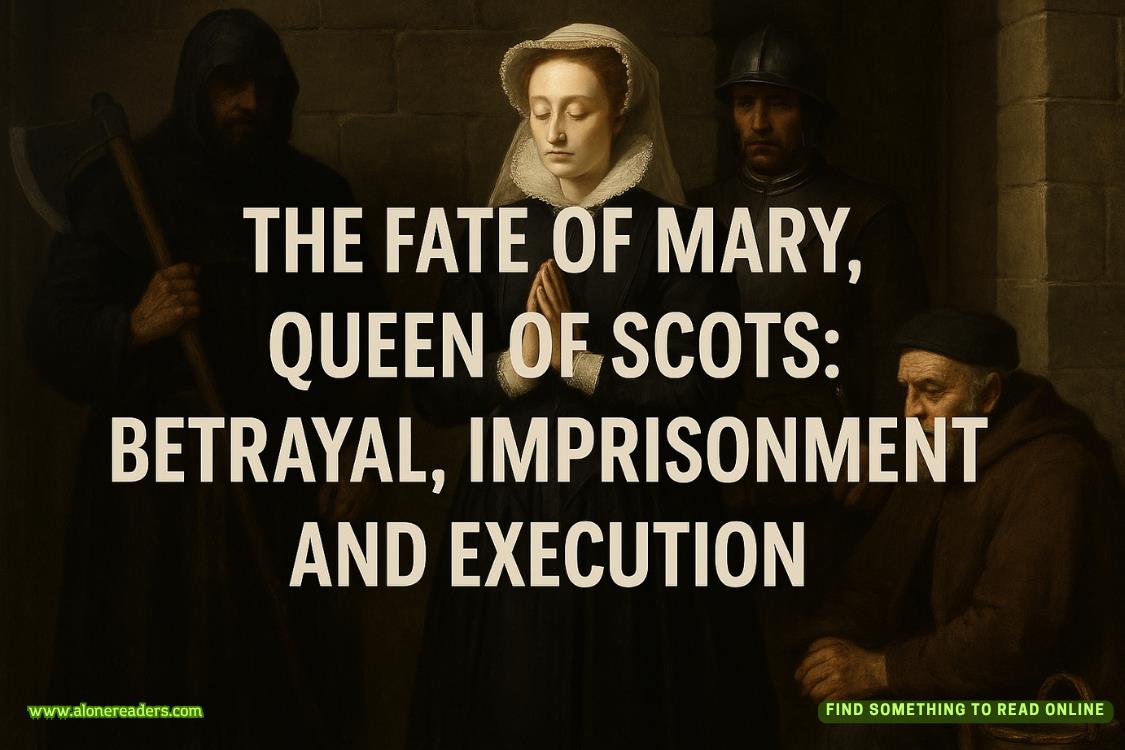
In February 1587, Mary was sentenced to death. Despite her pleas and appeals to her royal status, Elizabeth signed the death warrant. On the morning of February 8, 1587, at Fotheringhay Castle, Mary dressed in crimson, the color of martyrdom, and faced her executioners with remarkable composure. Eyewitnesses described her serenity and courage as she declared her Catholic faith and prayed for the forgiveness of her enemies. The execution itself was gruesome—the executioner required multiple blows to sever her head—but Mary’s final moments left an indelible impression on all who witnessed them. She died at the age of forty-four, a queen without a throne, a mother who never saw her son again.
Mary’s death reverberated across Europe. To Catholic powers like Spain and France, she became a martyr; to Protestant England, a necessary sacrifice for national security. Elizabeth I herself reportedly wept upon hearing of Mary’s execution, claiming she had not intended for the warrant to be carried out so swiftly. Yet the consequences were irreversible. Mary’s death eliminated a focal point for Catholic rebellion in England but also left Elizabeth’s throne morally stained in the eyes of many. Ironically, the very son Mary was forced to abandon would one day inherit Elizabeth’s crown. In 1603, upon Elizabeth’s death, James VI of Scotland became James I of England, uniting the crowns that his mother and cousin had once fought over.
The fate of Mary, Queen of Scots, thus stands as both a cautionary tale and a symbol of the dangers of dynastic rivalry. Her life intertwined deeply with the religious and political transformations of the sixteenth century—a time when faith could define nations and bloodlines determined survival. She was at once victim and participant, queen and prisoner, sinner and saint, depending on who tells her story. History continues to view her through competing lenses: the romantic Catholic martyr, the reckless conspirator, or the tragic figure caught in the ruthless games of Tudor politics. But perhaps the true tragedy lies in her unyielding belief in divine right and royal destiny, which blinded her to the political realism that her cousin Elizabeth mastered so well. In the end, Mary’s death was not just the fall of a queen—it was the final act in the long struggle between two powerful women whose intertwined fates defined the course of British history.



 The Hundred Days Offensive: How the Allies Defeated Germany in World War I
 The Second Battle of the Marne: The Turning Point of World War I in 1918
 The Spring Offensive of 1918: Germany's Final Gamble to Win World War I
 The Treaty of Brest-Litovsk: How Russia Left World War I
 The Russian Revolution and World War I: How War Brought Down the Tsar
 The Zimmermann Telegram Explained: Germany's Secret Offer to Mexico in World War I